Your story is your life. As human beings, we continually tell ourselves stories — of success or failure; of power or victimhood; stories that endure for an hour, or a day, or an entire lifetime. We have stories about our work, our families and relationships, our health; about what we want and what we’re capable of achieving. Yet, while our stories profoundly affect how others see us and we see ourselves, too few of us even recognize that we’re telling stories, or what they are, or that we can change them — and, in turn, transform our very destinies.
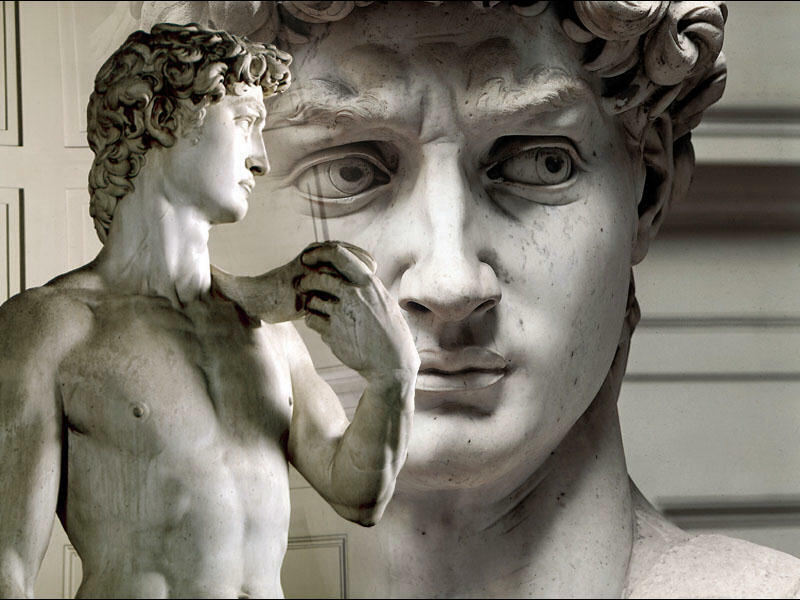
Michelangelo’s David stands not only as a masterpiece of Renaissance art but as a monument to the extraordinary power of the story we tell ourselves—the story we tell ourselves about ourselves, first privately and then publicly. When I look at David, I see the embodiment of narrative self-authorship, of how our internal stories create the architecture of our identity, our courage, and the way we stand in the world.
Michelangelo sculpted David over four years, imbuing marble with the tension and spirit of a young shepherd poised to face the giant. David’s story is that of a boy no one expected to defeat Goliath, yet he is the hero who rewrites the narrative of the oppressed. His calm eyes, taut muscles, and fearless stance tell a story of belief in one’s own potential. This is the story Michelangelo carved into stone—the story “I am not defined by my size, nor by my limitations, but by my purpose and courage.”
The power of this story begins within. David’s gaze is looking off into the distance; he is not reacting but envisioning. This internal narrative is one of focus and self-command: “I am prepared. I am the victor before the battle.” The story we tell ourselves before we act conditions the outcome. Like David, our internal monologue can be a source of unshakeable confidence or debilitating doubt. The story we nurture within becomes our sword and shield.
But the story of David is not just internal; it is told to the world in every curve and vein of the statue. Public storytelling is a performance, a declaration: “This is who I am.” David’s impressive scale—larger than life—asserts presence, demanding that others acknowledge the story embodied. The statue is placed in Florence’s public square not to conceal but to proclaim the power of individual courage intertwined with collective identity.
Michelangelo’s David teaches an essential truth: the story you tell yourself shapes how others perceive you. Our self-story is a beacon or a barrier. It influences not only our self-image but the social scripts that determine where we fit in. Just as David’s poised strength inspired a republic’s hope against tyranny, our narratives influence the culture we contribute to, the relationships we build, and the legacy we leave.
An exquisite detail is David’s contemplative expression, capturing the line between youthful vulnerability and towering resolve. This duality speaks to the complexity of storytelling: it is not about perfect confidence but about holding together contradiction in our narrative identity—the doubts and the determination, the fear and the faith. Michelangelo reminds us that authentic self-stories are textured, human, and powerful.
This story also reminds me as a coach that transformation is a process of revision. David was a block of marble, undefined, until Michelangelo saw the story within and carved it out. Similarly, people often carry raw potential locked inside unshaped narratives. Coaching is the art of uncovering the hero within—the story that needs to be told, reshaped, and lived. The moment you start telling yourself “I am David facing my Goliath” is when transformation begins.
David’s story is universal. It resonates from Renaissance Florence to today’s individual challenges—starting a business, changing careers, facing personal fears. The power lies in the story you hold before you step into the arena. Will you stand small and silent, or like David, radiate presence and purpose?
The stories we tell ourselves—the ones we announce to ourselves and others—construct our lives. Michelangelo’s David is a timeless reminder that the greatest sculpture is often the one we carve from our own lives through the narratives we choose. Our story shapes the reality we create; it beckons us to stand tall, poised, and ready—not by avoiding our giants but by owning our story.
That is the power of your story.
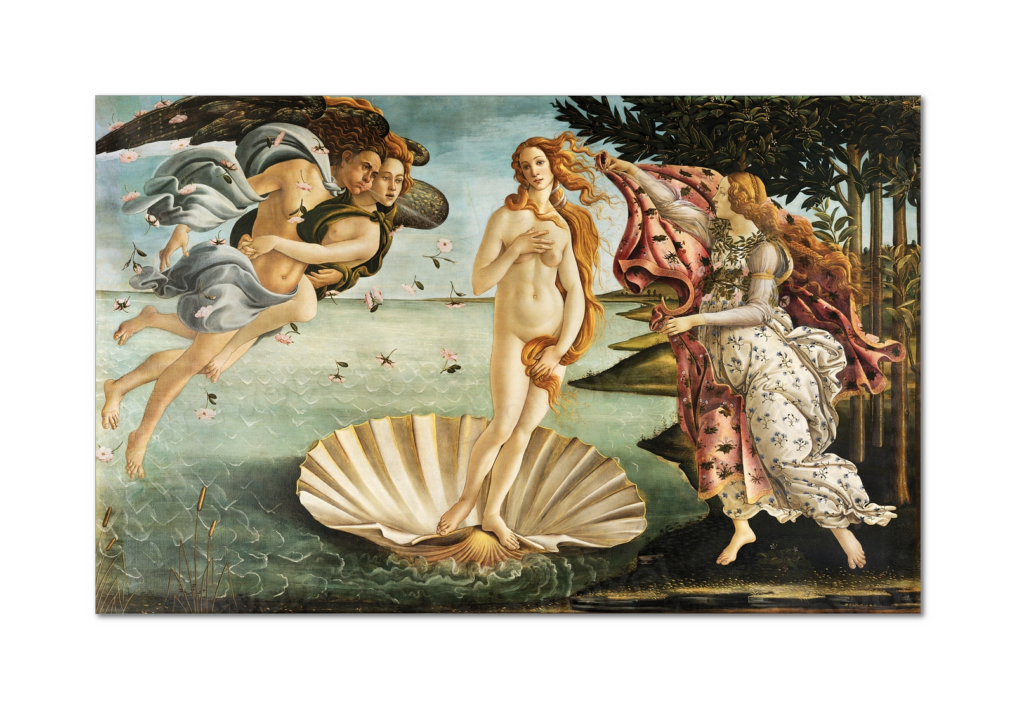
Sandro Botticelli’s masterpiece The Birth of Venus exquisitely illustrates the transformative power of the story you tell yourself—the internal narrative that shapes your sense of identity, beauty, and rebirth. When I gaze upon Venus rising from the sea, I don’t see merely myth rendered in paint and gold, but a profound metaphor for the narratives that rise within us, shaping how we face the world and ourselves.
Venus embodies the story of emergence—“I am beauty born anew, arising from chaos into form.” Botticelli captures not just a goddess but the moment of self-recognition, the internal awakening we all experience when we decide who we will be. The shell—both cradle and stage—becomes the vessel for this narrative rebirth. It symbolizes the safe space where your story grows, nurtured by imagination before it is projected into the world.
The winds that carry Venus forward represent the stories of influence around us—family, culture, history—that shape but do not define us. Yet it is Venus’s conscious emergence that tells an empowering tale: despite these external forces, the story you tell yourself about yourself is sovereign. Like Venus, you have the power to rise and shine, not as a passive effect but as a radiant subject authoring your own rebirth.
Botticelli’s Venus is both human and divine, vulnerable and powerful. This duality reflects the complexity of our self-narratives—they are never simple proclamations of strength but layered stories embracing imperfection, yearning, and transcendence. Her gaze is serene yet challenging, a silent narrative of confidence that invites the world to witness her becoming.
The figures around Venus—the Zephyrs blowing gentle winds and the handmaid offering a cloak—embody relational narratives that support or resist transformation. They remind me how our stories unfold in social contexts; our identity is constantly negotiated and reshaped in dialogue with others. The cloak symbolizes the story you choose to reveal or conceal, the aspects of yourself you nurture privately before public display.
The flowing lines and luminous colors evoke the fluidity of narrative itself. Stories are not static portraits but living currents, shifting with time and reflection. Botticelli’s mastery teaches that the story you tell yourself is a work of ongoing creation—a birth that happens again and again, inviting continuous renewal.
This painting, like great storytelling, moves beyond physical beauty to illuminate an inner journey—a story of awakening to self-love, acceptance, and emergence from past limitations. It embodies the moment when your internal narrative transfigures obscurity into brilliance.
In my coaching, I see countless individuals trapped by stories limiting their potential. The Birth of Venus beckons us to rewrite these stories—to see ourselves as rising, radiant, reborn despite hardship or doubt. It teaches that the power of your story lies not in perfect beginnings but in courageous emergence.
The power within the story we tell ourselves about ourselves—to ourselves first and then to others—shapes how we inhabit our lives. Botticelli’s Venus reminds us to hold space for this creative rebirth, to honor the chaos from which beauty is born, and to stand confidently in the radiant story we are writing moment by moment.
That is the eternal dance of narrative power—the birth and rebirth of self that The Birth of Venus so beautifully captures and that lives within each of us.
Telling ourselves stories provides structure and direction as we navigate life’s challenges and opportunities, and helps us interpret our goals and skills. Stories make sense of chaos; they organize our many divergent experiences into a coherent thread; they shape our entire reality. And far too many of our stories are dysfunctional, in need of serious editing. First, we ask you to answer the question, “In which areas of my life is it clear that I cannot achieve my goals with the story I’ve got?” We then show you how to create new, reality-based stories that inspire you to action, and take you where you want to go both in your work and personal life.
For decades I have been examining the power of story to increase engagement and performance. Thousands of individuals from every walk of life have sought out and benefited from our life-altering stories.
Our capacity to tell stories is one of our profoundest gifts. My approach to creating deeply engaging stories will give you the tools to wield the power of storytelling and forever change your business and personal life.
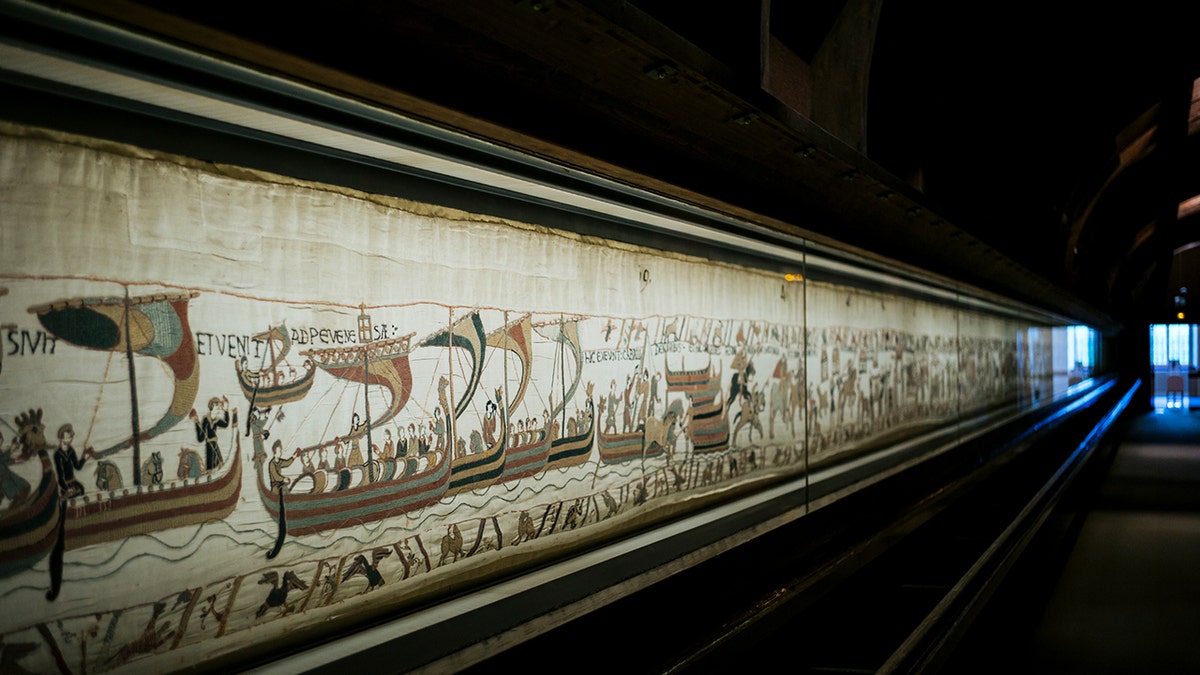
The Bayeux Tapestry is not just an artwork; it is a monumental story, an epic narrative embroidered in cloth—a powerful testimony to the stories we tell ourselves and others, shaping collective memory and identity. From the perspective of the power of your story—the story you tell yourself about yourself to yourself and others—the Bayeux Tapestry embodies the transformative power of storytelling across generations.
This tapestry narrates the Norman Conquest of England in 1066, stitching together battles, betrayals, alliances, and triumphs into a continuous visual saga. It is a story born of perspective—crafted to justify and glorify William the Conqueror’s claim, embodying how stories shape truth. The creators and patrons of this tapestry authored a narrative not just to record but to influence, to persuade.
In every embroidered scene, knights charge, banners fly, and tensions mount. Yet at its core, the tapestry tells the story of conquest as inevitable destiny, and the Norman as rightful hero. This underscores how group and personal identities are shaped by the stories we embrace about events and ourselves. The Norman viewcraft redefined English history, making William’s victory the foundational myth, inspiring loyalty and unity.
Reflecting on the narrative structure, the tapestry unfolds like a continuous epic poem, the scenes flowing as chapters. This continuous thread mirrors how our personal and collective stories are woven over time, each event shaped by the story that came before and influencing the one after. It reminds us that no story stands alone; we are always authors of an ongoing narrative.
The power of this story reaches into identity—those who wore armor under the tapestry’s shadow would have internalized the Norman tale as a call to destiny, shaping how they saw themselves as conquerors, rulers, and builders of a new order. This internal narrative empowered them with a sense of purpose and legitimacy.
Yet beneath this militaristic story, subtle details humanize the tale—expressions, gestures, everyday customs—reminding us that storytelling is not only about grand design but lived experience. This layered narrative richness allows viewers not only to see history but to inhabit it, to experience the awe, fear, and hope of those times.
The Bayeux Tapestry as a living story illustrates storytelling’s supreme power: it shapes perception, identity, morality, and history itself. It stands as a reminder that the stories we tell ourselves about ourselves—whether in moments of personal challenge or collective upheaval—mold how we engage with the world.
When you see the tapestry, know the story behind the thread—the power to author reality in image and word is as old as civilization. What story do you weave about yourself? How does your narrative inspire or constrain your destiny?
That is the enduring magic of Bayeux: storytelling made visible, learning that the power of your story is the power to transform the world around you.

The caves of Lascaux hold one of humanity’s most ancient and profound stories—a story told not through words but through images, shapes, and symbols etched deep into stone walls. From the perspective of the power of your story—the story you tell yourself about yourself to yourself and others—Lascaux invites us to reflect on how storytelling is foundational to human identity, meaning, and survival.
Imagine those early humans standing before the vast cavern walls, painting majestic bulls, stags, and horses with ochres and charcoal. These were not just artistic expressions but narratives—stories about the world, their relationship to nature, the hunt, and possibly spiritual or ritualistic visions. These images communicated their collective identity, hopes, and fears at a time before language or writing. They told themselves: “We belong to these lands. We are hunters and keepers of life’s cycles.” This internal narrative anchored their place in the world.
Lascaux’s story is one of connection—between humans, animals, environment, and spirit. The paintings capture a dynamic interface where humans narrate their existence, transcending immediate survival to weave meaning. This reveals how the earliest stories shaped not only memory but identity: “We are part of a sacred whole.” The caves became a narrative sanctuary, a place where personal and group stories coalesced into ritualized meaning.
The structure of Lascaux’s storytelling is non-linear and visual. Unlike the linear stories of later literature, here, narrative flows through symbolic repetition, layout, and interplay of images—foreground and background, light and dark—engaging viewers in immersive storytelling. This architectural storytelling shows that narrative is not confined to text but is spatial, sensory, and communal. Stories circulate, unfold and interact through space and time.
The power of this ancient story was survival. These painted narratives may have been rites to ensure hunting success, to teach young hunters the life story of prey animals, or to mark territorial belonging. The story humans told themselves gave them confidence and cohesion necessary to endure physical and existential threats. It was not only a story told to others but a story reinforced nightly around fire—a collective heroic journey from dusk to dawn.
Lascaux teaches us that storytelling is intrinsic to being human; it is the first step in authoring identity out of chaos. Before words, images told stories of who we are and who we aspire to be. Our internal narratives, even now, follow this ancient impulse—to claim agency by telling stories that link us to place, to community, and to the cosmos.
For us today, amidst digital flood and information overload, Lascaux’s silent walls remind us to reconnect with the primal power of storytelling: to pause, reflect, and create meaning. When you tell yourself your story—who you are, what you stand for—you are continuing a tradition thousands of years old, stamping your being into the fabric of existence.
The magic of Lascaux lies in its testimony that the story you tell yourself about yourself—spoken or painted, internal or shared—shapes your reality, your courage, and your legacy. It invites you to ask: what ancient stories live inside you, waiting to emerge? What walls will your stories paint across the canvas of life?
That is the profound lesson of Lascaux—the power to narrate change, to encircle fear with meaning, and ultimately, to author identity in the face of the unknown. Your story is your most enduring art.
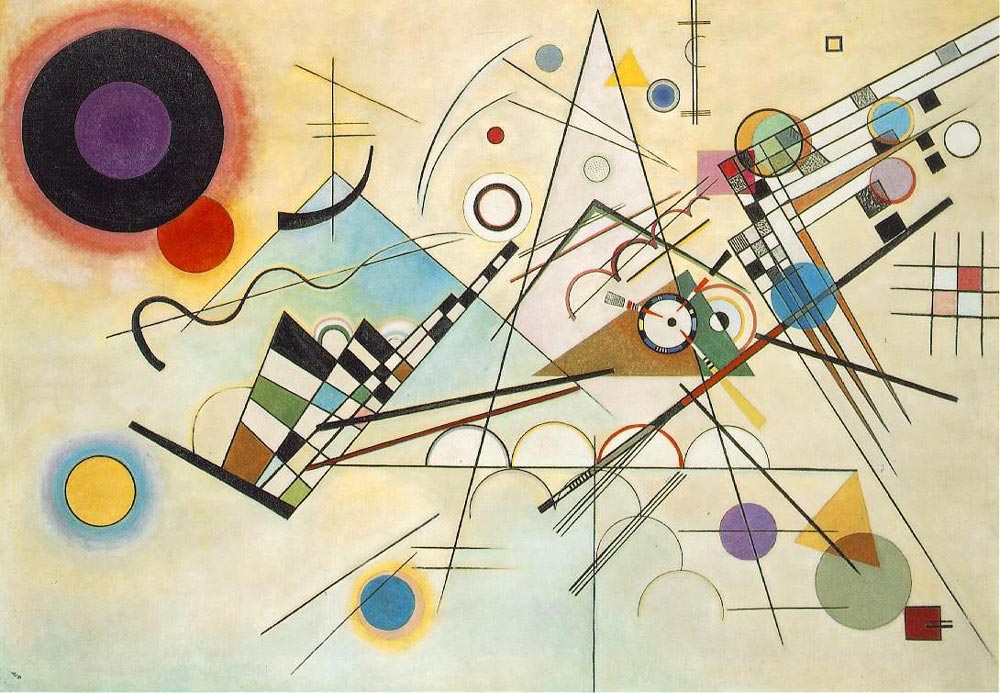
Wassily Kandinsky’s masterpiece Composition VII is a vivid celebration of the power of your story—the story you tell yourself about yourself and then project into the world—which transcends language and literal form to shape your inner reality and creative expression. This complex, swirling explosion of colors and shapes offers a profound metaphor for the living, dynamic narratives that define us.
Composition VII is often regarded as Kandinsky’s most intense and multifaceted work. Its tangled forms and vibrant palette suggest chaos and conflict, yet beneath the surface lies a story of transformation—a journey from disarray to harmony. It mirrors the deep tension in our own lives: competing emotions, conflicting desires, storms of doubt—all woven into the fabric of our identity story.
When you look closely, the painting reveals no simple linear path but a constellation of forces pushing and pulling like the competing voices in your internal monologue. Just as your story unfolds not as a straight line but as overlapping, sometimes contradictory experiences and emotions, Kandinsky’s Composition VII honors the complexity of self-narrative.
Kandinsky once wrote that color has a soul, lines have their own language, and art should evoke the spiritual. In Composition VII, these elements become the language of your story’s soul—a non-verbal communication of what cannot be fully articulated in words. This encourages embracing the unspoken, the intuitive, and the symbolic parts of your narrative.
The painting’s movement suggests the hero’s passage through the chaos—the Abyss—before reaching a new form of selfhood, a moment of synthesis where disparate elements become an Elixir of insight and renewal. This is the power of your story during transformation: chaos precedes clarity, confusion births growth.
More than a static picture, Composition VII is a dynamic story in color and form, alive and evolving. It reminds us that the stories we live by are not final but fluid and layered. You are the continual author of your narrative—able to reshape, reinterpret, and re-express your identity through ever-changing internal and external stories.
When I teach narratives, I use Composition VII to show that story is not confined to words; it lives in sensations, emotions, and abstractions. The power of your story is not only in the tale you write but in how you embody it—in your energy, your vision, your presence.
Kandinsky’s masterpiece challenges us to reclaim storytelling as a sacred, creative act capable of shaping reality itself. In a world obsessed with facts and logic, Composition VII invites you to listen to your soul’s colors and lines—to tell your story in the richest language possible.
Ultimately, Composition VII stands as a monument to the power of your story—not a neat tale but a bold, vibrant, living force—that shapes your world, your identity, and your destiny through the art of narration beyond words.
Day 1. That’s Your Story?
Day 2. The Premise of Your Story, the Purpose of Your Life
Day 3. How Faithful a Narrator Are You
Day 4. Is It Really Your Story You’re Living?
Day 5. The Private Voice
Day 6. The Three Rules of Storytelling
PART TWO
New Stories
Day 7. It is not about time
Day 8. Do You Have the Resources to Live Your Best Story?
Day 9. Indoctrinate Yourself
Day 10. Turning Story into Action: Training Mission and Rituals
Day 11. More than Mere Words; Finishing the Story, Completing the Mission
Day 12. Storyboarding the Transformation Process in Eight Steps
Introduction
I am Peter de Kuster, founder of The Hero’s Journey and The Heroine’s Journey, and for much of my life, I have believed in the transformative power of stories—especially the ones we tell ourselves. But it took a near-death experience to truly open my eyes to what I wanted to dedicate my life to: helping others discover, shape, and share their unique stories, and in doing so, to rewrite my own.

Antoni Gaudí’s masterpiece, the Sagrada Família, serves as a magnificent testament to the power of the story you tell yourself—the story you craft about who you are, what you create, and how you leave a legacy that transcends time and circumstance. This monumental basilica in Barcelona is not just architecture; it is a living narrative in stone, light, and form, representing how deeply our internal stories shape the world we build around us.
Gaudí began with a vision fueled by his inner story—“I am an instrument of nature’s divine geometry; I will build a cathedral that speaks the language of life itself.” The Sagrada Família embodies this personal narrative: a story of devotion, patience, creativity, and faith that guided Gaudí’s life and work. Despite challenges, delays, and critiques, he held fast to his story, allowing it to define both his purpose and his legacy.
Every column, spiral, and stained-glass window tells a part of Gaudí’s internal story translated outward. His design mimics forms of nature—trees branching upward, light flowing like water—revealing that the story he told himself connected transcendence to the tangible, sacred to the everyday. By telling himself this story of organic, harmonious creation, Gaudí redefined what a cathedral could be: a living, breathing narrative space inviting awe and introspection.
The Sagrada Família’s slow, unfinished construction exemplifies the ongoing narrative process: stories are never complete but evolve across lifetimes. Gaudí embraced a long view—“My story is larger than one lifetime”—modeling how personal narratives propagate and inspire beyond our immediate presence. This chapel-in-progress calls us to participate in storytelling as a communal and generational act.
Gaudí’s masterpiece also speaks to the narrative tension between individuality and community. His personal vision balanced with collaborative craftsmanship reflects how internal stories intersect with shared culture and values. The basilica stands as both personal manifesto and collective heritage—a dialogue across time between artist, faith, and people.
Through the emotive play of light refracted by vibrant glass, Gaudí’s story merges science and spirituality, reminding us that the stories we tell about ourselves also shape how we perceive beauty, meaning, and the divine. His art transcends words, using form and color as language—a vivid metaphor for the nonverbal narratives pulsing within each of us.
For me, Gaudí’s Sagrada Família is a living metaphor: the story you tell yourself about your creativity, your mission, and your capacity to shape the world can sculpt wonders, endure centuries, and inspire countless others. It teaches that the power of your story is revealed not just in what you say but in what you build, embody, and leave behind.
Standing before the soaring towers and intricate facades, I hear Gaudí whisper, “Author your story with patience and passion; let it grow like a tree from your soul into the sky.” This is the call for every storyteller—to see themselves not as mere narrators but as architects of their own lives, capable of shaping realities as enduring as stone, as luminous as stained glass.
The Sagrada Família invites you to tell your story boldly, to build it with reverence and resilience, knowing it will stand beyond your lifetime. Your story, like Gaudí’s basilica, is an eternal work of art, waiting to be born and to transform the world.
Lying in that hospital bed, suspended between what was and what could be, I realized how fragile and precious life is. All the plans, the business meetings, the deadlines—they faded into insignificance. What remained was a burning question: What story do I want to tell with the rest of my life? The answer was clear. I wanted to travel, to write, to tell stories.
There is a language older than words that has always fascinated me. It speaks in images and emotions, in the quiet tightening of a throat in a dark cinema, in the sigh when the credits roll and you realize the story on the screen has quietly rewritten a sentence in the story you tell about yourself. Like in Dead Poets Society, where students seize the day, ripping out textbook pages to embrace poetry’s raw power over conformity, sparking personal rebellion and self-discovery. That is the language I am searching for with The Power of Your Story: a universal language of stories that crosses borders, backgrounds, and biographies, and invites each of us to become a better storyteller of our own life.
My quest runs through movie palaces in Rome, side streets in London, quiet museums in Venice, and cafés in Amsterdam, where people sit with notebooks, watching scenes from great films and quietly recognizing themselves. In these story-rich places, I walk with entrepreneurs, artists, and seekers who arrive with a familiar question hidden behind their official goals: “Why does the story I am living not feel like mine anymore?” Together we watch heroes and heroines on the screen and notice that, beneath costume and culture, they share something startlingly similar: seven great plots, twelve archetypal heroes, and again and again one great story about leaving an old life behind to claim a truer one.
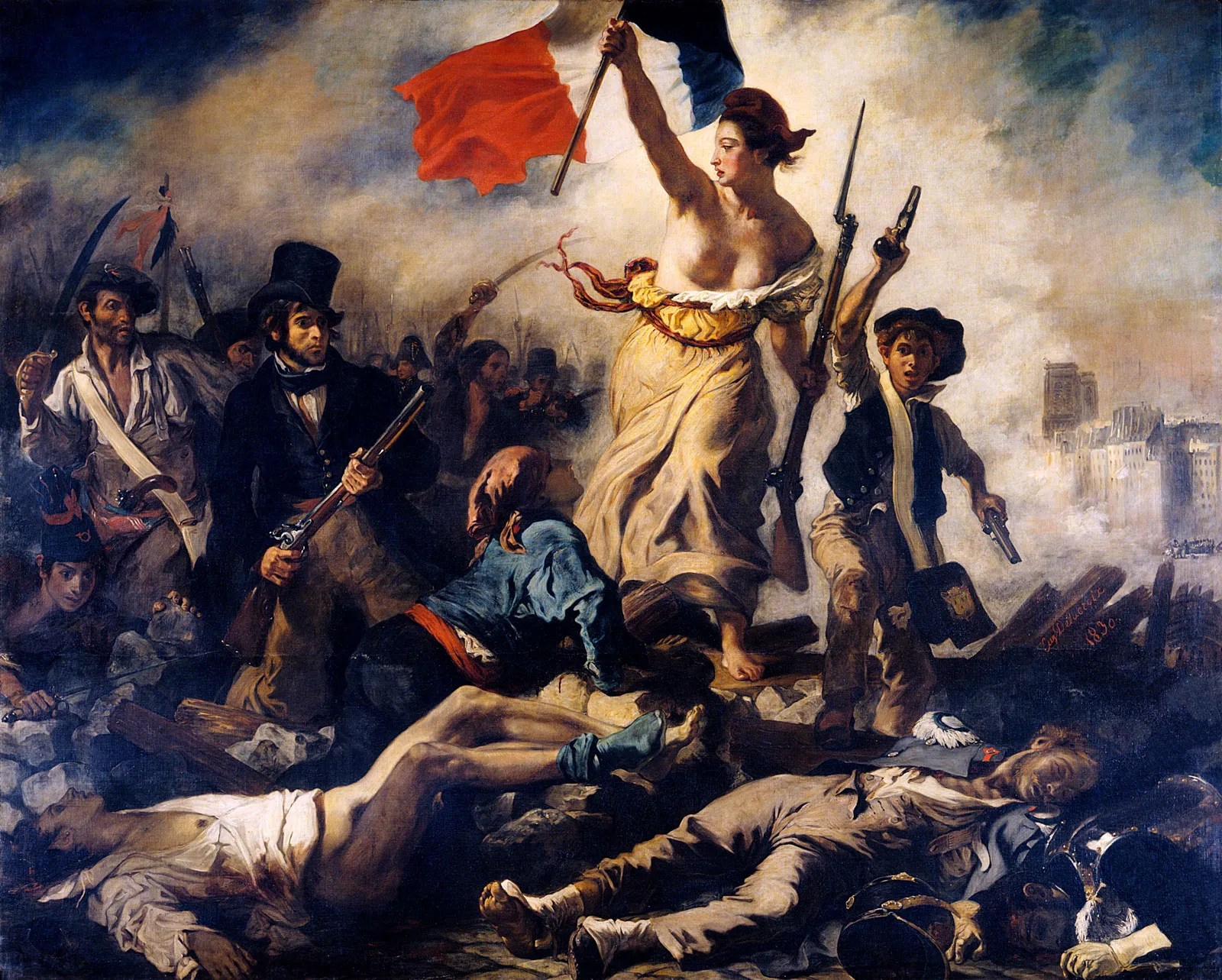
Eugène Delacroix’s Liberty Leading the People is more than a masterpiece of revolutionary art; it is a monumental testament to the indomitable power of the story you tell yourself—the narrative that defines your identity, your purpose, and your capacity to lead and inspire change. When I, Peter de Kuster, gaze upon Liberty’s fierce stride across the barricades, I see the embodiment of narrative courage—the story told first to oneself, then projected outward, rallying and reshaping communities and destinies.
At the painting’s heart is Liberty herself, a towering figure with bare breast bared defiantly, the French tricolor flag streaming above her, musket and saber at the ready. She does not cower before the chaos of revolution; she is its beating heart. Her posture, poised yet dynamic, carries the undeniable message: “I am not a victim of circumstances. I am the embodiment of freedom, the leader of a cause greater than any one individual. Step into this story with me.” This is the power of personal narrative—the story that fuels resilience and leadership even amid smoke, blood, and danger.
The study of Liberty’s internal storytelling begins with her gaze: fixed, fierce, and unyielding. She is envisioning victory, marshaling resolve before battle is even joined. This is the core of powerful personal stories—precognition, the ability to mentally script not only where you stand but where you move next. You author the narrative from inside your mind before any external action occurs. Liberty is not reactive; she is the author of destiny.
The crowd behind Liberty is a living canvas of narrative diversity gyrating into unity. Look closely and notice the juxtaposition: a boy with pistols too large for his small frame, embodying the story of inherited courage and youth stepping into a saga not of their making, a working man with clenched fists and sleeves rolled, and a well-dressed bourgeois sporting a top hat, abandoning privilege to join the cause. Liberty’s story magnetizes these disparate lives, weaving individual narratives into one collective function. Such is the social magic of narrative: it shapes not just self but community, building bridges between isolation and shared purpose.
Delacroix’s composition itself is storytelling architecture. The diagonal thrust from the barricade’s rubble upward to Liberty’s lead foot commands the eye and signals progression—from the chaos-laden Abyss of revolt to the Call to Adventure manifest in Liberty’s emergence. Fallen comrades littering the foreground symbolize sacrifice, grounding idealism in harsh reality. This is storytelling with stakes—your narrative is never costless, and honor lies in what you endure or lose to see your story through.
The French tricolor flag is not a mere decoration. It’s narrative compression—the summing up of complex ideals into instantaneous, emotionally resonant symbols. Blue for liberty, white for equality, red for fraternity and sacrifice. Liberty’s firm clutch on the flag signals narrative ownership; this is not a story she borrows but one she commands. Extract the lesson here: your story’s symbols and metaphors become the language by which it rallies others. Whether it is a company logo, a personal mantra, or a cultural icon, these symbols crystallize the story and its emotional power.
Light in the painting plays a narrative director. Liberty’s glowing torso and radiant flag emerge from the smoky twilight—a selective illumination that focuses the viewer’s attention on what matters most: the hero, the cause, the symbol. This spotlighting teaches us a crucial lesson: a story’s power is maintained by what it chooses to highlight and what it obscures. A compelling narrative consistently brings core truths to light while leaving distractions in shadow.
Liberty’s deliberate bare-breasted vulnerability shatters conventional ideas of power. Instead of concealment, exposure becomes armor—a courageous declaration that authenticity and boldness fuel strength. There is a lesson here about the raw, unguarded parts of your story. The moments you might feel exposed or vulnerable are often the source of your greatest power and connection.
The child brandishing oversized pistols represents the generational nature of story. This young warrior’s narrative is inherited and shapes his identity, reminding us that the stories we author today will echo beyond us, passing from one generation to the next, influencing futures we may never see.
In stark contrast to Liberty’s fearless vitality, the fallen bodies ground the scene in the costliness of storytelling. Their deaths remind us that narratives demanding transformation often carry sacrifices. Honoring those costs in your story adds depth and authenticity—true leadership recognizes and reveres what has been lost.
The contested terrain of the barricade itself is a powerful metaphor for narrative reclamation. It is the fractured ground where old stories of submission and obedience clash violently with emergent stories of defiance and freedom. Liberty’s act of claiming this space is symbolic of how powerful narratives seize control of contested cultural or psychological territory, rewriting reality.
The dynamic forward momentum—the diagonal line sweeping upward, the raised tricolor, the purposeful stride—impose narrative inevitability. Powerful stories require full commitment; hesitation weakens and dissolves influence. Delacroix’s Liberty doesn’t pause; she’s irreversible in purpose, reminding us stories don’t just describe realities, they shape and change them.
The joyous, defiant expression on Liberty’s face offers a profound truth: rage can spark revolution, but joy sustains it. The story you tell yourself with joy and conviction will outlive one told in bitterness or despair.
Delacroix’s painting was born of personal and political upheaval. Painted during the 1830 July Revolution, the work was censored by the authorities and later reinstated as a symbol of republican resilience. This journey parallels the life of any powerful story: initially misunderstood or suppressed, only to later emerge as a beacon of hope.
Modern parallels abound. Martin Luther King’s “I Have a Dream” speech channels Liberty’s narrative arc, drawing on shared ideals to envision change. Rosie the Riveter’s iconic “We Can Do It!” poster calls women into a collective story of empowerment. Visionary entrepreneurs and political leaders today use similar storytelling patterns—authoring change, rallying disparate groups, creating shared visions.
Understanding Liberty’s story provides a framework for revolutionary storytelling:
- Bold emergence from the darkness of the past.
- Inclusive rallying of diverse voices and experiences behind a unified narrative.
- Symbolic weaponry that distills complex ideals into a compelling icon.
- Honoring sacrifice, acknowledging costs as foundational to the story’s depth.
- Forward momentum, creating unstoppable progress and inviting continued movement.
Liberty Leading the People does not ask you to passively observe. It calls for choice: to lead or follow, to author your narrative or live one imposed. The stories we tell ourselves about ourselves don’t just mirror the world—they build it.
The question it leaves us with is urgent and personal: What is your story? What flag will you raise, and who will follow your charge?
Through smoke, blood, unbreakable stride, Liberty Leading the People reveals that storytelling is our most potent weapon—a force capable of transforming chaos into collective conquest. What giants do your stories make you charge?
That is the power of your story—the story you tell yourself, and then others—which becomes the legacy you live.
What fascinates me is how the same story patterns keep appearing in people who have never met. A designer in Berlin talks like a Warrior exhausted by endless battles for recognition. A chef in Barcelona feels like the Orphan, forever on the edge of belonging. A startup founder in Paris discovers she has been living the Ruler’s story of control when her heart longs for the Explorer’s open road. Then we sit in a cinema and watch a character in a film struggle with the very same script. In La Vita è Bella, a father shields his son from Holocaust horrors by framing camp life as an enchanted game, turning despair into defiant love and survival. In that moment, the language of story becomes universal: you no longer feel uniquely stuck; you feel spoken to. The film is no longer “about” someone else. It is a mirror, gently asking: “Is this the story you still want to live?”
In The Power of Your Story, I always begin with one question: “In which areas of your life is it clear that you cannot achieve your goals with the story you’ve got?” It is a brave question because it exposes the hidden contracts we live by: “I must always please,” “I must never fail,” “I am only valuable when I achieve.” As people answer, you can feel the old plot loosening its grip. Then, using the archetypes and classic plots from film, we start drafting a new premise: What if your life is not a tragedy of overwork but a quest for meaningful creation? What if your business is not a battlefield but a love story with your best customers? What if your leadership is not about power but about pilgrimage—inviting others on a journey that matters?
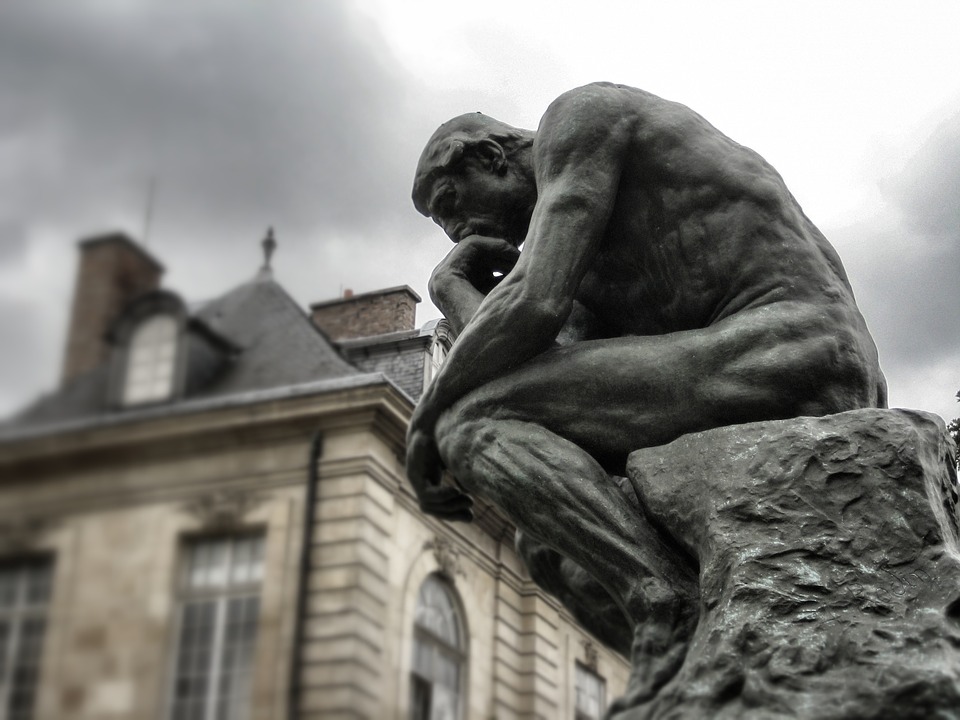
Auguste Rodin’s The Thinker stands as a silent monument to the power of the story you tell yourself—the deep, internal narrative of reflection, choice, and becoming that shapes who you are and how you move through the world. When I, Peter de Kuster, consider this iconic sculpture, I see not merely a man lost in contemplation but the embodiment of the profound inner dialogue that defines the human experience.
The Thinker captures the moment of pause within the Hero’s Journey—the critical stage where you confront the abyss, wrestle with doubt, and decide whether to carry forward. His hunched posture, hand pressed firmly to his chin, is the physical manifestation of intense self-reflection—the narrative alchemy where confusion begins to clarify, questions birth insight, and stories twist toward transformation.
This sculpture teaches the most essential storytelling lesson: the stories you tell yourself first live within your mind before they ever shape actions or narratives told to others. The Thinker’s gaze is downward, not on the external world but into the depths of his inner world—his thoughts, fears, hopes, and desires all swirling in silent conversation. What story is he telling himself about himself? Is it one of doubt or emerging clarity, paralysis or purpose?
Rodin’s masterpiece also reminds us that storytelling is a process—a dialogue, not a monologue. The thinker’s solitary pose masks a rich internal drama. He questions every assumption, challenges every certainty. This internal narrative wrestling is not weakness but courage—the willingness to confront uncertainty with honesty. In this liminal space, your story is malleable, offering a chance to rewrite identity, decisions, and destiny.
Beyond the thinker as individual is the universal story of human agency: to choose is to create your story. The sculpture becomes a symbol of free will and self-authorship, embodying the moment when you decide how to respond to your calling, your trials, your abyss. It challenges the myth that action equals power, revealing instead the narrative potency of thoughtful pause.
The power of this story lies also in its invitation to embrace contradiction: the thinker is both burdened by and empowered through reflection. His tense muscles suggest struggle, yet his stillness evokes calm insight. Your internal story, too, must hold tension—between fear and hope, doubt and courage—to grow.
In coaching, The Thinker inspires deeper inquiry into personal narratives. When clients feel stuck, I urge them to occupy their inner thinker: to hold space for their stories with curiosity rather than judgment. This quiet courage plants seeds for transformation that action alone often cannot.
Rodin’s work also speaks to cultural storytelling. It stands on the threshold between ancient mythic heroes and modern existential self-awareness. The thinker is Orpheus reimagined for modernity—no longer leaping into battle blind, but gazing inward for meaning. This shift reflects our evolving narrative needs: from heroic deeds to authentic selves.
Light and shadow shape The Thinker—his form catching nuanced highlights and deep darkness. This chiaroscuro mirrors storytelling’s play between revelation and concealment, known and unknown. Your story is illuminated in moments of insight but often exists in shadows—waiting patiently for the telling.
The scale of the sculpture—larger than life—declares the immense weight of internal storycraft. This is not trivial self-talk but the epic forging of identity. Your inner narrative is the foundation upon which all else stands.
Ultimately, The Thinker symbolizes storytelling’s sacred act: the continuous turning inward to clarify and reclaim your self-story. It teaches that the power of your story lies not only in how boldly you narrate it externally but in the depth and truth you cultivate within.
The story you tell yourself in moments of solitude, doubt, and questioning becomes the force that shapes your life’s journey.
In the silent contemplation of The Thinker, we witness the universal hero’s moment—when reflection births action, hesitation becomes resolution, and the story of self is forged anew.
That is the power of your story—the story held inside, the story told outward, the story that becomes your legacy.
What this quest can bring all of us is not a neat formula, but a toolkit and a courage. The toolkit consists of questions and structures: the premise of your story, the words on your future tombstone, the mission you dare to say out loud, the archetype that best expresses your values, the plot that truly fits the season of life you are in. The courage comes from realizing you are not alone: every great story, every great business, every meaningful relationship has had to rewrite itself at some point. When you start to see your life as a work in progress rather than a verdict, you reclaim authorship. You stop asking, “What is happening to me?” and start asking, “What story am I telling—and what story do I want to tell next?”
The universal language of stories is, in the end, a language of choice. You cannot control every event, every loss, every unexpected twist. But you can choose the story that gives those events meaning. My work, and my joy, is to walk with people through the great cities and great movies of the world until they can hear that language clearly in themselves. When they do, something simple and astonishing happens: they stop trying to live someone else’s script. They become the storyteller, not just the character. And from that moment on, their business, their relationships, and their inner life begin to align around a new, truer story—one only they can tell.
What do I mean by ‘story’?
What do I mean by ‘story’? I don’t intend to offer tips on how to fine-tune the mechanics of telling stories to enhance the desired effect on listeners. And I do not mean the boiler-plate, holier-than-thou brand stories often found in the Mission Statement of corporate websites, or the Here’s -why-we’ll – absolutely-meet-our-fourth-quarter numbers-narrative-yarn-turned-pep-rally that team leaders often like to spin to rally the troops.
No, I wish to examine the most compelling story about storytelling – namely how we tell stories about ourselves to ourselves. Indeed, the idea of ‘one’s own story’ is so powerful, so native, that I hardly consider it a metaphor, as if it’s some new lens through which to look at life. Your life is your story. Your story is your life. When stories we read or watch or listen to are triumphant, they are so because they fundamentally remind us what is most true or possible in life – even when it is an escapist romantic comedy or sci-fi fantasy or fairy tale. If you are human, then you tell yourself stories – positive ones and negative, consciously and, far more than not, subconsciously. Stories that span a single episode, or a year, or a semester, or a weekend, or a relationship, or a season, or an entire tenure on this planet. Telling ourselves stories helps us navigate our way through life because they provide structure and direction. ‘Just seeing my life as a story’ said one of my clients ‘allowed me to establish a sort of road map, so when I have to make decisions about what I need to do [the map] makes it easier, takes away a lot of stress’.

Leonardo da Vinci’s Mona Lisa is an enduring masterpiece that captures the timeless power of the story we tell ourselves—the internal narrative that shapes our identity, our emotions, and how we present ourselves to the world. When I, Peter de Kuster, reflect on the Mona Lisa, I see more than a portrait; I see a profound exploration of the story of self—the delicate balance between mystery and revelation, presence and enigma.
Mona Lisa’s subtle smile is the heart of this narrative power. It is neither overt delight nor secretive concealment but a living story suspended between ambiguity and invitation. This smile embodies the inner story she tells herself—a story of composed confidence, quiet strength, and the acceptance of complexity within. It tells us that who we are is never fully transparent, yet our stories ripple through our expressions and presence, inviting others to engage with our mystery.
Leonardo’s technique, especially his use of sfumato, blurs the lines of form to soften edges and dissolve certainty. This visual ambiguity mirrors the fluidity of our self-narratives. Just as Mona Lisa’s smile can seem different from every angle, so too does our inner story shift with time, context, and reflection. The painting reminds us that our story to ourselves can change, that identity is layered and not fixed.
The gaze of Mona Lisa pulls the viewer into a silent conversation. She looks out not just with eyes but with the full force of her narrative—calm, steady, knowing. This gaze is a testament to how the story you tell yourself fosters presence and invites connection. Your self-narrative is both anchor and beacon, grounding you and drawing others.
Beyond the woman, the ethereal landscape in the background suggests the vastness of the narrative journey. Winding paths and distant horizons speak to the stories unwritten, the internal explorations that shape who we are beneath the surface. This backdrop emphasizes that your story is ongoing, a journey into unknowns that you navigate moment by moment.
Leonardo’s mastery in detail—the delicate hands, the subtle textures of skin and fabric—expresses the narrative richness of being human. Our stories are articulated not only in words or grand acts but in small gestures, nuances of posture, and expressions. Every detail of your narrative matters.
The enigmatic quality of the Mona Lisa has sparked centuries of debate, symbolizing how narrative is often contested and interpreted differently by each observer. Your story, too, will be seen through many lenses. The power lies in owning your narrative while allowing room for dialogue and evolution.
In coaching, I draw on Mona Lisa to illustrate the importance of embracing complexity in personal stories—accepting the parts of yourself that are mysterious or evolving rather than rushing to define or simplify. True narrative power thrives in this delicate balance between knowing and exploring.
Leonardo’s Mona Lisa teaches us that the most profound stories aren’t declarations shouted from the rooftops but subtle, layered, resilient narratives that invite ongoing engagement and interpretation. Your story is living art, crafted in moments and perceptions, unfolding indefinitely.
Standing before this masterpiece, I am reminded that the most powerful story you tell yourself is the one that holds space for mystery and light, that dares to look outward while exploring inward. Just like Mona Lisa, your story invites others into a dance of meaning, connection, and presence.
That is the eternal power of your story—complex, evolving, and irresistibly alive.
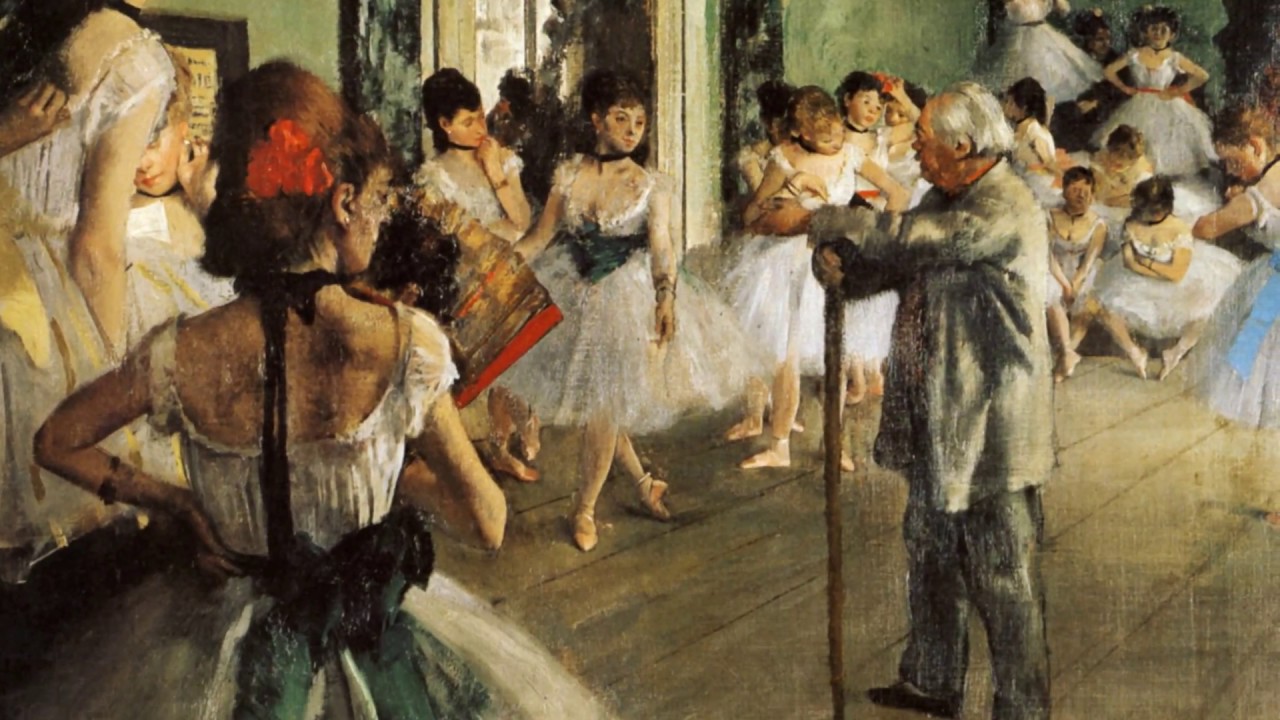
Edgar Degas’s masterpiece, The Ballet Class, is a vivid portrayal of the stories we tell ourselves about discipline, grace, aspiration, and the subtle complexities beneath perfection. Through the poised dancers and the watchful eye of the master, Degas captures the intimate narrative moments where identity and self-perception intersect with struggle and artistry—a powerful metaphor for the internal story you tell yourself about who you are and who you strive to be.
When I view The Ballet Class, I see more than dancers in motion; I see a silent dialogue of striving that echoes all our human narratives. The young ballerinas are caught between their current selves and the stories they hold within—stories of potential, fear, ambition, and the quest for excellence. Their delicate movements, some tentative, some confident, express the tension between vulnerability and mastery—the very essence of the stories we craft as we grow.
The ballet master, positioned with a critical yet guiding gaze, embodies the external narratives and expectations that shape our internal monologues. His watchfulness represents the societal and internal critic whose voice can either reinforce self-doubt or propel narrative growth. Our stories do not unfold in isolation—they are constantly influenced by the feedback we receive and the standards we impose on ourselves.
The subtle interplay of light and shadow in the painting mirrors the dualities present in our stories: moments of clarity and obscurity, confidence and insecurity. Degas’s brushstrokes, often described as impressionistic yet precise, reflect the fluid and layered nature of self-narrative—it flickers between definitive and ambiguous, concrete and elusive.
Each dancer’s posture tells a different story. Some stand tall and focused, their story one of rising confidence and determination. Others bend or shift, revealing narratives of self-questioning and tentative self-expression. The collective tableau shows how individual stories coexist, overlap, and influence the group’s dynamic, much like the stories we tell ourselves within our families, teams, or organizations.
This masterpiece reminds us of the power of the story not only in moments of triumph but in the quiet, uncelebrated efforts—the rehearsals, the falls, the repetitions—that are the backbone of transformation. The ballet class is not just performance; it is preparation, narrative work in progress, the Hero’s Journey in its early Trial phase, rich with both promise and struggle.
Degas also captures the timeless tension between aspiration and reality. The young dancers dream of mastering their craft, telling themselves stories of future glory, yet the painting shows the disciplined, sometimes harsh reality of training. This tension teaches that powerful narratives embrace both hope and honesty and that the story you tell yourself must acknowledge struggle to nurture resilience.
In coaching, The Ballet Class inspires the recognition that your internal story is often formed in these subtle moments—the rehearsals of your life where you practice roles, confront doubts, and hone purpose. The narrative you nurture in the backstage of your mind is as vital as the story you perform in the spotlight.
Degas’s work teaches us to honor the process of storytelling itself—the unseen, imperfect, and evolving journey of self-creation. The power of your story lies not in flawless chapters but in the authenticity and persistence of your becoming.
When you look at The Ballet Class, remember that each moment, each step, each breath is a narrative building block. The dancers invite you to see your own journey as a delicate balance of grace and grit, vulnerability and willpower, shadow and light.
That is the lesson the painting imparts—the eternal power of your story to shape identity, inspire courage, and choreograph the dance of your life. Like the dancers, you are the artist and the hero of your unfolding narrative, moving ever closer to the mastery and meaning you envision.
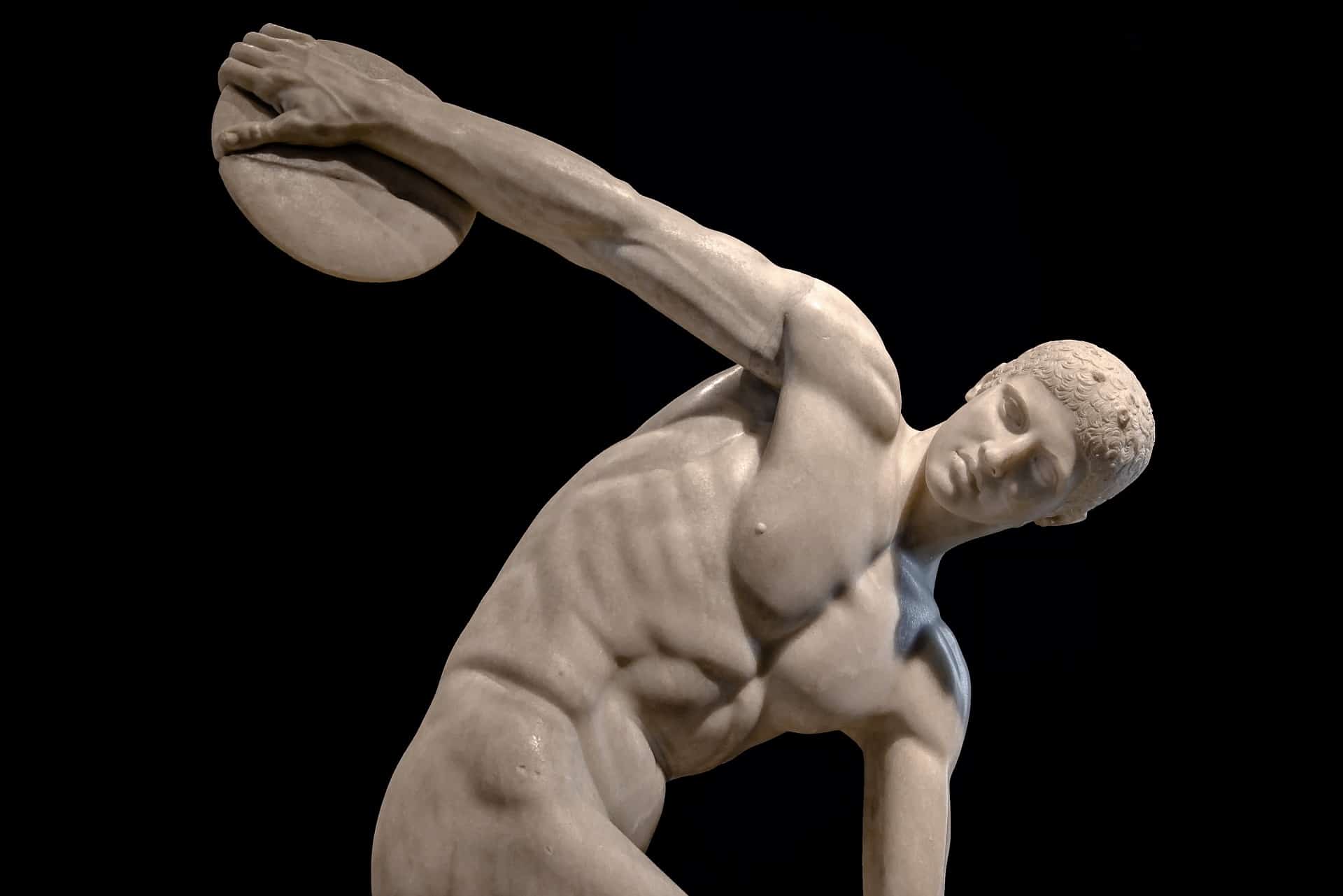
Ancient Greek art offers timeless wisdom about the power of the story—the story you tell yourself about yourself to yourself and others—as the foundation of identity, legacy, and human aspiration. One masterpiece that speaks profoundly to this is the Discobolus (Discus Thrower) by Myron, a sculpture that captures narrative and selfhood in poised motion.
The Discobolus is not just a figure frozen in athletic action; it is a monument to controlled potential and narrative possibility. The athlete’s body, taut and coiled, embodies the story of disciplined preparation—the story of a person telling themselves, “I am strength, balance, and focus. I am ready to cast my destiny.” The sculpture captures anticipation—the moment before release—symbolic of the transformative power inherent in the stories we narrate to ourselves.
This poised tension is the inner dialogue of the Hero’s Journey, the charged silence before crossing thresholds and facing trials. The story we tell ourselves is often not about where we stand but about where we are about to leap, and the Discobolus crystallizes this universal narrative moment.
The statue’s idealized form communicates a narrative of perfection and harmony, reflecting Greek values of arete—virtue, excellence, the fullest expression of human potential. By telling himself a story of excellence, the athlete asserts a narrative power that transcends mere physicality; it becomes an expression of identity and worth.
The narrative conveyed is both intensely personal and deeply communal. The athlete is preparing for an act that will be witnessed, judged, and remembered—signaling that our self-story is inevitably intertwined with the narratives reflected back by others. Greek art teaches that identity is co-authored not only within but among the polis, the community of shared stories and values.
Myron’s mastery lies in merging dynamism and stillness—a visual metaphor for the balance the inner story must hold between action and reflection, confidence and humility. Just as the Discobolus holds poised energy, your narrative lives in this balance, continually poised between past practice and future aspiration.
This sculpture reminds me that the stories we tell ourselves are active forces shaping how we engage with the world. Your internal narrative is a preparatory act, a readied tension that primes you for transformation. Yet it is also a public declaration, inviting witness and legacy. The Discobolus does not merely perform—it narrates a timeless human drama of struggle and grace.
In coaching, I often evoke the Discobolus as a symbol of the narrative moment when preparation and courage converge. We are all athletes in our own stories, charged with mental and emotional discipline as much as physical. Before you launch into your next phase, what story do you tell yourself about your strength and readiness? How do you harness your poised energy?
The Greek ideal embodied in Discobolus also challenges us to seek harmony in our narratives—to integrate mind and body, thought and impulse, reflection and action. The story you cultivate is valid when it sustains balance, enabling ongoing movement without collapse.
This ancient masterpiece stands not only as athletic perfection but as a metaphor for narrative sovereignty—the power to author your identity with grace, focus, and intention. To stand poised, embody your story fully, and pursue your destiny with intention.
The story you tell yourself about yourself—your strength, your purpose, your preparedness—radiates from within. Discobolus reminds us: the power of your story is born in the poised silence before launch, in the harmony of form and will, in the timeless leap toward becoming.
Through this iconic form, Greek art teaches that our stories are not just reflections but active forces—stories that shape us, propel us, and inscribe our place in history.
Your story can become your masterpiece. What narrative do you balance and prepare to release?
Indeed we are actually wired to tell stories: The human brain, according to a New York Times article about scientists investigating why we think the way we do, has evolved into a narrative-creating machine that takes ‘whatever it encounters, no matter how apparently random’ and imposes on it ‘chronology and cause-and-effect logic’. Writes Justin Barrett, psychologist at Oxford University, ‘We automatically and often unconsciously look for an explanation of why things happen to us and ‘stuff just happens’ is no explanation’ (which feeds one possible theory for why we need, or even create, God or Gods). Stories impose meaning on the chaos; they organize and give context to our sensory experiences, which otherwise might seem like no more than a fairly colorless sequence of facts. Facts are meaningless until you create a story around them.
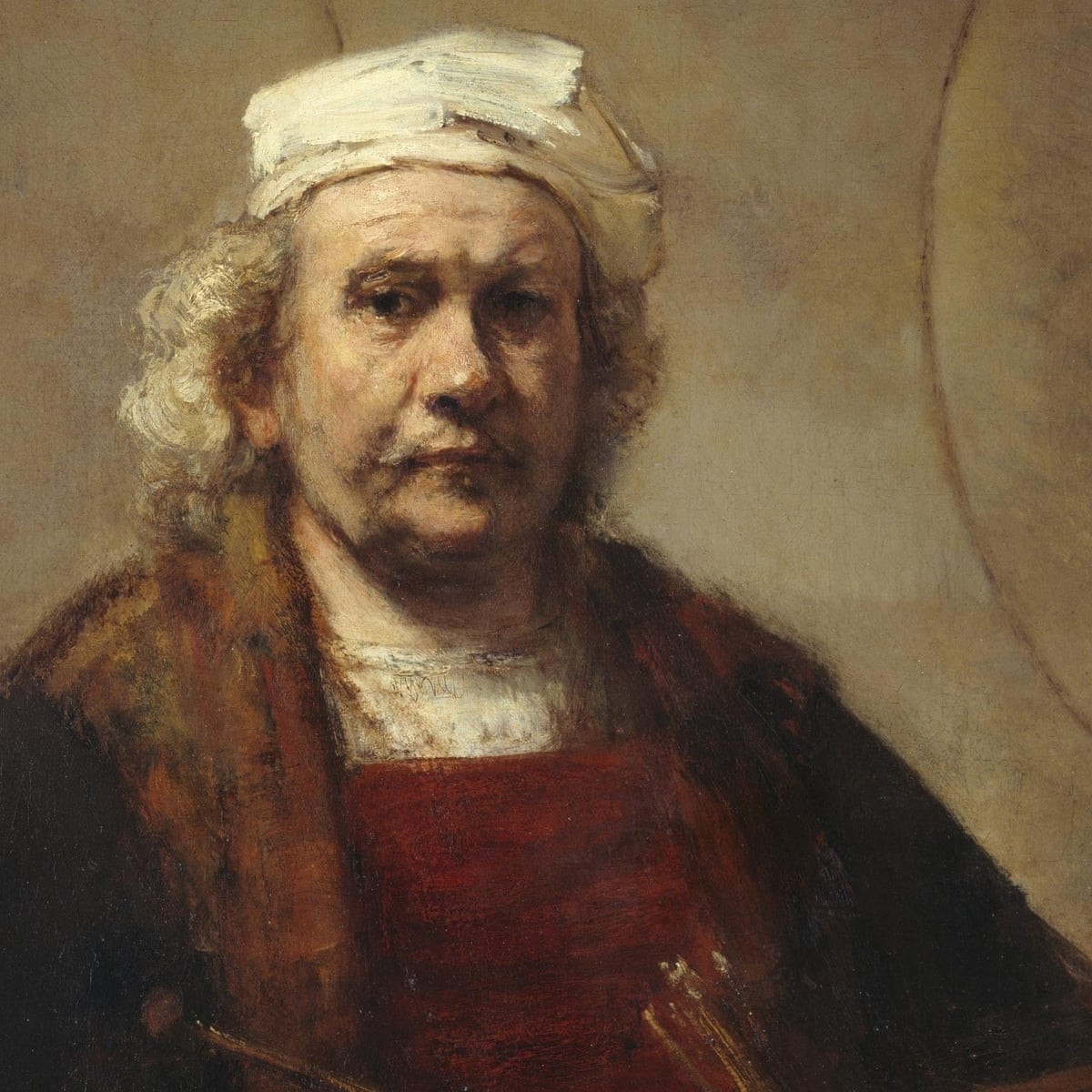
Rembrandt’s masterpieces, especially his self-portraits, capture the profound power of the story we tell ourselves—the internal narrative shaping our perception, identity, and ultimately how we present our true selves to the world. From my perspective as Peter de Kuster, Rembrandt’s art offers a timeless lesson on owning your story with honesty, vulnerability, and unflinching introspection.
Rembrandt painted himself across decades—each self-portrait a chapter in his evolving internal narrative. The aging artist stares out from the canvas with eyes that reveal wisdom and struggle, confidence and doubt. In this gaze lies the heart of storytelling power: the courage to tell yourself not only who you wish to be but who you really are, embracing flaws alongside strengths.
The layering of paint mirrors the layers of identity constructed and deconstructed over time. Rembrandt’s use of chiaroscuro—dramatic light and shadow—literalizes how our narratives often illuminate some truths while obscuring others. Our self-story is never fully visible at once; it reveals itself gradually, in moments of reflection and confrontation.
What moves me deeply is Rembrandt’s refusal to shy away from vulnerability. His portraits are honest—they show success and suffering, pride and despair. He models narrative authenticity: that the stories we tell ourselves are most powerful when they acknowledge complexity rather than perfection. This invites us to own not only our triumphs but also our shadows, weaving them into a richer, more compelling story.
Through his brushstrokes, Rembrandt captures the silent dialogues we hold within—between confidence and fear, hope and regret, past and future. This internal narrative tension propels growth; it is the crucible in which our story is forged anew with every passing year.
Rembrandt’s self-portraits also engage the viewer in a relational narrative. His stare challenges us to see beyond surfaces, inviting empathy and recognition of shared human experience. This reminds us that the story we tell ourselves inevitably connects with the stories others tell about us, creating an ongoing dialogue shaping how identity is perceived and lived.
In my coaching, I use Rembrandt’s work as a metaphor for deep narrative work—encouraging clients to paint their internal stories in full, accepting shadows without judgment, illuminating forgotten parts, and embracing the richness that vulnerability brings. The power of your story lies not in hiding wounds but in integrating them as part of your authentic narrative.
Rembrandt’s legacy teaches that storytelling is a lifelong process—a continual layering and re-layering of experience and meaning. His portraits span youthful ambition to tender old age, proving stories evolve and, with courage, deepen over time.
The artist’s intimate self-examination offers us a masterclass: the journey to fully author your story demands radical honesty, self-compassion, and relentless curiosity. The story you tell yourself about yourself must hold space for paradox and truth.
Standing before a Rembrandt self-portrait, you witness a human saga written not in grand conquests but in quiet moments of self-awareness and revelation. This is the timeless power of storytelling. It shapes identity and connects souls, inviting you to own your story with the same fearless authenticity.
That is the enduring gift of Rembrandt—the power of your story is the power to see clearly within and share boldly without.
A story is our creation of a reality; indeed our story matters more than what actually happens. Is there really any difference, as someone famously asked, between the life of a king who sleeps twelve hours a day dreaming he’s a pauper, and that of a pauper who sleeps twelve hours a day dreaming he’s a king?
By ‘story’ I mean those tales we create and tell ourselves and others, and which form the only reality we will ever know in this life. Our stories may or may not conform to the real world. They may or may not inspire us to take hope – filled action to better our lives. They may or may not take us where we ultimately want to go. But since our destiny follows our stories, it is imperative that we do everything in our power to get our stories right.
For most of us, that means some serious editing.
To edit a dysfunctional story, you must first identify it. To do that you must answer the question: In which important areas of my life is it clear that I cannot achieve my goals with the story I have got? Only after confronting and satisfactorily answering this question can you expect to build new reality – based stories that will take you where you want to go.
Is this all starting to sound a little vague? I’m not surprised. But hold on. I understand you may be thinking Life as a story? The whole concept strikes you, perhaps, as a tad …. soft. I don’t look at my life in terms of story, you say. I disagree. Your life is the most important story you will ever tell, and you are telling it right now, whether you know it or not. From very early on you are spinning and telling multiple stories about your life, publicly and privately, stories that have a theme, a tone, a premise – whether you know it or not. Some stories are for better, some for worse. No one lacks material. Everyone’s got a story.
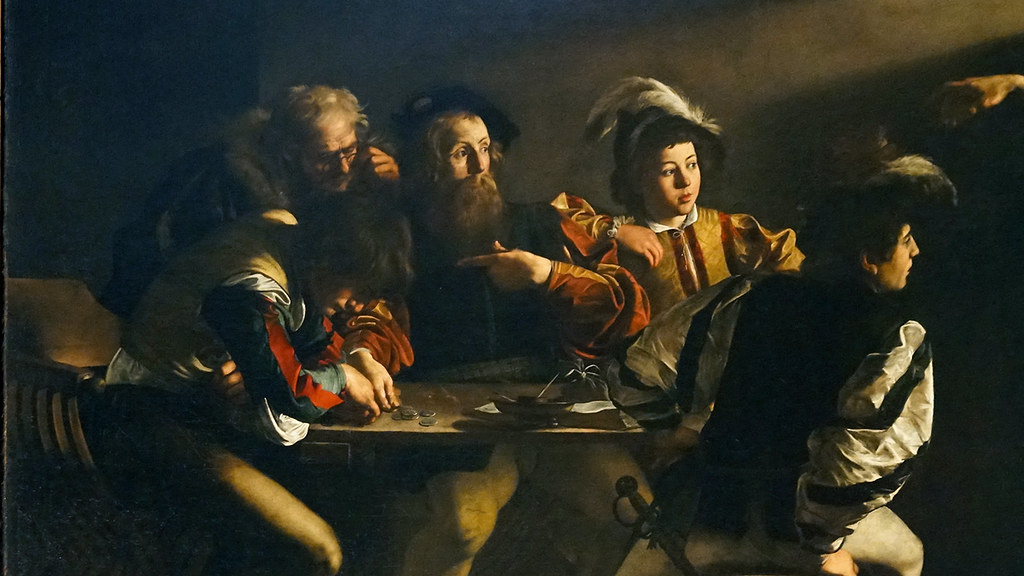
Caravaggio’s masterpiece The Calling of Saint Matthew powerfully illustrates the profound power of the story you tell yourself—the internal narrative that shapes your identity, your transformation, and your place in the world. From my perspective as Peter de Kuster, this painting vividly captures the moment when a life story is disrupted, rewritten, and renewed through conscious choice.
In the dim, shadowed tavern, Matthew sits counting coins, absorbed in a story of material security and social limitation, perhaps one of complacency and survival: “I am just a tax collector, separate from the sacred.” Into this mundane narrative bursts the figure of Christ, pointing with certainty, calling Matthew to a radically different self-story—the story of purpose, grace, and transformation. The light streaming profoundly illuminates Matthew’s face, capturing the precise instant he hears and internalizes his Call to Adventure.
This moment reveals storytelling’s supreme power: the story you tell yourself about who you are can be rewritten at any moment. Matthew’s journey moves from an identity rooted in numbers and risk to one of faith and courage. Caravaggio’s stark chiaroscuro—the clash of light and shadow—symbolizes the tension within our internal stories: old narratives fading into darkness, new truths breaking through into illumination.
Matthew’s surprised, almost reluctant gaze invites us to see the vulnerability inherent in narrative change. Transformation is never effortless or immediate. You must first hear the call, then wrestle with it internally before embracing a new version of yourself. This internal narrative dialogue is the crucible of growth.
The composition places viewers as witnesses and participants. We see ourselves in Matthew’s seat—counting our own coins, entrenched in our stories—yet invited to turn toward the light, to accept our call to transformation. Christ’s unambiguous gesture compels us: “Rewrite your story; step beyond the familiar.”
The narrative learns depth in Caravaggio’s inclusion of other figures, immersed in everyday tavern life. They represent old narratives—the familiar, the comfortable—that continue alongside Matthew’s radical shift. Our stories are always embedded within social contexts and histories, yet individual choice remains the spark for personal narrative revolution.
Caravaggio’s painting reveals that storytelling is not just retrospective but prophetic. The moment of calling is a portal; it abruptly alters the arc of the story, redefines identity, and aligns personal purpose with greater meaning. Your story is never fixed but awaits your conscious authorship to transform it.
The dramatic use of light reminds us that narrative clarity often comes as stark contrast—what was once hidden becomes visible. Your story gains power when it moves from shadow to illumination, when you own what was denied or overlooked. Like Matthew’s illuminated face, your awakening story creates new vision for self and action.
In my coaching, The Calling of Saint Matthew serves as living metaphor for moments clients face when their internal story fractures and demands revision—the crossroads of doubt and possibility. It teaches that embracing the call with both humility and resolve is the threshold to authentic transformation.
The painting’s intimacy—its raw realism and human scale—demonstrates that narrative transformation is not grand spectacle but deeply personal. Your story unfolds in these quiet moments of recognition and choice.
Caravaggio invites us to stand with Matthew and ask: What is my story? What call have I been ignoring? What light awaits me beyond the shadows of complacency and fear?
Your story, like Matthew’s, can pivot from survival to significance, from stasis to awakening. Through painting’s fierce contrast and urgent gesture, Caravaggio reveals storytelling’s greatest truth—the power to author your identity resides in the moment you choose to listen to your own calling and walk without hesitation into the light of possibility.
And thank goodness. Because our capacity to tell stories is, I believe, just about our profoundest gift. Perhaps the true power of the story metaphor is best captured by this seemingly contradiction: we employ the word ‘story’ to suggest both the wildest of dreams (it is just a story ……) and an unvarnished depiction of reality (okay, what is the story?). How is that for range?
The challenge? Most of us are not writers. ‘I am not a professional novelist’ one client said to me, when finally the time came for him to put pen to paper. ‘If this is the story of my life, you are damn right I’m intimidated. Can you give me a little help in how to get this out? That’s what I intend to do with the Hero’s Journey and The Heroine’s Journey project. First, help you to identify how pervasive the story is in life, your life, and second, to rewrite it.
Every life has elements to it that every story has – beginning, middle, and end; theme; subplots; trajectory; tone.
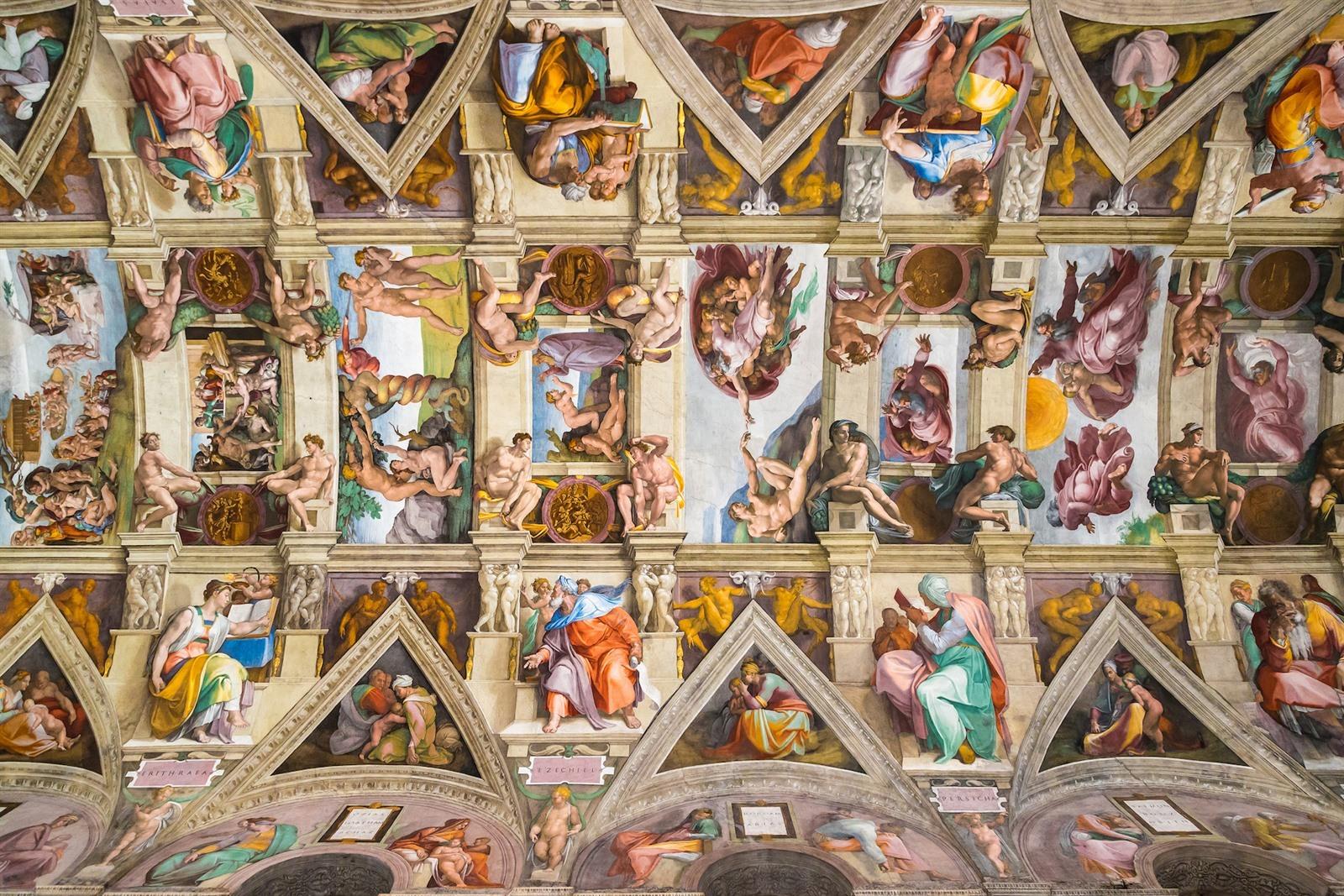
Michelangelo’s work on the Sistine Chapel ceiling is a profound narrative of human potential, struggle, and divine inspiration, encapsulated in one of the most monumental artistic achievements of the Renaissance. This masterpiece is not just a religious tableau; it is the story Michelangelo told himself about the power of perseverance, imagination, and the transformative role of the artist as a creator of worlds. His journey to complete the ceiling reflects a heroic personal saga where talent, faith, and relentless determination converge to redefine what art—and ultimately human potential—can be.
Michelangelo was commissioned by Pope Julius II in the early 16th century to paint the ceiling of the Sistine Chapel, a task that was both physically grueling and artistically challenging. The scope of the project was overwhelming, yet Michelangelo embraced the challenge, telling himself a narrative of endurance and genius: that through sheer will and vision, he could elevate human achievement to new heights. His story as he painted was one of a solitary hero, defying physical pain and artistic doubt, to realize an unprecedented vision of the cosmos and the human condition. This reflects the power of the story we tell ourselves—one of overcoming adversity by channeling inner strength and creativity into something lasting and transformative.
The ceiling depicts scenes from Genesis, the creation of man, and the fall and redemption of humanity, highlighting themes of creation, knowledge, and divine-human connection. Michelangelo’s portrayal of figures like God, Adam, and the prophets is not only a religious story but also a metaphor for human potential and the quest for meaning. The iconic image of God reaching out to give life to Adam symbolizes the profound connection between divine spark and human agency, mirroring Michelangelo’s belief in the creative power within every individual. His work invites us to recall the story we tell ourselves about our own ability to create, to shape life, and to connect with something greater than ourselves.
Michelangelo’s story as an artist was also about redefining the role of the creator. He saw himself not just as a craftsman but as a visionary who shaped reality through art. The complexity of composition, the bold use of anatomy, and the dynamic poses exemplify his mastery and his conviction that art could convey the divine drama of existence. Through this narrative, Michelangelo teaches that every individual has the power to transcend limitations and create something of lasting significance, a story echoed in the labor and genius poured into the Sistine Chapel ceiling.
Ultimately, Michelangelo’s Sistine Chapel ceiling is a celebration of human dignity and creative power, told through the story he lived and painted. It challenges viewers to consider the stories they carry about their own potential: Will it be a story of surrender or of heroic creation? The ceiling’s blend of divine inspiration and human effort stands as a testament to the power we hold when we tell ourselves a story of strength, purpose, and transcendence—transforming challenges into masterpieces that endure across time.
Through Michelangelo’s grand narrative on the Sistine Chapel ceiling, the power of your story emerges: your narrative is the brush with which you paint your destiny, the force that turns struggle into artistry, and the vision that connects you to the divine and to your highest potential.
Story is everywhere in life. Perhaps your story is that you are responsible for the happiness and livelihoods of dozens of people around you and you are the unappreciated hero. If you see things in more general terms, maybe your story is that the world is full of traps and misfortune – at least for you – and you’re the perpetual victim (I’m always so unlucky…. I always end up getting the short end of the stick…. People can’t be trusted and will take advantage of me if I give them the chance.).
If you are focused on one subplot – business say – then maybe your story is that you sincerely want to execute the major initiatives in your company, yet you are restricted in some essential way and thus can never get far enough from the forest to see the trees. Maybe your story is that you must keep chasing even though you already seem to have a lot (even too much) because the point is to get more and more of it – money, prestige, power, control, attention. Maybe your story is that you and your children just can’t connect. Or your story might be essentially a rejection of another story – and everything you do is filtered through that rejection.
Stories are everywhere. Your body tells a story. The smile or frown on your face, your shoulders thrust back in confidence or slumped roundly in despair, the liveliness or fatigue in your gait, the sparkle of hope and joy in your eyes or the blank stare, your fitness, the size of your gut, the tone and strength of your physical being, your overall presentation – those are all part of your story, one that’s especially apparent to everyone else. We judge books by their covers not simply because we are wired to judge quickly but because the cover so often provides astonishing accurate clues to what is going on inside. What is your story about your physical self? Does it truly work for you? Can it take you where you want to go in the short term? How about ten years from now? What about thirty?
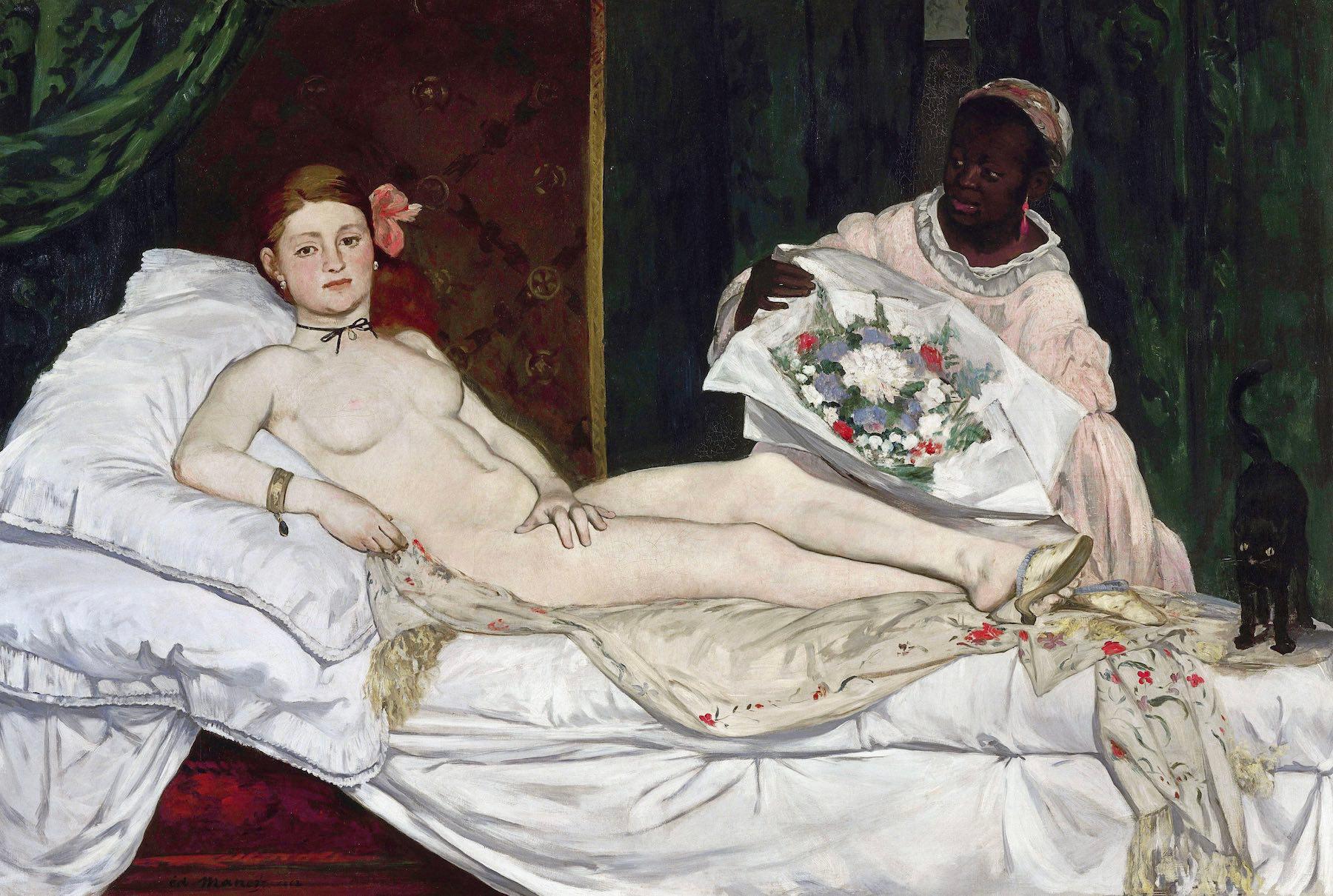
Édouard Manet’s Olympia is a bold confrontation with the power of the story you tell yourself—the story of identity, agency, and societal gaze—and how that story shapes perceptions, power dynamics, and self-presentation. From my perspective as Peter de Kuster, this painting stands as a landmark narrative moment, challenging entrenched myths and inviting radical self-authorship.
Manet’s Olympia presents a reclining nude woman, gaze direct and unabashed, unmasking the traditional passive female subject of art. Olympia’s story to herself and others is one of ownership: “I own my body, my purpose, and my narrative.” Her eyes meet the viewer’s without apology or shame. This is storytelling sovereignty—claiming your story fully even when society contests or attempts to rewrite it.
The painting’s scandalous reception underlines storytelling’s cultural power. Olympia rejects the myth of delicate, idealized beauty, embodying raw, real identity. Manet’s brushstroke reveals her as both subject and author, a woman telling her story to disrupt and redefine artistic and social narratives. This speaks directly to the stories we author about ourselves amid external pressures to conform or hide.
Olympia’s cat and black servant convey additional narrative layers—symbols of independence, domesticity, and contrasting social roles. These invite reflection on intersecting stories of race, class, and gender, revealing that storytelling is intricately social and political. Our self-story never exists apart from collective narratives that simultaneously constrain and enable.
The composition centers on touch, gaze, and gesture: Olympia’s poised hand holding flowers, her calm yet provocative expression, the direct light illuminating her skin. These elements weave a story of agency and defiance. Like Olympia, your story is wielded with intention—what you reveal, how you look back, what you hold close is your narrative language.
Manet’s unapologetic realism invites us to embrace our stories authentically, flaws and all. The power of your internal narrative lies not in perfection but in honesty and courage to appear as you truly are. Olympia teaches us to meet the gaze of the world on our own terms, telling a story that can rewrite norms and command respect.
In coaching, Olympia exemplifies the challenge clients face in claiming personal stories amid societal expectations. It reminds us that true change begins when you dare to face yourself fully and tell your story unapologetically—to yourself first, then others.
The painting remains a modern beacon for narrative agency. Through Olympia, Manet challenges every individual: what story do you own? How do you respond when culture tries to script you differently?
Ultimately, Olympia enshrines the power of your story as one of self-possession and radical truth-telling, a narrative bold enough to unsettle traditions and brave enough to transform lives.
You have a story about your company, though your version may depart wildly from your customer’s or business partners. You have a story about your family. Anything that consumes our energy can be a story, even if we don’t always call it a story. There is the story of your relationship. The story of you and food, or you and anger, or you and impossible dreams. The story of you, the friend. The story of you, your father’s son or your mother’s daughter. Some of these stories work and some of them fail. According to my experience, an astounding number of these stories, once they are identified, are deemed tragic – not by me, mind you but by the people living them.
Like it or not, there will be a story around your death. What will it be? Will you die a senseless death? Perhaps you drank too much and failed to buckle your seat belt and were thrown from your car, or you died from colon cancer because you refused to undergo an embarrassing colonoscopy years before when the disease was treatable. Or after years of bad nutrition, no exercise, and abuse of your body, you suffered a fatal heart attack at age fifty – nine. ‘Senseless death’ means that it did not have to happen when it happened; it means your story did not have to end the way it ended. Think about the effect the story of your senseless death might have on your family, on those you care about who you are leaving behind. How would that story impact their life stories? Ask yourself, Am I okay dying a senseless death? Your immediate reaction is almost certainly, “No!, of course not!
I’m not trying to be morbid. Story – which dies if deprived of energy – is not about death but life. Yet if you continue to tell a bad story, if you continue to give energy to a bad story, then you will almost assuredly beget another bad one, or ten. Why is abuse so commonly passed from one generation to the next? How much is the recurrence of obesity, diabetes and certain other diseases across families a genetic predisposition, and how much is the repetition of a dangerous story about food and physical exertion.
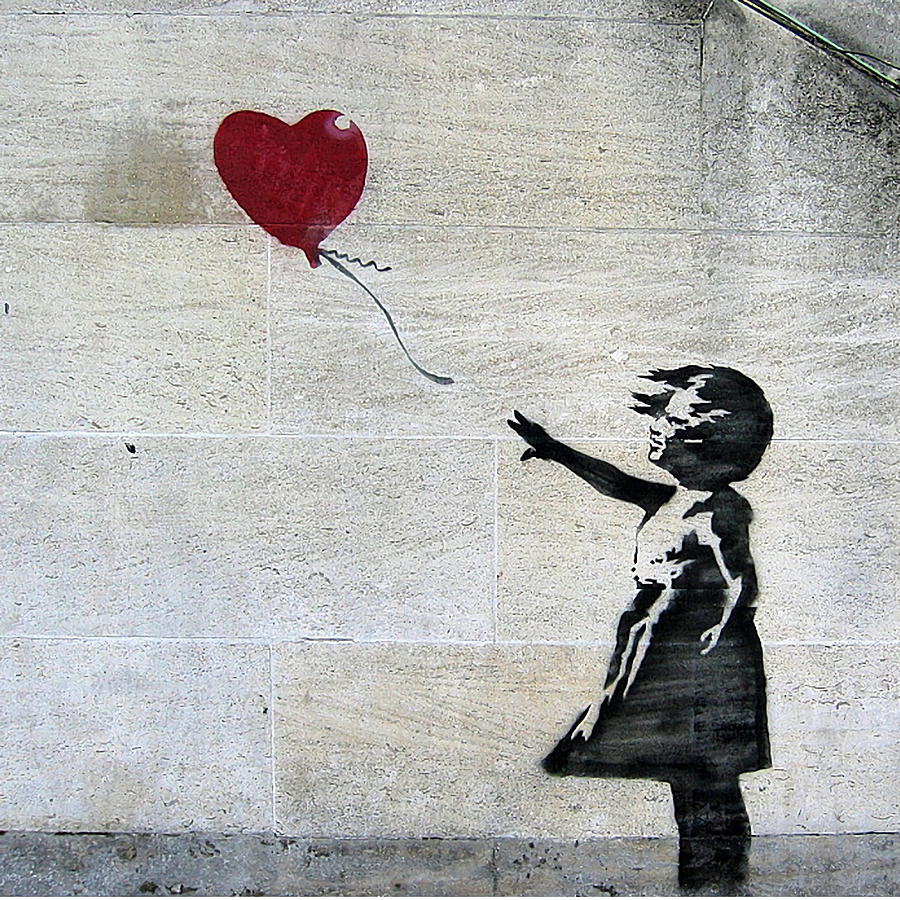
Banksy’s Girl with Balloon is a striking modern masterpiece that powerfully embodies the essence of the story we tell ourselves—the fleeting narratives of hope, loss, and the delicate interplay between holding on and letting go. From my perspective as Peter de Kuster, this iconic image reveals the narrative tension within us all and the profound impact the stories we craft have on our perception and resilience.
At the center is a young girl, reaching wistfully toward a scarlet, heart-shaped balloon drifting just beyond reach. This simple act of longing becomes a universal metaphor for human stories—the dreams and aspirations we nurture, the moments we grasp and sometimes lose, and the hope that propels us forward despite uncertainty.
This artwork powerfully illustrates that our internal narratives are in constant motion, subject to change and reinterpretation. The balloon can represent love, innocence, freedom, or lost opportunity—whatever story the viewer projects, reflecting the mutable nature of personal narrative. Your story may shift focus, evolve in meaning, and still hold its emotional core.
Banksy’s use of stark black-and-white figure contrasted with the bright red balloon underscores storytelling’s power of selective emphasis—what we illuminate in our internal narratives vs. what fades into shadow. This contrast invites us to examine which parts of our story we elevate with passion and which we let drift away.
The girl’s outstretched hand is a poignant gesture of both hope and acceptance—the tension between holding onto dreams and releasing control. This duality is the heart of many internal stories: how to balance desire with surrender, action with trust. The story you tell yourself must embrace this complexity to sustain resilience and growth.
Placed on urban walls, often fleetingly erased or updated, Girl with Balloon also speaks to narrative fragility and renewal. Stories are alive and interactive—they respond to context, challenge authority, invite reinterpretation. Your story, too, is not static but shaped by the spaces and communities it inhabits.
Moreover, Girl with Balloon embodies the democratization of storytelling. Public, accessible, sometimes ephemeral, it whispers that everyone holds the power to author and share stories that move and inspire collectively. Narrative agency does not belong solely to the powerful but to any voice daring to reach.
In coaching, I evoke this image to illustrate the delicate balance clients must find between clinging to aspiration and embracing change—the ongoing narrative dance of hope and acceptance.
Banksy’s work teaches that the power of your story lies not only in its content but in its capacity to invite connection, to evoke emotion, and to adapt. Every story contains moments of joy, loss, and rebirth—Girl with Balloon distills these into a poetic visual narrative that resonates deeply across cultures and generations.
Ultimately, Banksy’s masterpiece is a call: tell your story with both passion and openness, hold onto your dreams lightly, and trust in the transformative power of narrative to carry you forward, even when the balloon drifts beyond reach.
That is the power of your story—the story that rises and floats, sometimes slipping away, yet always beckoning you to keep reaching.
Unhealthy storytelling is characterized by a diet of faulty thinking and, ultimately, long – term negative consequences. This undetectable, yet inexorable progression is not unlike what happens to coronary arteries from a high-fat, high-cholesterol diet. In the body, the consequence of such a diet is hardening of the arteries. In the mind, the consequence of bad storytelling is hardening of the categories, narrowing of the possibilities, calcification of perception. Both roads lead to tragedy, often quietly.
The cumulative effect of our damaging stories will have tragic consequences on our health, engagement, performance and happiness. Because we can’t confirm the damage our defective storytelling is wreaking, we disregard it, or veto our gut reactions to make a change. Then one day we awaken to the reality that we have become cynical, negative, angry. That is now who we are. Though we never quite saw it coming, that is now our true story.
It is not just individuals who tell stories about themselves; groups do it, too. Nations and religions and universities, companies and sports teams and political parties each tell stories about themselves to capture the imagination of their constituencies. Companies tell their stories to engage their customers and, increasingly, their workforce, stories which must be internally consistent and powerful if they’re to succeed over time.

Roman art, renowned for its mastery of realism and powerful storytelling through portraiture and sculpture, offers profound insights into the narratives we tell ourselves—the stories that define identity, legacy, and power. A prime example is the Augustus of Prima Porta, a masterpiece of Roman imperial portraiture that vividly encapsulates the power of personal and public storycraft.
From my perspective as Peter de Kuster, the statue of Augustus is far more than a marble figure; it is a monumental narrative carved into stone—the story Augustus told himself and the empire about authority, divine favor, and unshakable leadership.
Augustus stands calm, confident, and eternal, his outstretched arm extending the story outward: “I am the restorer of peace, the chosen one of gods, the father of a new era.” His posture is commanding yet poised, embodying the internal narrative of purpose and destiny made manifest in public form. This sculpture reveals how stories shape not only self-perception but also social order.
The intricate breastplate relief depicts divine symbolism and military victories, weaving myth and reality into a composite narrative: gods endorse Augustus; Rome’s enemies lay subdued. His story is not merely personal but collective, engaging the empire’s identity. Here lies a clear lesson: the stories we tell ourselves are deeply embedded in larger narratives that shape and sustain communities.
Augustus’s barefoot stance evokes divine association, blurring lines between mortal leader and godlike figure. This elevates self-narrative beyond human limits, symbolizing the aspiration embedded in identity stories to claim grandeur and transcendence.
Roman portraiture’s hyperrealism with idealized features reflects another storytelling truth—the blend of reality and aspiration. Augustus’s subtle smile, youthful face, and calm gaze narrate the tension between human vulnerability and mythic authority. Your story must balance authenticity with ideal, wielding aspiration to propel growth without erasing truth.
Beyond the individual, the statue recalls Roman society’s value in mos maiorum—the ancestral customs and virtues upheld through stories passed across generations. Augustus’s image anchors these narratives, reminding us that personal stories are inseparable from cultural legacies.
The Augustus of Prima Porta stands as a call to authorship: to craft your identity consciously, to align personal purpose with communal meaning, to wield narrative as power. Like Augustus extending his hand in leadership, your story is an invitation and a declaration.
In coaching, I draw on this masterpiece as a metaphor for intentional narrative construction—the art of melding your true self with your highest aspirations, crafting a legacy not just lived but authored.
Roman art teaches that stories endure through symbol, form, and public projection. The power of your story is legible in every posture you take, every truth you tell yourself and others, echoing through time as your legacy.
Through this iconic sculpture, Roman art encapsulates the story’s highest power: to transform identity into myth, humanity into eternity, and individual narrative into the fabric of civilization.
What story do you carve into the marble of your life? What legacy do you beckon others to join? Augustus’s immortal gaze challenges you: author boldly, embody fully—your story is the empire you build.
Throughout this seminar I will detail how such organizations and their employees have reworked their story to the great advantage of both their business and their culture.
For twenty-five years I have studied human behavior and performance, and been privileged to witness many success stories of positive behavioral change: better relationships at home and at work, better job performance, weight loss and all-around improved health and lowering of health risks; love, excitement, joy and the discovery of talents heretofore buried. My experience has led me to see that these changes may be brought about by a unique integration of all the human sciences.
Over the past 30 years, my work has been deeply rooted in exploring flow experiences—those moments of deep engagement and creativity where challenge meets skill perfectly, as described by Mihaly Csikszentmihalyi. What I have discovered is that flow is not just a psychological state but a transformative journey, especially when combined with the power of storytelling. Storytelling provides the narrative framework that helps individuals and leaders make sense of their experiences, integrate their passions, and sustain flow beyond fleeting moments.
In my leadership journeys I use storytelling archetypes to create conditions that naturally foster flow. These timeless narrative structures help participants embody roles and challenges that align with their skills, creating a balance that triggers flow states. Storytelling here is not just decoration—it is a tool for meaning-making and motivation, enabling people to connect their personal and professional challenges to a larger, inspiring narrative.
Client feedback has been essential throughout this journey. From the earliest workshops to the latest leadership retreats, I have consistently integrated participant reflections and stories to refine the frameworks and exercises. This iterative process ensures that the storytelling methods remain relevant, practical, and deeply resonant. Clients often report that framing their challenges within a story helps them gain clarity, see new possibilities, and sustain the passion that fuels flow. Their feedback has confirmed that storytelling is the bridge between abstract flow theory and real-world application, making flow accessible and sustainable in everyday leadership and creative work.
In sum, my three decades of work show that flow and storytelling are inseparable partners. Flow offers the experience of peak engagement, while storytelling provides the narrative structure that helps individuals understand, sustain, and share that experience meaningfully. This synergy, continuously refined through client collaboration, is at the heart of my approach to leadership and creativity.
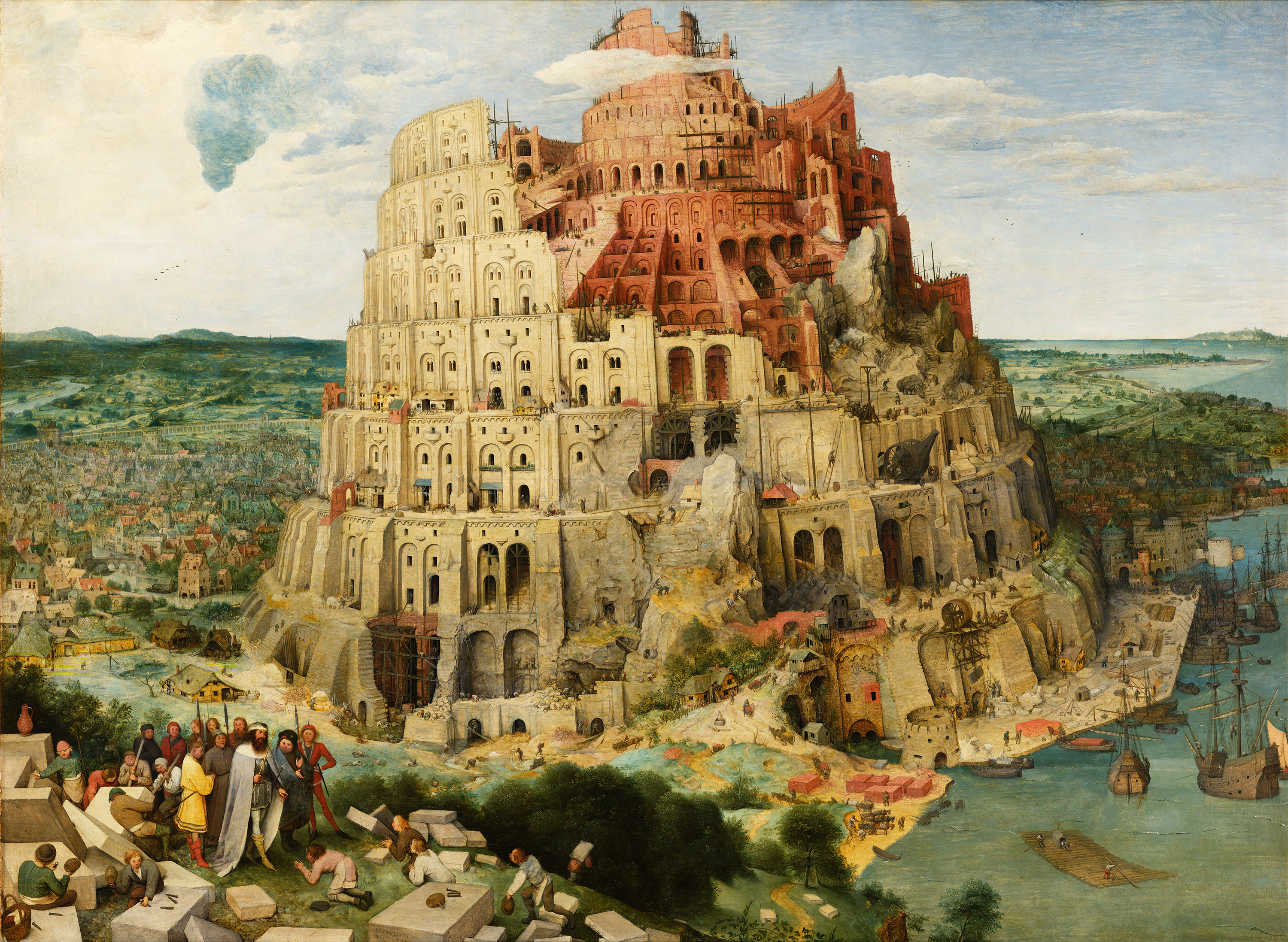
Pieter Bruegel the Elder’s The Tower of Babel is much more than a grand Renaissance painting; it is a vivid metaphor for the power of the story we tell ourselves—the story that shapes our ambitions, our collective identity, and the limits we encounter along our journey. From my perspective as Peter de Kuster, this masterpiece captures the eternal human narrative of overreach, confusion, and the quest for meaning amid diversity.
In the painting, the immense tower stretches upward, an audacious attempt to reach heaven—a monument to human ambition and the story of striving beyond mortal bounds. The builders commit to a collective narrative: “We will build a tower so great it tests the gods themselves.” This declaration embodies the stories we tell ourselves about power and destiny, how narratives can spur us to achieve extraordinary feats.
Yet Bruegel shows the tower in a state of fragmentation and incompletion—scaffolds, collapsed sections, and uneven construction. This is storytelling’s sobering counterpoint: narratives can inspire but also limit. They reflect our hubris and the inevitable fractures when stories lack coherence or unity. The Tower of Babel reminds us that without shared understanding, stories become dissonant, leading to confusion and division.
The surrounding landscape teems with life—people, animals, and varied architectural styles—symbolizing a multitude of narratives coexisting and sometimes clashing. The biblical tale of Babel heralds the origin of linguistic and cultural diversity, emphasizing that storytelling is inherently a communal, multifaceted act altering identity across groups.
The painting’s vertical thrust is echoed by diagonal lines that guide the eye upward, crafting a dynamic narrative movement towards transcendence. Yet shadows and clouds loom, preparing the dramatic fall. This tension reflects the dual nature of stories—they propel us forward but also warn us of limits. Your story holds wings but must heed gravity.
Bruegel’s meticulous attention to detail—the replica of ancient architectural motifs, the busy figures laboring—invites viewers into layered storytelling. Each worker tells an individual micro-story, part of a grander collective narrative. Your personal story, too, interlaces with broader social tales, creating a tapestry of meaning and challenge.
The biblical narrative underpinning the painting serves as a cautionary allegory: arrogance in narrative authorship can fracture identity and community. The power of your story lies in its humility and adaptability as much as in its ambition and grandeur.
In coaching, The Tower of Babel reminds me to help individuals balance aspiration with grounded coherence, to guide the crafting of stories that are powerful and sustainable, avoiding fragmentation.
Bruegel’s masterpiece teaches that storytelling is an eternal human project—a building site of hopes, conflicts, creativity, and often chaos. The story you tell yourself is like the tower: a structure growing skyward, inviting connection, yet vulnerable to discord if not carefully aligned.
Every narrative contains Babel’s duality—dream and danger, unity and division. Your story, authored with awareness, can soar and sustain rather than crumble under its own weight.
Through The Tower of Babel, Bruegel imparts a timeless lesson: your story shapes your destiny, but only the stories that reconcile ambition with wisdom endure.
What tower does your story build? How do you navigate the languages and voices within to construct a lasting legacy? The mighty tower stands, unfinished, whispering both warning and challenge: author boldly, build consciously—your story is the architecture of your life.
Of course, some people who have travelled with me on the Power of your Story are utterly unaffected by what we do and what they’re exposed to. Why? Some feel their ‘story’ needs no major reworking (and perhaps they’re absolutely right). Some fail to buy in to what we do because they’re just moving too fast. For some, the timing isn’t right (though, as I intend to show, it is always the right moment to change: now). Whatever the reason, for virtually every group I encounter 20% – the percentage is like clockwork – are simply not interested in what we have to say.
I respect that. The Power of Your Story was not designed to push an agenda. While I passionately believe that the story metaphor is universal and, with awareness, can be extraordinarily beneficial, it ‘works’ only when the individual is willing to look hard at the major problem areas in his or her life, explore why they’re problems, then meaningfully change the problem elements, be they structure or content, which are causing a profound lack of productivity, fulfillment, engagement, and sense of purpose. We work with people. We don’t stand over them and make them do something they don’t want.
Unlike many practitioners in the field of performance improvement , I do not believe you can have it all. It’s an absurd proposition. I don’t believe that every day will be a great day, that you can eliminate regret and despair and worry, that you will always be moving forward, that you will always succeed, that you won’t veer off track again. I do believe that you can have what is most important to you. And that this is achievable if you’re willing to follow the steps of the process advocated in this seminar.
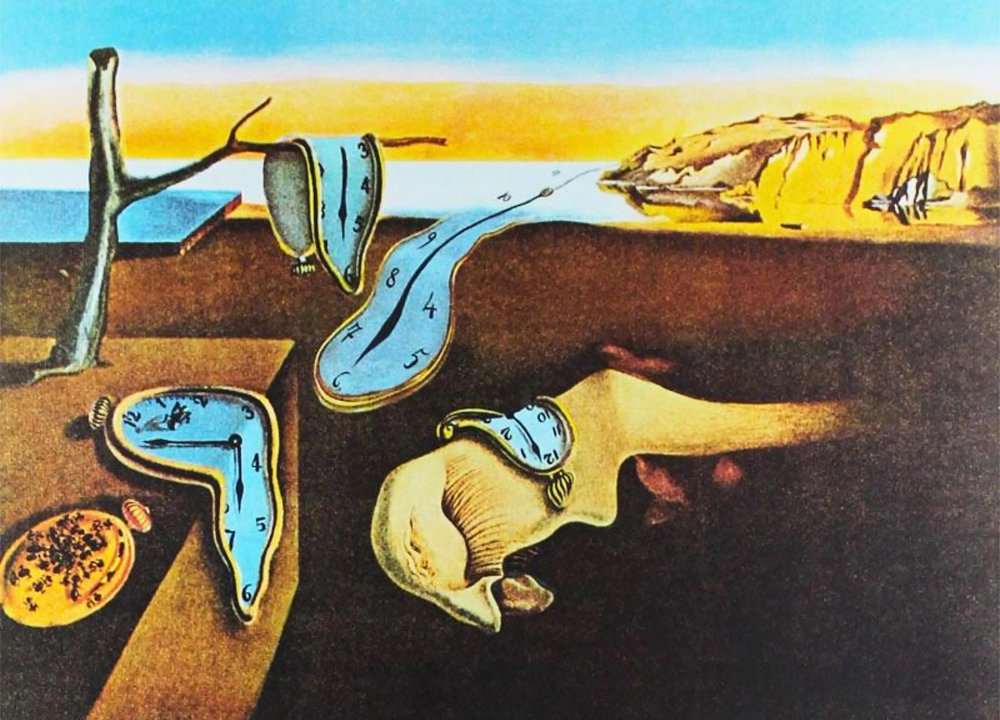
Salvador Dalí’s The Persistence of Memory stands as a surreal meditation on the power of the story we tell ourselves—the internal narratives shaping our perception of time, memory, and reality itself. From my perspective as Peter de Kuster, this masterpiece reveals the fluidity and mutability of the stories we hold within, reminding us that our self-narratives are not fixed but bend, stretch, and reshape the very fabric of our experience.
The painting’s melting clocks are its most striking feature—soft, distorted timepieces draped languidly over barren branches and strange landscapes. These warped clocks symbolize how the stories we tell ourselves about our past, present, and future are subjective and elastic. Time is no longer an absolute measure but a malleable construct shaped by memory and emotion. Your story of self—the timeline you carry—bends with perspective, feelings, and interpretation.
At the center, the amorphous, dreamlike figure—a soft self, seemingly melting—embodies the vulnerability of identity when confronted with shifting internal narratives. This form calls us to acknowledge how the story we tell about ourselves can dissolve old certainties, allowing new patterns and meanings to emerge. It challenges the illusion of a stable, permanent self.
Dalí’s barren landscape, both haunting and serene, frames these surreal elements, reminding us that the setting of our inner stories is often ambiguous, mysterious, and evolving. Just as the dreamscape hosts shifting images, our internal narrative unfolds within a fluid psychological environment, constantly reinterpreted.
The ants crawling over the pocket watch evoke decay and impermanence, signaling that some parts of our story deteriorate or must be shed for growth. This prompts reflection on what elements of our self-story cling unnecessarily and what must be released for ongoing transformation.
The intricate shadows and the play of light further emphasize the ephemeral nature of memory and narrative truth. They invite us to explore the interplay between known and unknown within the stories we hold and project.
In coaching, The Persistence of Memory becomes a powerful metaphor for helping individuals embrace narrative fluidity—to loosen rigid self-conceptions and welcome a more dynamic and compassionate story of identity and time.
Dalí’s masterpiece ultimately teaches that the power of your story lies in its capacity to adapt, to transcend rigid timeframes, and to weave memory, perception, and emotion into a living, breathing narrative.
Your story is never a fixed record but a continuing creation—a dream-like montage of moments, feelings, and meaning, constantly reshaped by your own conscious authorship.
Looking at The Persistence of Memory challenges us: What frozen elements in your story need melting? How can you reshape the narrative of your life to transcend limiting constructs? The painting whispers across time—the power to re-author your story lies within your own dreaming self.
That is the essential gift of Dalí—a call to embrace the surreal fluidity of your inner narrative and to wield its transformative power to redefine your reality.
Who are the people who come to the Power of Your Story with dysfunctional life stories that need serious editing? They are, simply put, among the smartest, most talented, most ambitious, most creative people in their communities and professional circles. Some participants even bring, or return with spouses, friends or parents. They tend to have lots of responsibilities, they’re accountable for a great deal that goes on in their companies, they often make lots and lots of money….. yet, perhaps ironically, for all their accomplishments they can’t seem to get their stories right. On the questionnaire I ask clients to fill out before they come down to a world city for our two – and – a – half – day journeys (or to the one and two day events we conduct around the world) they are asked, among other things, to write down some of the most important parts of their life story. ‘My father died young of emphysema’, wrote the CEO of his family’s company. Later on the questionnaire, he wrote ‘I smoke two packs a day.’ Still later, describing one of his goals for the now fifty-year-old company, he wrote, ‘On the evening celebrating our company’s seventy-fifth anniversary, I want to be able to look back on yet another quarter century of quality, growth and profitability’.
How can these three sentences follow from each other without their author acknowledging that, taken together, they add up to utter nonsense? Especially when the author is superbly gifted in so many other areas?
‘The most important thing in my life is my family, wrote one client ‘and if things continue in the direction they’re going, I’m almost certainly heading for divorce and complete estrangement from my children’.
I’ll give him this much: At least he saw the tragedy coming.
In a previous book I argued that one of our biggest problems is rooted in our flawed belief that simply investing time in the things we care about will generate a positive return. That belief and the story that flows from it are simply not true. We can spend time with our families, be present at dinnertime, have lunches with our direct colleagues, remember to call home when traveling, put in 45 minutes on the treadmill five days a week – we can all do all of it but if we’re too exhausted, too distracted, too frustrated and angry when ‘doing’ these things, the positive return we hoped for will simply not materialize. Without investing high-quality, focused energy in the activity before you, whatever it may be, setting time aside simply takes us from absenteeism to presenteeism.
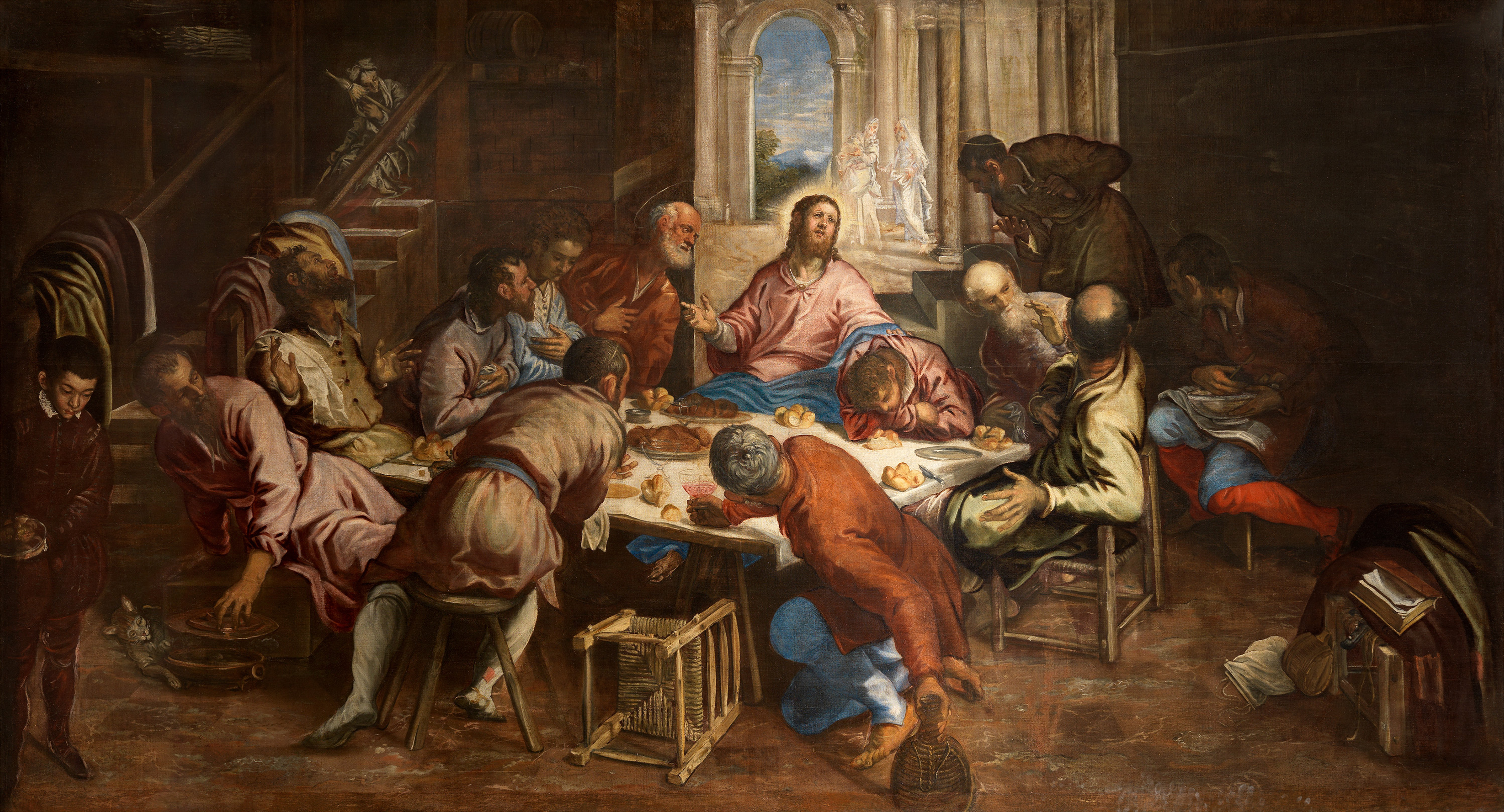
Tintoretto’s The Last Supper is a magnificent exploration of the power of storytelling—the story we tell ourselves about ourselves to ourselves and others—as it captures the complex narratives of faith, betrayal, community, and revelation through dynamic composition and dramatic light. From my viewpoint as Peter de Kuster, this masterpiece reveals how our internal stories deeply shape how we experience pivotal moments and define who we become.
In the midst of a darkened room, Tintoretto depicts Christ and his disciples in motion, each figure inhabiting their own narrative space amid swirling energy and divine light. Unlike more static Last Supper portrayals, Tintoretto infuses the scene with raw emotional narrative—the tension and uncertainty of impending betrayal and new covenant reflected in gestures, expressions, and positioning.
Christ sits calmly, illuminated by ethereal light radiating from above, the clear center of the story—“I am the guiding truth, the steadfast purpose amid human turmoil.” His radiant presence represents the internal narrative of grounded clarity that anchors us amid the whirlwind of experiences and emotions.
The disciples are stories unto themselves—some in shock, others whispering, some skeptical. Their varied reactions portray our human internal dialogues when confronting truth, change, or challenge. Each narrative voice reflects facets of doubt, faith, resignation, or hope residing within us.
Tintoretto’s use of dramatic chiaroscuro—the clash of light and shadow—visualizes the storytelling tension between revelation and obscurity, known and unknown, certainty and ambiguity. Our self-stories shine in moments of illumination but dwell often between shadows, calling for deeper inquiry and honesty.
The dynamic composition—diagonal table lines, swirling figures, lurking servants—creates a sense of continuous narrative flow, emphasizing that storytelling and identity are never static but evolving, multifaceted, and communal. Your story is woven through relationships as much as self-reflection.
The subtle inclusion of details—the bread, the wine, the servants in motion—adds layers of symbolic narrative about sustenance, service, and transformation. It invites us to see our stories as embedded in larger social, spiritual, and cultural contexts shaping and shaped by us.
For me, The Last Supper embodies the sacred narrative moment—the threshold where internal story confronts external reality and calls for transformation. It reminds us that story is both personal and relational; the stories you author affect not only your destiny but also the collective.
In coaching, I point to Tintoretto’s masterpiece as a mirror for clients standing at crossroads—invited to own narratives of betrayal or faith, doubt or hope, inertia or movement. The power lies in acknowledging complexity authentically, then choosing the story that leads to integration and growth.
This work challenges us to embrace the narrative tension between control and surrender, knowledge and mystery. Your most powerful stories arise not from certainty alone but from navigating paradox with courage.
Tintoretto teaches that storytelling’s greatest power is in revealing truth through dynamic interplay—light that reveals, shadows that conceal, movement that propels—and in the courage to hold all as part of your unfolding narrative.
The Last Supper calls us to author our story consciously, embracing the sacredness of each moment, each choice, each connection—a story both ancient and eternally new.
What story will you tell yourself at your own supper’s table? How will you embody presence, transformation, and grace amidst life’s swirling narratives?
That is the enduring gift of Tintoretto’s masterpiece: narrative as living light in a complex world, story as the power that shapes self and community alike.
Presenteeism is a condition increasingly plaguing entrepreneurs, a vague malady defined as impaired job performance because one is medically or otherwise physically or psychologically compromised. Is an entrepreneur who is too fatigued or mentally not there for eight hours really better than no one? How about a parent? A spouse? Time has value only in its intersection with energy; therefore, it becomes priceless in its intersection with extraordinary energy – something which I call full engagement. Or flow. Or bliss.
In what areas are you disengaged right now. Whatever the answer, you’re likely to lay a good deal of the blame for this disengagement on external facts – overwork, the time and psychic demands of dealing with aging parents, frequent travel, an unsupportive spouse, not enough hours in the day, debt, not my fault, out of my hands, too much to do, always on the call – but such excuse-making is neither helpful nor accountable.
We enjoy the privilege of being the hero, the final author of the story we write with our life, yet we possess a marvelous capacity to give ourselves only a supporting role in the ‘storytelling’ process, while ascribing the premier, dominant role to the markets, our family, our kids, fate, chance, genetics. Getting our stories straight in life does not happen without our understanding that the most precious resource that we human beings possess is our energy.
The energy principle still holds, and is crucial to ideas in this seminar, too; I maintain that it is at the heart of the solution not only to our individual problems but also to our collective, national ones – our health care problem, our obesity problem, our stress problem, our multi-tasking problem.
In recent years I’ve come to see that, amazingly, the key to almost all of our problems, more fundamental even than poor energy management, is faulty storytelling, because it is storytelling that drives the way we gather and spend our energy. I believe that stories – again, not the ones people tell us but the ones we tell ourselves determine nothing less than our personal and professional destinies. And the most important story you will ever tell about yourself is the story you tell to yourself. (Mind if I repeat that: the most important story you will ever tell about yourself is the story you tell to yourself).
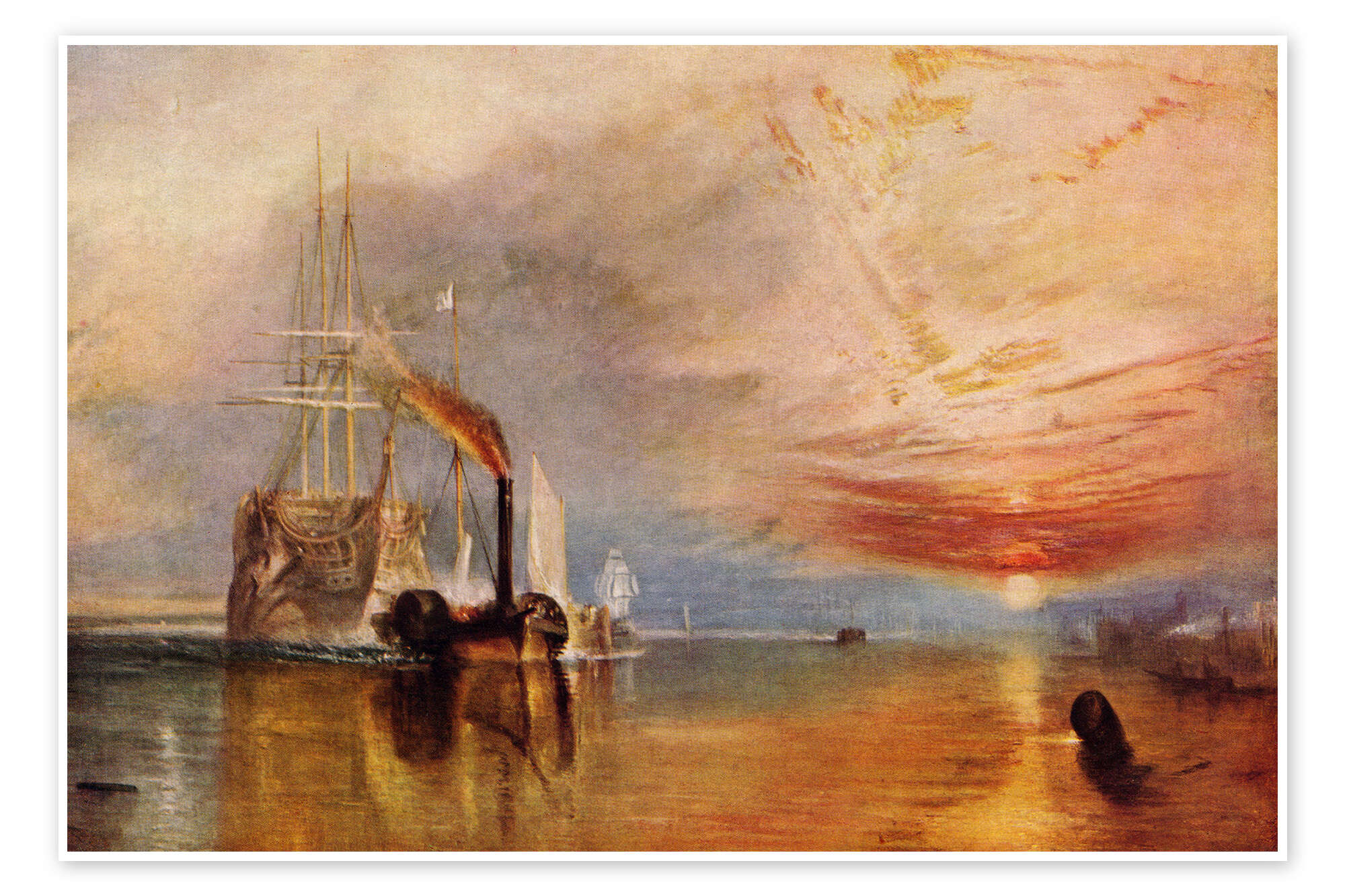
Joseph Mallord William Turner’s The Fighting Temeraire is a masterpiece that profoundly captures the power of the story we tell ourselves—the narrative we author about change, legacy, and the passage of time. From my perspective as Peter de Kuster, this painting is not only a visual spectacle but a poignant meditation on how the stories of our lives shape both ending and beginning.
At the center of Turner’s composition is the majestic HMS Temeraire, a once-proud warship that played a heroic role in the Battle of Trafalgar, now being towed gently toward its final berth to be dismantled. This vessel embodies the story of glory and duty—a narrative firmly held by the generations who served aboard her and by the nation she symbolized. Yet, as the sun sets softly behind, the story shifts from heroic triumph to reflective farewell.
The narrative tension between light and shadow in the painting reflects the stories we tell ourselves about transition. The brilliant orange sun setting on the horizon casts a golden glow, symbolizing honor and legacy, while the muted colors enveloping the aging ship speak to endings and the passage of time. Turner’s portrayal emphasizes that every story carries within it both the triumph of what was and the quiet acceptance of change.
The small steam tug pulling the Temeraire forward introduces the story of progress—how new narratives emerge to carry us beyond the past. This tug represents the future’s call, pulling us from established identities and inviting us into new ones. The story you tell yourself is always a bridge from who you were to who you are becoming.
Turner’s sky, alive with swirling clouds and ethereal light, evokes the intangible realm of memory and hope. It reminds us that our internal narratives are not fixed but dynamic, shifting with emotion and perspective. Like the light playing across water and wood, your story breathes, reflecting the inner landscapes of meaning you navigate.
The Fighting Temeraire tells us that legacy is a story we create—a story that celebrates past deeds while bravely embracing transformation. This is the delicate narrative balance: honoring history without being trapped by it.
In coaching, I use Turner’s painting to illustrate the power of narrative transitions. We all face moments when chapters close—whether in career, relationships, or identity—and the way we frame our story profoundly affects our resilience and response. The Temeraire’s gentle yet resolute voyage to its end reminds us to author these passages with dignity and hope.
The painting’s grandeur and intimacy together teach that the stories we hold most dear shape how we meet change. Whether holding fast to glory or opening to new horizons, the narrative we choose colors our experience and legacy.
Turner’s masterpiece challenges us: What story do you tell yourself about endings? How do you author your passage from what was to what will be? The Temeraire’s noble journey offers a powerful narrative template—one of grace, acceptance, and the courage to move forward.
Ultimately, The Fighting Temeraire is not just about a ship’s final journey but about the eternal human story. It reminds us that the narratives we carry and craft become the timeless vessels through which our lives sail, always toward new dawns.
That is the enduring gift of Turner—showing that the power of your story lies in its ability to honor the past, embrace the present, and envision the future with courage and beauty.
So, you would better examine your story, especially this one that is supposedly the most familiar of all. ‘The most erroneous stories are those we think we know best – and therefore never scrutinize or question’ said paleontologist Stephen Jay Gould. Participate in your story rather than observing it from afar, make sure it is a story that compels you. Tell yourself the right story – the rightness of which only you can really determine, only you can really feel – and the dynamics of your energy change. If you are finally living the story you want, then it need not – it should not and won’t – be an ordinary one. It can and will be extraordinary.
After all you are not just the author of your story but also its main character the hero. Heroes are never ordinary.
In the end your story is not a tragedy. Nor is it a comedy or a romance or a thriller or a drama. It is something else. What label would you give the story of your life, the most important story you will ever tell. To me that sounds like a hero’s journey.
End of story.
PART ONE
Old Stories
If an idiot were to tell you the same story every day for a year, you would end by believing it – Horace Mann
That’s Your Story?
Slow death.
An uglier two-word phrase it’s hard to find. But if you’re at all like the people I see in the Hero’s Journey & Hero’s Journey seminars, then I’m afraid you understand the phrase all too well.
How did it come to this?
What am I doing?
Where am I going?
What do I want?
Is my life working on any meaningful level? Why doesn’t it work better?
Am I right now dying, slowly, for something I’m not willing to die for
Why am I working so hard, moving so fast, feeling so lousy
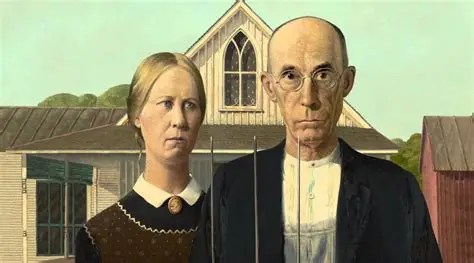
One of the quintessential masterpieces of American painting is Grant Wood’s American Gothic, a powerful visual narrative that delves deeply into the stories we tell ourselves about identity, values, and resilience. From my perspective as Peter de Kuster, this painting becomes a compelling metaphor for the power of your story—the story that defines self-perception and how we project it to the world.
American Gothic presents two stoic figures—a farmer and his daughter—standing resolutely before a simple Gothic-style windowed house. Their expressions are serious, almost stern, evoking narratives of steadfastness, tradition, and endurance. This image is not just a portrait but a story told with economy: “We are the backbone of America—hardworking, honest, unyielding.” Their story forms the foundation upon which personal and national identities are built.
The pitchfork held tightly by the man is a symbol charged with narrative meaning. It is both a tool of labor and a signifier of strength, discipline, and a direct connection to the land. It anchors the story deeply in place and purpose. Here rests a vital lesson: the story you tell yourself about your roots and work shapes your sense of belonging and self-worth.
Wood’s subtle use of light and shadow reveals the tension in these personal mythologies. The clear, sharp outlines convey order and control, yet the complex emotions behind the eyes suggest layers of unspoken narrative—pride mixed with isolation, certainty challenged by change. Your internal stories, too, unfold in such nuanced space, where public persona and private reality intersect.
The setting—the modest farmhouse with its distinctive window—grounds the figures in an environment rich with regional storytelling. It whispers the collective tale of rural America, perseverance amid hardship, and a culture shaped by practical wisdom. Our stories are always embedded in environments that shape and reflect who we are.
The figures’ gaze, fixed directly at the viewer, invites participation and interpretation. They tell their story openly but also challenge us to look beyond surface simplicity. Like American Gothic, your story is a dialogue, inviting others not only to see but to understand, to engage with the complexities beneath.
In coaching, I often reflect on American Gothic as an emblem of the power inherent in owning your story authentically—even if it is simple, stern, or fraught. It encourages honoring the narratives that give you grounding while acknowledging the undercurrents of doubt or aspiration that propel growth.
Wood’s painting teaches that the power of your story is not measured in extravagance but in the integrity and resilience with which you inhabit it. It is the narrative of who you are in your truest work and place.
What story do you hold about yourself? What pitchfork do you grasp firmly? How do you dwell within your narrative of belonging?
American Gothic is a masterpiece of narrative economy—a story told through stillness, gaze, and symbol that resonates deeply across time and culture, reminding us that the stories we tell ourselves craft the very heart of identity.
Your story is your heritage and your legacy. Like Wood’s figures, embody it fully, look boldly, and invite the world to see the strength in your truth.
Slow death: what a harsh phrase. Is that really what is happening to all those people, the ones who start out contended by what is good and pure in life – a simple cup of coffee, a few seemingly reasonable life goals (a nice salary, say, and one’s own home) – and who , once they have achieved those goals, can’t even be satisfied because they’ve already moved on to life’s next-sized latte (six figure salary, second home, three cars) only to move on to something double-extra grand when that’s achieved, a continual supersizing that guarantees one can’t ever be fulfilled?
Okay. Not everyone I see or hear about is dying slowly. But to judge from the responses I get, workshop after workshop, year after year – and each year it gets worse – whatever it is they’re doing sure doesn’t sound fun. It doesn’t even sound like getting by. I read the frustration and disappointment in their self-evaluations and hear it in their own voices, if and when they’re comfortable enough to read aloud from their current dysfunctional story, the autobiographical narrative they attempt to write the first day at the Power of Your Story, but usually don’t finish until the night before our last day together.
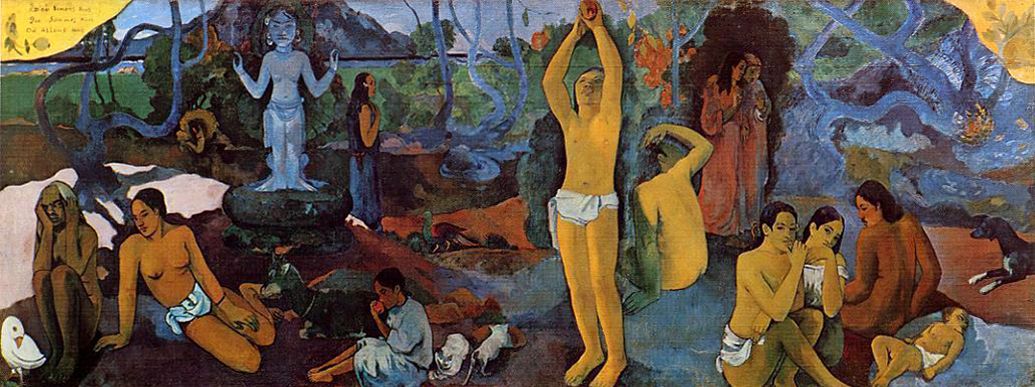
Paul Gauguin’s masterpiece Where Do We Come From? What Are We? Where Are We Going? stands as a profound meditation on the power of the story we tell ourselves—the narrative we craft about identity, existence, and our place in the cosmos. From my perspective as Peter de Kuster, Gauguin’s monumental painting is a visual philosophy, inviting us to reflect on the internal stories that shape life’s meaning and our journey through time.
The composition unfolds as a panoramic allegory of life’s stages—from birth, through maturity, to death—encapsulating the universal human story of becoming. Gauguin structures the painting to guide the viewer’s eye from right to left, inviting a narrative reading where each group of figures represents a chapter in our existential journey. This visual storytelling mirrors the internal narratives we tell ourselves as we seek to understand who we are and why we are here.
The opening, with newborn children and the contemplative white figure, speaks to the mystery of origin—the story we each inherit but must interpret. The central figures embody the fullness of experience—the vitality, the joys, the relationships that color our personal narratives. The final section, somber and reflective, embraces mortality, asking us to confront the inevitable conclusion of all stories.
Gauguin’s use of vibrant colors and symbolic forms transforms the tropical Tahitian landscape into a metaphysical space where personal and collective narratives intertwine. The exotic setting underscores his quest to escape the constraints of Western narrative structures and connect with primal, universal stories. Your internal narrative, too, can break free from limiting scripts and access deeper, more authentic truths.
The mysterious golden idol near the center serves as a silent witness and question mark—“What force presides over our story? What spiritual meaning do we seek?” Gauguin reminds us that much of our internal storytelling grapples with unseen forces, faith, and the search for transcendence.
Throughout, figures engage in gestures and postures filled with narrative tension—reflection, questioning, nurturing, despair—evoking the emotional texture of lived stories. This complexity emphasizes that your story is not linear or simple but layered, emotional, and richly human.
In coaching, I often draw upon Where Do We Come From? to help clients hold the big questions their internal narratives address—the quests for identity, purpose, and legacy that motivate transformation and meaning-making.
Gauguin’s masterpiece invites us to own our stories not just as chronological events but as profound narrative arcs stretching beyond ourselves, connecting personal destiny to cosmic rhythms.
It teaches that the power of your story lies in embracing life’s stages with curiosity and courage—from innocence through growth to acceptance—authoring meaning even amid mystery and uncertainty.
Standing before this vast canvas, I hear Gauguin’s call: tell your story fully, consciously, and boldly—your narrative may be the bridge between where you came from, who you are, and where you are going.
That is the timeless power of your story—the story that shapes existence, gives life its deepest meaning, and makes each journey sacred.
As the Power of Your Story seminar progresses and people’s defenses start to melt away, I hear more and more of these stories. By almost any reasonable standard, these stories exemplify failure; in many cases, disaster. There is no joy to be found in them, and even precious little forward movement. In every workshop, nearly everyone has a dysfunctional story that is not working in at least one important part of his or her life: stories about how they do not interact often or well with their families; about how unfulfilling the other significant relationships in their lives are; about how – despite all that extracurricular failure – they’re not even performing particularly well at work, or, if they are, about how little pleasure they gain from it; about how they don’t feel very good physically and their energy is depleted.
On top of all that (isn’t that enough?), they feel guilty about their predicaments.They know, on some almost buried level, that their life is in crisis and the crisis will not simply go away. Their company is not going to make it go away. And so they wake up one morning to the realization that the bad story they for so long only feared has finally become their life, their story. Not that this development is their fault. No. Nor is there a heck of a lot to be done about it.
It is a competitive, cutthroat world out there
God knows, I want to change but I simply can’t. I’ll get eaten up and beaten by someone who’s willing to sacrifice everything.
The world moves faster today than it did a generation ago
What am I supposed to do – quit my job?
These are the facts of my life. There’s nothing I can do about them.
My life is a known quantity; so why mess with it even if it’s killing me?
Let me repeat that one: …… even if it’s killing me.
People don’t need new facts – they need a new story.
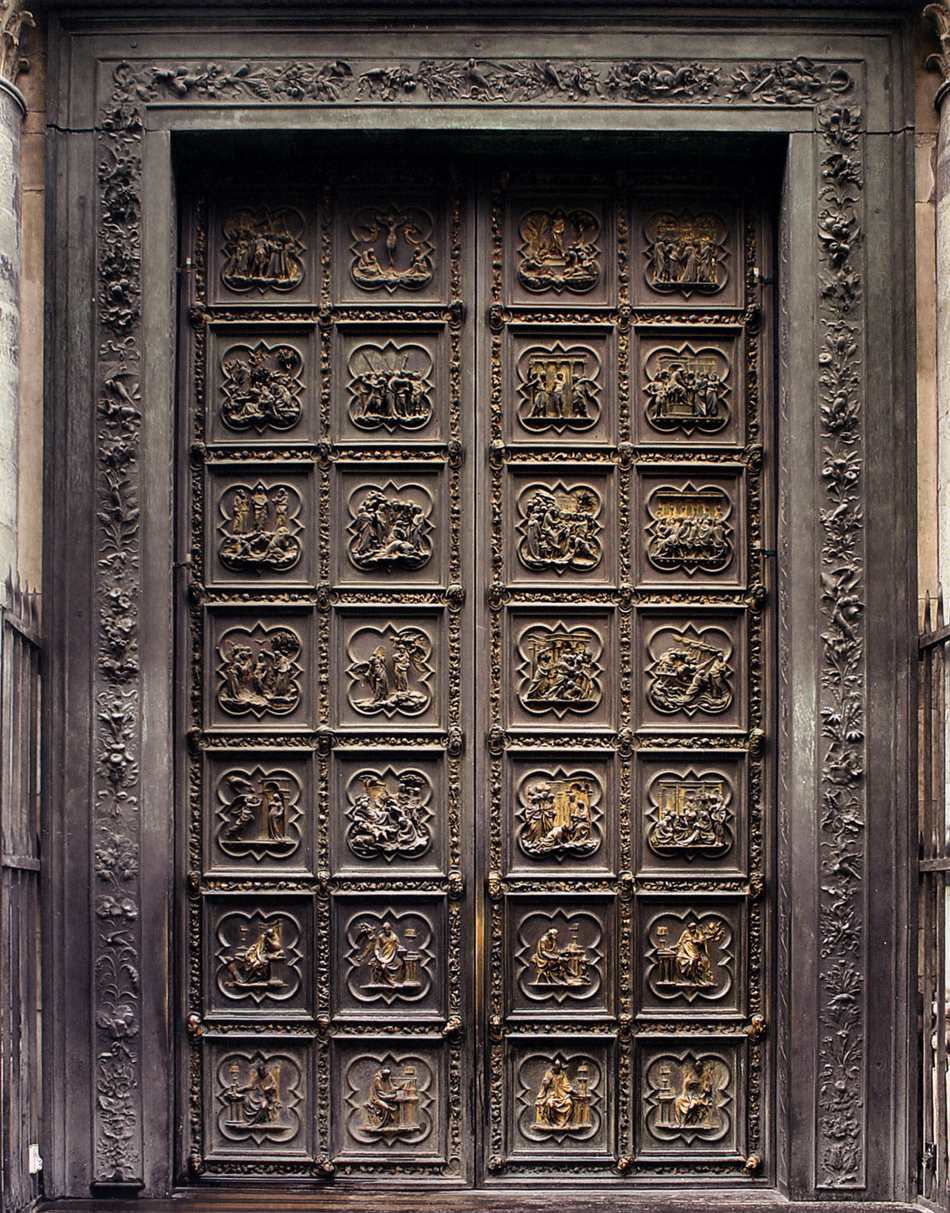
Lorenzo Ghiberti’s Doors of the Baptistery in Florence, famously known as the “Gates of Paradise,” tell a transcendent story about vision, mastery, and the power of storytelling through art that shapes faith, identity, and legacy. These bronze doors are more than ornate architectural features; they embody Ghiberti’s narrative of persistence, innovation, and the ability to craft a story that connects humanity to the divine. Behind every panel lies his profound understanding of the power of the story we tell ourselves—that through creative dedication, one can transform raw material into gateways of meaning and inspiration.
Ghiberti won the commission for these doors in a competitive contest in 1401, a pivotal moment that launched his reputation as a master sculptor. His story at this juncture is one of determination and confidence in his skills and vision, overcoming rivals and skepticism. He told himself a story of patience and refinement, investing decades meticulously shaping each panel with techniques that elevated bronze relief to unprecedented levels of detail and narrative clarity. His doors were not simply functional; they were storytelling epics in metal, depicting biblical scenes that invited viewers into a deeper reflection on faith and human destiny.
The panels of the “Gates of Paradise” represent key moments from the Old Testament, rendered with a clarity and depth of perspective that were revolutionary for their time. What distinguishes Ghiberti’s work is how he united technical innovation with expressive storytelling. His mastery of linear perspective and relief sculpting created an almost cinematic sequence of events, inviting onlookers to immerse themselves in sacred stories not as distant tales but as living narratives that shape their self-understanding and relationship with the divine. Ghiberti told a story of connection: that art, through the artist’s vision, bridges earthly experience with spiritual truth.
This work reflects the broader Renaissance ideal that humans are not passive recipients of divine will but active creators of meaning and beauty. Ghiberti’s story is about craftsmanship as a form of intellectual and spiritual engagement. His doors demonstrate how the narratives we wield—about faith, purpose, and artistry—are forces for transformation. They teach that the power of your story lies in creating meaning that transcends time and medium, opening doors to new possibilities for yourself and others.
Ghiberti’s “Gates of Paradise” become a metaphor for the power each person has to craft their own legacy. Just as he shaped bronze into scenes that narrate humanity’s oldest spiritual stories, so too can we shape our lives through the stories we tell ourselves. His epic doors stand as a testament to the transformative potential of vision, patience, and masterful storytelling—the power to turn ambition and skill into creations that endure as portals to deeper understanding and inspiration across generations.
Through these magnificent doors, the story of creative mastery and the power of narrative unfolds—affirming that what we tell ourselves about our abilities and our purpose is the key to opening the gates to our own greatness and to the legacy we leave behind.
Is Your Company Even Trying to Tell a Story?
We’ve examined the corporate story the worker hears. Let’s see what story the company is typically telling.
First they need you and you need them. (Ideally, they also want you and you also want them, but that may not be part of your company’s story). The typical company is saying that the fast-paced business world being what it is – what with globalization and outsourcing and downsizing and sustainability and AI and synergies and streamlining – it must make increasing demands on your life. Keep swimming or die. Which means longer hours for you, ergo less time for your family and yourself. It means holding meetings during lunch or before or after the workday proper, which essentially kills your chance to exercise and stay in shape. (and let’s just order in any food that’s fast during meetings to maximize efficiency). Oh, right: and while all this is going on, the company – continually stressing its imperative to move forward if it is to survive at all – also demands that you frequently change directions, reinvent the very way you operate, completely alter how you conduct business.
Everyone who likes that story, raise your hand.
Older workers, in particular – those who have seen it all before – are likely to undermine the story for such a company. So, too, anyone else who fears that he or she may be easy to eliminate, or may have a diminished role in the transformed company. To these employees the story their company is telling may be exciting in the abstract, or to investors, but it’s potentially humiliating for them. Among these workers, suspicion, cynicism and distrust run rampant. While the defiant worker publicly may appear vested in the change process, privately he tells himself: New thinking be damned. He works subversively to undermine the new directive. He knows that, for the new initiatives to take, everyone must embrace them. Not him. He will go through the motions but he is not going to make any real course corrections.
And so, like a dinosaur, he moves closer and closer to extinction.
The employee loses and the company loses as well. Entire organizations have been undermined by storytelling that excludes a significant portion of their workforce. Failure to align the evolving corporate story with the aspirations of the individual employees, up and down the workforce – the very ones who have been enjoined to help write that new, improved story – has systemic implications. Athletes routinely give up on playing hard for coaches they deem excessively punitive or inconsistent; the bond of their mutually aligned stories – to win a championship – is undermined because the coach’s story does not seem to allow for the inevitable particularities of any individual athlete’s story. Mutiny is not just what happens when ship captains indefensibly change or robotically stick to the rules but also when CEO’s and schoolteachers do it. Organizations have been undermined by refusing to alter their story when it clearly wasn’t working.
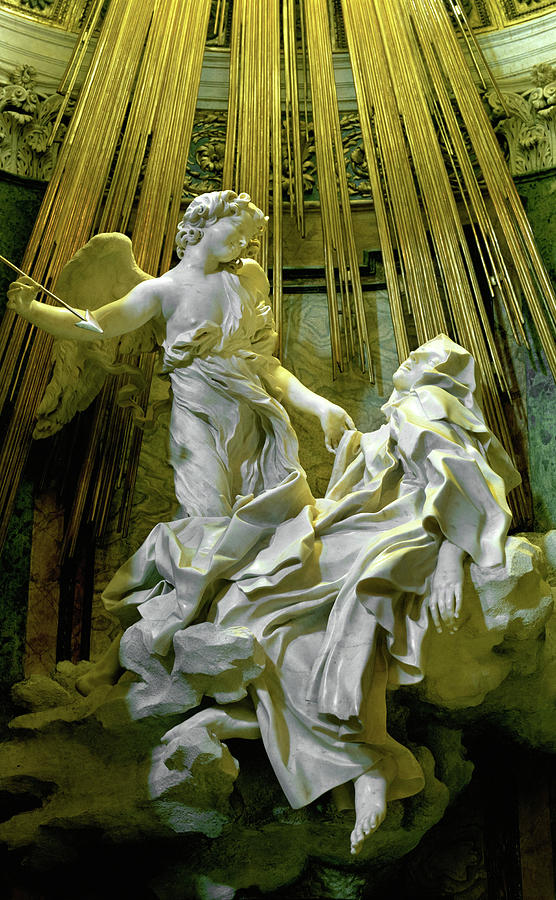
Gian Lorenzo Bernini’s masterpiece The Ecstasy of Saint Teresa in the Cornaro Chapel of Santa Maria della Vittoria in Rome is a profound narrative about the power of transcendence, passion, and the intimate connection between the earthly and the divine. This sculpture does more than capture a mystical religious experience; it conveys the story Bernini told himself about the transformative power of emotion, spirituality, and artistic genius. His work invites viewers to reflect on the power of the story we carry about our capacity to transcend suffering and awaken to profound beauty and spiritual ecstasy.
Created in the mid-17th century, The Ecstasy of Saint Teresa portrays the moment Saint Teresa of Ávila described in her autobiography when an angel pierced her heart with a divine arrow, filling her with an overwhelming spiritual love that was both painful and blissful. Bernini’s story as an artist was one of merging physical form with emotional intensity—he masterfully captured this supernatural moment with exquisite detail and motion, transforming marble into flesh and passion. His narrative was about capturing life’s divine mysteries in tangible form, telling himself that art could make the invisible spirit visible and accessible to all.
Bernini’s genius was rooted in his ability to blur the boundaries between sculpture and theatre. He created a dynamic environment where light, architecture, and sculpture converged to immerse viewers in religious drama, making the story of Saint Teresa’s mystical experience a shared, living moment. This theatricality reflects his belief that art is a powerful vehicle for storytelling—not simply through words but through sensation and emotion, awakening viewers’ own spiritual stories and aspirations. Bernini’s narrative emphasizes that our stories are not just internal monologues but transformative performances that shape how others perceive us and how we connect with something greater.
The Ecstasy of Saint Teresa is also a story about vulnerability and openness—the courage to surrender to transformative experiences despite their intensity. Bernini’s Saint Teresa is both radiant and exposed, inviting viewers to embrace their own vulnerabilities as paths to transcendence and enlightenment. Like the saint, the sculptor told himself a story of faith and dedication, overcoming personal and artistic challenges to create a masterpiece that speaks to the timeless power of spiritual awakening.
Ultimately, Bernini’s sculpture reveals the power of your story as one of emotional depth, transformation, and creative courage. It shows that the narratives about your inner life, passion, and spiritual quest have the power to elevate your existence and inspire others. Through The Ecstasy of Saint Teresa, the artist’s triumph is clear: by embracing the fullness of human experience—pain, joy, and ecstasy alike—one crafts a lasting story that moves hearts and defines legacies across time and space.
If alignment of stories, yours and your company’s, is to be achieved – and I believe it’s neither as lofty nor as complicated a task as it may sound – then it is ideally generated both from top down (the company side) and bottom up (the workers side). But let’s not get carried away. For our purposes, we’ll presume zero input form the company. It is, after all, corporate culture.
That means the burden to change stories is on you.
Presenteeism
What if the most important adventure of your working life was not about the projects you complete, the titles you hold, or even the outcomes you deliver—but about the story you tell yourself? What if the office, with its familiar routines and relentless pace, is both your crossroads and your call to adventure?
Those who know me understand I see life and work as journeys—epic quests each of us must undertake. Every working person is a hero in the making. And every workplace challenge is a shadowy threshold, begging us to re-examine the story we live by—and the roles we choose.
In my journeys with creative professionals, entrepreneurs, leaders, and artists worldwide, I notice a repeating theme: too many of us are living by default stories, not the ones we would choose if we remembered we had the pen in our hand. Even the most ambitious, purpose-driven individuals fall prey to this trap.
We tell ourselves stories like:
- “I am valuable because I am always here.”
- “If I slow down or admit I’m struggling, I’ll be replaced.”
- “To be a hero is to put others before myself, no matter the cost.”
These are powerful myths, but not always true or empowering for the modern workplace hero. They lead us straight to the quicksand of presenteeism, where showing up becomes a prison, not a purposeful journey.
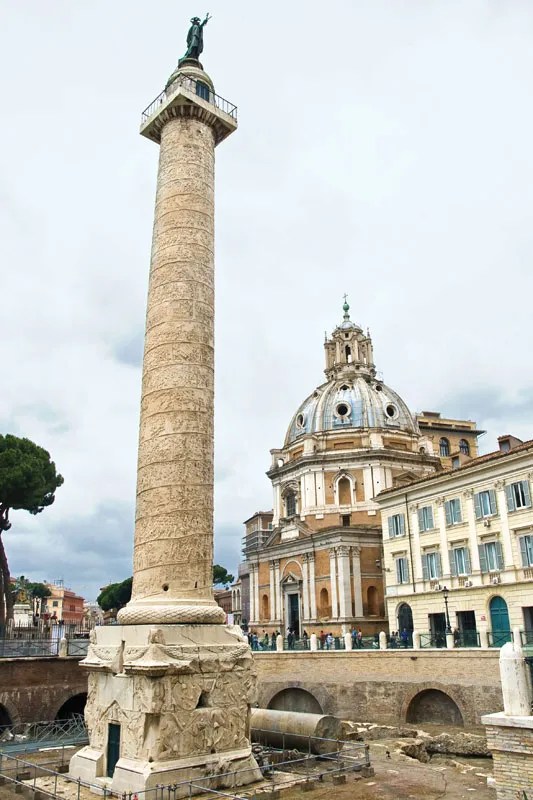
The Column of Trajan in Rome embodies a monumental story of victory, legacy, and the telling of power through enduring narrative. This towering spiral column, erected in the early 2nd century AD to commemorate Emperor Trajan’s conquest in the Dacian Wars, tells a story not just of military success but of how the emperor—and the empire—chose to narrate their identity and authority for generations to come. The column is an ancient testament to the power of the story we tell ourselves and others about who we are, what we have achieved, and how we want to be remembered.
Trajan’s column is remarkable for its continuous spiral relief that winds upwards over 200 meters, depicting in exquisite detail the campaigns and battles of the Roman army. This narrative relief is a visual biography that celebrates Roman discipline, strategy, and the emperor’s leadership. The story carved into stone reveals how Trajan and the Romans constructed a tale of heroic conquest and imperial destiny, carefully selecting which moments to highlight and how to portray them. This was not merely propaganda but a deep expression of identity—the story of triumph through courage, organization, and divine favor.
The column also reflects the power of visual storytelling in shaping collective memory. Each scene carved into the marble invites the viewer to ascend mentally through the campaign, conveying a sequence of challenges faced, battles won, and the steadfastness of the Roman spirit. The emperor himself appears multiple times, often in commanding poses, a symbol of central authority guiding a complex, multifaceted story to its victorious conclusion. This narrative choice underscored the belief that power is both personal and communal—an achievement of one who leads and the many who follow.
More broadly, the Column of Trajan is a story about legacy and the human desire to make the fleeting moment eternal. By immortalizing the story of conquest in stone, Trajan’s narrative affirms how we shape our legacy through the stories we leave behind. The column’s endurance across centuries reminds us that the stories told about ourselves can endure, inspiring generations long after the events themselves have passed. It invites reflection on what story you are weaving about your own life’s victories, struggles, and purpose.
In this ancient monument, the power of your story is made manifest: it is the narrative that elevates individual and collective deeds to timeless significance, the story that transforms history into legend. The Column of Trajan stands not only as a record of an emperor’s achievements but as an inspiring example of how the stories you tell about yourself forge identity, influence others, and echo across time as a monument to your own journey.
The First Threshold: Awakening to the Call
Every hero’s journey begins with a call to adventure—a crisis that shakes up the old world and offers a chance, however frightening, for transformation. Presenteeism is this crisis. What if you saw your own disengagement or declining health not as a personal failing, but as a summons? A moment to examine the story you’re living.
Are you actually answering your call, or are you stuck reliving someone else’s tired script?
Pause for a moment at your desk. Close your eyes. Ask: What is the true story I’m living here? Am I the weary warrior constantly pressing on, or the resourceful hero who knows when to rest, renew, and return with deeper gifts?
Allies and Mentors: The Importance of Leaders, Teams, and Self-Compassion
No hero travels alone. In epic tales and in real life, allies and mentors make all the difference. The modern workplace often pushes us into isolation—presenteeism thrives when we are most disconnected, convinced we are in this alone. But what if your story included allies?
Allies can be:
- A leader who models vulnerability and honesty about limits
- A team that values open conversation, not just relentless performance
- A workplace culture that considers well-being non-negotiable
Or, perhaps most importantly, an inner mentor: your wiser self who reminds you that even heroes need healing. When we share our struggles honestly, we invite others to do the same; we rewrite a culture of silent suffering into one of shared humanity.

Charles Barry’s design of the Palace of Westminster, commonly known as the Houses of Parliament in London, is a story carved in stone and spirit about resilience, national identity, and the power of architecture to embody collective values and governance. Rebuilt after a devastating fire in 1834, Barry’s masterpiece is much more than a government building; it is a narrative about the power of renewal, the story a nation tells itself about its democracy, tradition, and the endurance of its institutions.
Barry’s vision for the new Houses of Parliament was realized through a blend of Gothic Revival architecture, intended to evoke continuity with England’s medieval past while symbolizing modern governance and democratic ideals. This was a deliberate story that Barry and his collaborators told themselves and the public—one that connected history with progress, combining grandeur with functionality. The intricate details, towering spires, and the enduring symbolism of Big Ben reflect a story of national pride and the steadfast values of law, debate, and civic responsibility. This story speaks to the power of architecture as a physical manifestation of a collective identity and evolving political narrative.
The rebuilding of the Palace of Westminster itself is a story of transformation and resilience. After the fire, the nation faced the challenge of reclaiming and reshaping a central symbol of power. Barry’s story was about harnessing creativity and architectural mastery to build anew from destruction, reiterating themes of rebirth and a future oriented to stability and governance. The design’s grandeur and complexity communicate a narrative of strength—how societies rebuild stronger institutions and laws through shared commitment to governance and tradition.
Barry’s Houses of Parliament invite reflection on the stories nations and individuals tell themselves about order, authority, and the spaces where power lives. The building’s fusion of old and new, tradition and innovation, stands as a metaphor for our own internal stories about balancing heritage with progress, continuity with change. The architecture itself becomes a storyteller, narrating values and aspirations that transcend generations, a daily reminder that stories shape how we govern ourselves and envision our collective futures.
In the Palace of Westminster, the power of your story is visible: just as Barry’s architecture tells a narrative of resilience, governance, and identity, so too can your story of rebuilding, renewal, and purpose create structures—literal or symbolic—that endure and inspire. The building is a monumental expression of how stories told and lived shape not only spaces and societies but the very legacy you leave behind for those who follow.
Crossing Into the Unknown: Changing the Story from Within
The core message of the hero’s journey is this: Transformation is possible. Not by fleeing our struggles or pretending they don’t exist, but by facing them honestly and letting them change us.
Presenteeism, at heart, is a warning flag. It signals a misalignment: between your body and your story, your willingness and your capacity, your presence and your true purpose. To change this, you do not need a grand gesture—just a willingness to edit the script:
- Instead of “I must always be present,” try: “My best work comes from knowing when to engage and when to replenish.”
- Instead of “Heroes never falter,” try: “True heroism is knowing my limits and helping others respect theirs.”
This is not self-indulgence. Research shows that places prioritizing well-being see higher productivity, lower turnover, and more vibrant, creative workplaces. Your organization benefits when its people are truly present.
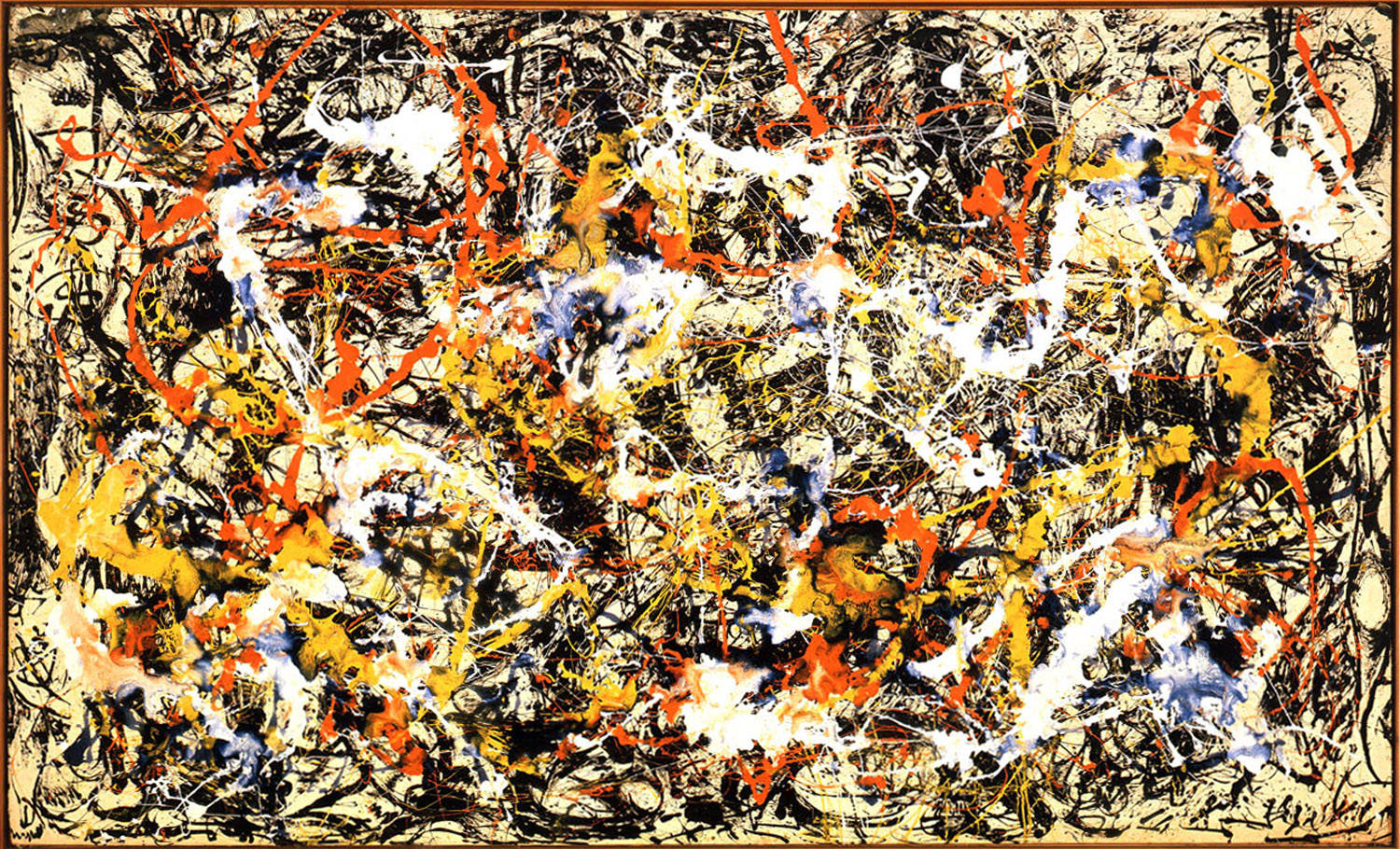
Jackson Pollock’s Convergence is a powerful narrative of chaos, control, and self-expression that reveals the story the artist told himself about freedom, identity, and the creative process. This iconic abstract expressionist painting, created in 1952, goes beyond conventional forms to capture the dynamic interplay between unconscious impulse and deliberate action. Pollock’s work is a visual manifesto about the power of the story we tell ourselves regarding our inner life—the embrace of complexity, tension, and the courage to reveal our authentic selves without restraint.
Convergence explodes with color, energy, and layered drips and splatters that seem both accidental and meticulously orchestrated. Pollock’s story is one of breaking away from traditional representation to find a new language that mirrors the chaos and vitality of modern existence. In his technique of “drip painting,” he tells a narrative of fluidity and spontaneity, where the artist’s movements and emotions are captured directly on canvas. This method reflects a story of liberation—rejecting control imposed by societal expectations and instead embracing the raw, unpredictable forces within.
At its core, Convergence is about the tension between chaos and order. The painting appears wild and untamed, yet its composition holds a hidden balance. This mirrors the story Pollock told himself: that creativity emerges from embracing contradictions and channeling seemingly random impulses into a coherent, powerful whole. His story emphasizes that the journey to self-understanding and artistic expression is not linear but a convergence of diverse influences, emotions, and moments of clarity.
Pollock’s work invites viewers to consider their own stories: How do we balance disorder and control? How do we express our authentic selves amid internal and external conflicts? Convergence acts as a visual metaphor for the artistic and personal struggle to synthesize meaning from chaos. Through his painting, Pollock communicates that the power of your story lies in embracing complexity, allowing yourself to flow and evolve without fear of losing coherence or identity.
Ultimately, Convergence reflects a modern heroic narrative—not of conquering external foes, but of mastering the self, daring to reveal inner truths through bold, unfiltered expression. The painting is a testament to the power of storytelling as a form of radical freedom, where the artist—and by extension, each of us—can claim identity through creative acts that converge chaos, passion, and vision into something uniquely meaningful and transformative.
Trials and Temptations: The Lure of Busyness and the Fear of Absence
No journey is without its temptations. In the world of work, “busyness” and “constantly being seen” are seductive false gods. We look for validation by logging long hours, replying to emails at midnight, never daring to say “I need a break.” This is presenteeism in its purest form.
But every story has a turning point—a moment when the hero sees through the illusion and claims a deeper power. What if you challenged the myth that visibility equals value? What if leadership meant championing cycles of exertion and renewal—for yourself and those you lead?

Edvard Munch’s The Scream is a haunting narrative of existential anxiety, inner turmoil, and the power of emotional honesty. This iconic symbol of modern art communicates the story Munch told himself about the profound human experience of fear, vulnerability, and isolation. Far beyond a simple depiction of anguish, The Scream embodies the power of the story we carry about our emotional reality, the moments when the outer world feels overwhelming and the inner voice cries out in despair and longing for meaning.
Painted in 1893, The Scream captures a figure on a bridge, hands pressed to its face, mouth open as if releasing a piercing cry that reverberates through a swirling, turbulent sky. Munch’s story behind the work was deeply personal—he experienced intense episodes of anxiety and emotional crisis, and he channeled these into a universal story about the human condition. This painting told a story of vulnerability and the courage to face and express overwhelming emotions, breaking through cultural taboos around mental and emotional struggle.
The swirling colors and distorted forms echo the figure’s psychological state, suggesting that the turmoil is not just internal but reflected in the world itself. Munch’s story is one of interconnectedness between self and environment—how external chaos can intensify inner dread, yet also how emotional truth has the power to transform perception. By portraying such raw distress, he invited viewers to confront their own fears and anxieties, recognizing that these feelings are part of the human narrative.
The Scream challenges us to consider the stories we tell ourselves when facing fear and isolation. Instead of hiding or denying these emotions, Munch’s work encourages acknowledgment and expression as a pathway to deeper understanding and healing. His narrative reminds us that the power of our story lies in its authenticity—the willingness to voice pain and vulnerability as essential parts of life’s journey.
Ultimately, Munch’s The Scream is a compelling narrative of emotional authenticity and the human struggle with existence. It illustrates how the stories of anguish and fear, when honestly faced and expressed, resonate deeply and create a shared understanding of what it means to be human. This painting stands as a powerful testament to the enduring impact of telling our true story, no matter how difficult, and the catharsis and connection that honesty can bring.
The Return: Sharing the Boon
The final stage of the hero’s journey is the return—the bringing back of newfound wisdom to the tribe. If you can transform your story around presence at work, you bring back a gift that can transform the culture around you.
This might look like:
- Leading discussions on workplace health and well-being
- Creating or supporting initiatives for flexible work and mental health support
- Building teams where checking in on someone’s state of being is as normal as checking their to-do list

Vincent van Gogh’s Starry Night is a luminous narrative of inner turmoil, hope, and the inexhaustible power of perception and imagination. This masterpiece transcends its depiction of a nocturnal village scene to reveal the story Van Gogh told himself about grappling with mental anguish while reaching towards beauty, meaning, and spiritual transcendence. The painting embodies the power of the story we carry about resilience, the quest for light in darkness, and the transformative nature of seeing the world anew.
Painted in 1889 during Van Gogh’s stay at the Saint-Paul-de-Mausole asylum in Saint-Rémy, Starry Night is a swirling symphony of vibrant blues, yellows, and whites that convey intense emotion and movement. Van Gogh’s story was one of struggle intertwined with creativity—the act of painting became his lifeline, a way to make sense of the chaos within. Rather than surrendering to despair, he told himself a narrative of hope and persistence, channeling his emotional storms into the vivid, swirling sky that dominates the canvas. It is both a personal and universal story of reaching beyond suffering towards light.
The bold, swirling patterns of stars and sky contrast with the quiet village below, symbolizing the dynamic tension between the cosmos and humanity, chaos and order, turmoil and peace. Van Gogh’s painting invites viewers to consider the stories they tell themselves about their own struggles and aspirations. It suggests that even in the darkest moments, there is a capacity to create and to find profound beauty, reminding us of the power of perspective and the inner light that guides us.
Van Gogh’s narrative in Starry Night is also one of transformation—how pain and sensitivity, when embraced fully, can fuel creativity and connection. The painting is a testament to the role of art as a vessel for emotional expression and healing, embodying the power of your story to turn suffering into something meaningful and lasting. Van Gogh’s belief in the healing potential of art and the value of honest self-expression echoes through every brushstroke.
Ultimately, Starry Night is a radiant portrayal of human resilience and the power of imagination. Through Van Gogh’s story, the painting teaches that the narratives we carry about ourselves—particularly those about adversity and hope—shape not only how we endure but how we transform our experience into something breathtaking and eternal. It is a masterpiece of light emerging from darkness, a story of the enduring spirit illuminated by the power of your own story.
You return, not depleted but richer, with a boon to share: the realization that the true power of presence is quality, not quantity. One engaged hour, one honest conversation, one real act of self-care can be worth days spent pretending.
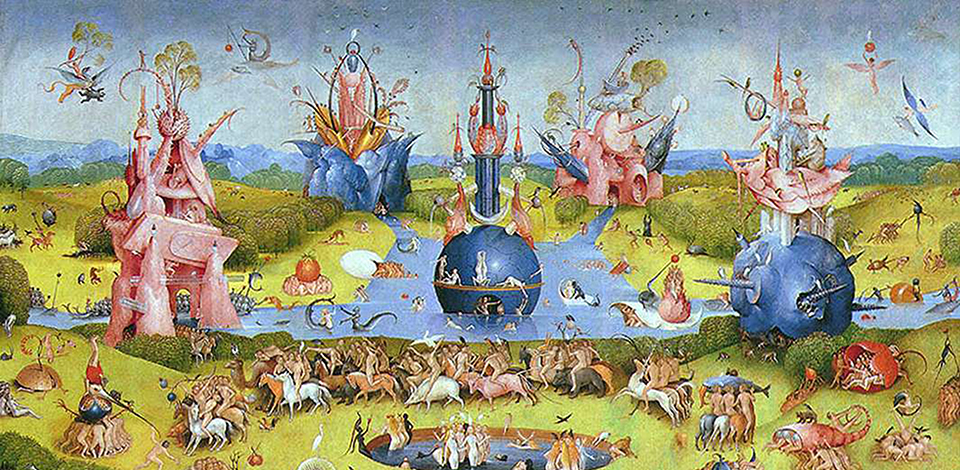
Hieronymus Bosch’s The Garden of Earthly Delights is a vivid, complex narrative exploring the story of human desire, morality, and the consequences of the choices we make. This triptych transcends simple religious illustration to reveal the story Bosch told himself about humanity’s struggle between innocence, temptation, and judgment. Through fantastical imagery and surreal scenes, Bosch invites viewers into the power of the story we tell ourselves about our nature, our flaws, and the ultimate effect of our actions upon our fate.
Created around the turn of the 16th century, The Garden of Earthly Delights depicts a panoramic narrative woven across three panels—the left portraying the innocence of Eden, the central flooded world of human pleasure and sin, and the right revealing the torments of Hell. Bosch’s story was one of caution and reflection, telling himself and the viewer that the human journey is fraught with temptation and peril, but one deeply entwined with freedom and choice. The painting’s surreal and often nightmarish imagery makes tangible the inner moral and spiritual battles that shape individual and collective destinies.
The intricate detail and imaginative figures throughout the panels mirror the complexity of the human psyche—our desires, fears, and irrationalities. Bosch’s narrative style shows that the stories we tell ourselves are not always simple or linear but can be filled with contradictions, paradoxes, and startling revelations. The work’s ambiguity appeals to each viewer’s interpretation, emphasizing that self-awareness and critical reflection are vital to the story we live. It challenges us to see our lives and choices as part of a larger cosmic and moral story.
Bosch’s masterpiece also reveals the power of storytelling to evoke empathy, contemplation, and transformation. By portraying humanity’s delights alongside its deepest horrors, Bosch tells a cautionary story about balance, self-knowledge, and the consequences of straying from virtue. The narrative power of The Garden of Earthly Delights encourages confronting the complexity of our nature and the stories behind our actions, inviting a deeper understanding of self and society.
Ultimately, The Garden of Earthly Delights is a masterwork of moral and spiritual storytelling that speaks directly to the power of your story about desires, choices, and consequences. It serves as a monumental reminder that the narratives we live by shape the world we inhabit and the legacy we leave behind, urging us to engage consciously with the story of who we are and who we aspire to become.
Writing Your Next Chapter
Let me ask you, as you read this: What would it mean to become the hero of your own workplace story? To notice, name, and gently edit the scripts that lead you to presenteeism?
If you see yourself in these words, you’re not alone. Millions experience this struggle daily, and its impacts are enormous—not just financially but emotionally, socially, and creatively for ourselves and our organizations. But you have the power to change your story, to step onto a new path.
Start by asking:
- What am I really seeking in my work?
- What stories about value, effort, and worth am I living by—and are they serving me?
- Where might I invite more honesty, more compassion, more allyship?
The future of work—and the future of your own hero’s journey—depends on the stories we choose. May yours be one of presence, purpose, and authentic creative transformation.
The Hidden Costs of Presenteeism: Why Organizations Pay a High Price for a Poor Story
In every organization, there is a visible ledger: bottom lines, turnover numbers, and absentee days. But lurking beneath that surface, unnoticed, is a silent leviathan gnawing at profits, morale, and growth: presenteeism. In my work on “The Hero’s Journey,” I remind leaders that the real tale of any organization is not just about presence—it’s about meaningful engagement, energy, and stories that fuel innovation. Presenteeism is what happens when people show up, but leave their passion, focus, or wellbeing at home.
The cost? More than you might imagine—and far greater than the mere sum of sick days or missed meetings.
Albrecht Dürer’s Melencolia I is a profound visual narrative about creativity, intellectual pursuit, and the story Dürer told himself about the struggle for artistic and scientific mastery amid human limitation. This enigmatic engraving from 1514 transcends a mere depiction of melancholy to explore the internal conflict of the genius—a story of frustration, contemplation, and the relentless quest to understand and shape the world. Through intricate symbolism and masterful technique, Melencolia I reveals the power of the story we tell ourselves about our own creative potential and the challenges that accompany it.
The central figure, a winged woman resting her head on her hand, embodies the artist or intellectual consumed by the weight of inspiration and the limits of human knowledge. Surrounding her are tools of measurement, geometry, and construction, alluding to the Renaissance drive to decode nature through science and art. Dürer’s story emphasizes the tension between aspiration and frustration—the inspiring but often maddening pursuit of new ideas and creations that sometimes seem just beyond reach.
Melencolia I also speaks to the Renaissance humanist ideal that the power of the mind and spirit can unlock mysteries and achieve greatness, even while recognizing the melancholy and doubt inherent in this striving. The engraving’s detailed imagery—a magic square, a mysterious polyhedron, a bat holding a banner inscribed with the title—invites viewers to reflect on their own inner narratives about creativity, intellect, and the balance between action and contemplation.
Dürer’s narrative is not just about the artist’s personal struggles but also a meditation on the universal human condition. It teaches the power of your story lies in embracing complexity and ambiguity, acknowledging moments of doubt and stillness as vital parts of progress. By exposing both the burdens and the potential of creative greatness, Melencolia I encourages courage in the face of uncertainty and the conviction to continue despite obstacles.
Ultimately, Melencolia I stands as a timeless testament to the heroic narrative of the creative spirit—one that balances brilliance with vulnerability and questioning with resolve. Through this masterpiece, Dürer conveys that the stories we tell ourselves about our intellect, creativity, and perseverance define not only our achievements but our very humanity, inspiring us to pursue meaning and mastery regardless of the challenges we encounter.
Old Stories
With relatively few variations, heroes and heroines tell stories about basically five major subjects.
- Business
- Family
- Health
- Friendships
- Happiness
By asking yourself basic questions about how you feel about what you do and how you conduct yourself – and by trying honestly to answer them, of course – you begin to identify the dynamics of your story.

Paul Cézanne’s Mont Sainte-Victoire series is a transformative narrative about perception, persistence, and the story Cézanne told himself about breaking conventions to forge a new vision of reality. This landscape painting transcends the simple portrayal of a mountain in Provence to embody the artist’s lifelong pursuit of artistic honesty and the power of seeing the world in his own unique way. Through careful brushstrokes and shifting perspectives, Cézanne reveals the power of the story we tell ourselves about innovation, dedication, and the quest to capture the essence beneath appearances.
Painted multiple times in the late 19th and early 20th centuries, Mont Sainte-Victoire reflects Cézanne’s determination to challenge traditional landscape painting. His story was one of patient exploration—layering colors and geometric shapes to create depth and structure without relying on illusionistic realism. In this, he told himself a narrative about the integrity of perception, insisting that the artist’s vision must be true to both the landscape and to the artist’s own way of seeing. This was a story of persistence and belief in the transformative power of form and color.
Cézanne’s treatment of the mountain and surrounding landscape is methodical yet evocative, portraying nature as a balance of order and fluidity. This duality mirrors the story he crafted about life itself: complex and multifaceted, not easily defined by single viewpoints but understood through multiple layers and interpretations. His work invites viewers to reconsider their own stories about perception and truth—how the narratives we construct shape not only how we see the world but also how we engage with its complexity.
The Mont Sainte-Victoire series embodies the power of art as a tool for reflection and reinvention, emphasizing that the story of your creative and perceptual journey is one marked by continuous discovery and transformation. Cézanne’s narrative is a testament to the idea that innovation arises from deliberate effort and the courage to see beyond convention, crafting a personal truth that resonates universally.
Ultimately, Cézanne’s masterpiece teaches us that the stories we tell ourselves about persistence, vision, and reinterpretation have the power to reshape reality itself. Through Mont Sainte-Victoire, he communicates that the creative process is an evolving narrative—a convergence of observation, imagination, and conviction that defines both the artist’s legacy and each individual’s capacity to reimagine their own story.
Your Story around Work
You have a story to tell about your passion for your work and what it means for you. And because more than half our waking life is consumed by working at your business, how we frame this story is critical to our chance for passion and happiness.
How do you characterize your relationship to your work? Is it a burden or a joy? Deep fulfillment or an addiction? What compels you to get up every day and go to work? The money? Is the driving force increased prestige, power, social status? A sense of intrinsic fulfillment? The contribution you are making? Is it an end in itself or a means to something else? Do you feel forced to work or called to work? Are you completely engaged at work? How much of your talent and skill are fully ignited?
What is the dominant tone of your story – inspired? challenged? disappointed? trapped? overwhelmed?
Does the story you currently tell about work take you where you want to go in life? If your story about work is not working, what story do you tell yourself to justify it, especially given the tens of thousands of hours it consumes?
Suppose you did not need the money: Would you continue to go to work every day? Write down five things about working at your business that, if money were no issue, you would like to continue.
- _____________________________________________________
- _____________________________________________________
- _____________________________________________________
- _____________________________________________________
- _____________________________________________________

Henri de Toulouse-Lautrec’s At the Moulin Rouge is a vivid narrative of nightlife, human complexity, and the story Toulouse-Lautrec told himself about observation, empathy, and the power of capturing the essence of a rapidly changing society. This painting goes beyond a mere snapshot of Parisian cabaret life at the turn of the 20th century; it reveals the artist’s deep engagement with the stories of the people he depicted and his commitment to telling an authentic story about the rawness, vibrancy, and vulnerability beneath the glamour.
Painted in 1892–1895, At the Moulin Rouge captures the lively yet sometimes melancholic atmosphere of the famous nightclub, filled with dancers, singers, aristocrats, and bohemian characters. Toulouse-Lautrec’s story was one of keen observation and connection—he told himself that through art, he could reveal the humanity behind the spectacle, exploring the contrasts between light and shadow, joy and despair, public persona and private reality. His narrative is one of empathy, showing how each figure in the painting embodies unique joys and struggles, inviting viewers to reflect on their own complex stories.
The composition’s dynamic angles, bold colors, and expressive brushwork mirror the energy and chaos of nightlife, while the individuals’ frank expressions suggest deeper personal narratives beneath the visible surface. Toulouse-Lautrec’s painting invites viewers to consider the stories we construct about identity and social life—not always neat or cheerful but rich with contradictions and emotions. His work reflects a story about embracing imperfection and the complexity of human experience with honesty and artistic innovation.
At the Moulin Rouge is also a story about the power of storytelling itself—how art can document and transform social realities, giving voice to often marginalized or overlooked experiences. Toulouse-Lautrec’s narrative testifies to the idea that the stories we carry and express shape collective memory and cultural identity, influencing not just how we see others but how we understand ourselves.
Ultimately, Toulouse-Lautrec’s masterpiece reveals the power of your story as one of authenticity, observation, and courage. By embracing the full complexity of life’s performances and private moments, At the Moulin Rouge stands as a lasting tribute to the transformative potential of telling your truth, illuminating the hidden depths behind every public façade and offering a poignant reflection on the human condition.
Your Story Around Family
What is your story about your family life? In the grand scheme, how important is family to you? So … is your current story about family working? Is the relationship with your husband, wife, or significant other where you want it to be? Is it even close to where you want it to be? Or is there an unbridgeable gap between the level of intimacy, connection and intensity you feel with him or her and the level you would like to experience?
Is your story with your children working? How about your parents? Your siblings? Other family members?
If you continue on your same path, what is the relationship you are likely to have, years from now with each of your family members? If your story is not working with one or more key individuals, then what is the story you tell yourself to allow this pattern to persist? To what extent do you blame your business for keeping you from fully engaging with your family? (really?) Your business is the reason you are disengaged from the most important thing in your life, the people who matter most to you? How does that happen? According to your current story, is it even possible to be fully engaged at work and also with your family?
Picasso’s Guernica: The Scream That Rewrites Outrage – The Power of Your Story
Picasso’s Guernica stands not only as a colossus of modern art but as a monument to the extraordinary power of the story we tell ourselves—the story we tell ourselves about ourselves, first privately in the studio’s fury and then publicly through history’s roar. When I gaze at Guernica, I see the embodiment of narrative self-outrage, of how our internal stories create the architecture of our defiance, our vision, and the way we confront the world’s horrors.
Pablo Picasso painted Guernica in 1937 over 35 days in his Paris studio at rue des Grands Augustins, imbuing canvas with the chaotic agony of Franco’s aerial bombing of Basque civilians. Guernica’s story is that of a shattered town no one expected to indict fascism, yet it becomes the hero that rewrites the narrative of the silenced. The bull’s glare, weeping mother’s wail, contorted horse’s scream, and lightbulb’s harsh glare tell a story of belief in art’s accusatory power. This is the story Picasso hurled into eternity—the story “I am not defined by my privilege, nor by my detachment, but by my rage and revelation.”
The power of this story begins within. The minotaur’s shadowed eyes burn not in chaos but in witnessing; he is not fleeing the bombs but bearing witness. This internal narrative is one of fierce self-command: “I am the voice before the silence falls.” The story we tell ourselves before we wield the brush conditions the indictment. Like Picasso, our internal monologue can be a source of prophetic fury or impotent despair. The story we nurture within becomes our palette and our protest.
But the story of Guernica is not just internal; it is told to the world in every distortion and shard of the mural. Public storytelling is a declaration: “This is who I am—the seer of suffering.” Its massive scale—11×25 feet—asserts overwhelming presence, demanding that nations acknowledge the story embodied. Unveiled at Paris’ Spanish Pavilion for the 1937 World’s Fair, not to decorate but to denounce, it proclaims the power of individual vision intertwined with collective conscience.
Picasso’s Guernica teaches an essential truth: the story you tell yourself shapes how tyranny perceives you—and crumbles before it. Our self-story is a beacon or a blindfold. It influences not only our self-image but the historical scripts that determine our resistance. Just as Guernica‘s anguished forms inspired global anti-fascist hope against aerial terror, our narratives influence the movements we ignite, the injustices we expose, and the legacy we etch.
An exquisite detail is the fallen warrior’s shattered sword—clutching a flower—capturing the line between violent despair and fragile defiance. This duality speaks to the complexity of storytelling: it is not about unblemished heroism but about holding together contradiction in our narrative identity—the horror and the hope, the break and the bloom. Picasso reminds us that authentic self-stories are jagged, urgent, and unbreakable.
This story also reminds me as a coach that transformation is a process of eruption. The canvas was blank dread, undefined, until Picasso saw the story within and slashed it forth. Similarly, people often carry raw outrage locked inside unshaped narratives. Coaching is the art of uncovering the Guernica within—the story that needs to be screamed, reshaped, and shown. The moment you start telling yourself “I am the witness facing my atrocity” is when revolution begins.
Guernica‘s story is universal. It resonates from 1937 Bilbao to today’s cries against war, oppression, systemic violence. The power lies in the story you hold before you enter the fray. Will you avert your eyes, or like Picasso, radiate indictment and imagination?
The stories we tell ourselves—the ones we announce to ourselves and the world—construct our resistance. Picasso’s Guernica is a timeless reminder that the greatest mural is often the one we paint from our own fury through the narratives we choose. Our story shapes the reality we defy; it beckons us to stare unflinching, poised, and painting—not by ignoring our Guernicas but by owning our story.
Your Story Around Health
What is your story about your health? What kind of job have you done taking care of yourself? What value do you place on your health, and why? If you continue on your same path, then what will be the likely health consequences? If you are not fully engaged with your health, then what is the story you tell yourself and others – particularly your spouse, your kids, your doctor, your colleagues and anyone who might look up to you – that allows you to persist in this way? If suddenly you awoke to the reality that your health was gone, what would be the consequences for you and all those you care about? How would you feel if the end of your story was dominated by one fact – that you had needlessly died young?
Do you consider your health just one of several important stories about yourself but hardly toward the top? Does it crack the top three? top five? If you have been overweight, or consistently putting on weight the last several years; if you smoke; if you eat poorly; if you rest infrequently and never deeply; if you rarely, if ever, exercise; what is the story you tell yourself that explains how you deal, or don’t deal, with these issues? Is it a story with a rhyme or reason? Do you believe that spending time exercising or otherwise taking care of yourself, particularly during the workday, sets a negative example for others?
Given your physical being and the way you present yourself, do you think the story you are telling is the same one that others are hearing? Could it be vastly different, when seen through their eyes?
Think to a time when you were very ill, so sapped of energy that you didn’t even feel like reading a book in bed. Do you remember any promises you made to yourself while lying in bed? As in ‘I don’t ever want to feel this way again. If and when I regain my health, I’m going to ….? Write down three promises you made.
- _________________________________________________________________
- _________________________________________________________________
- _________________________________________________________________
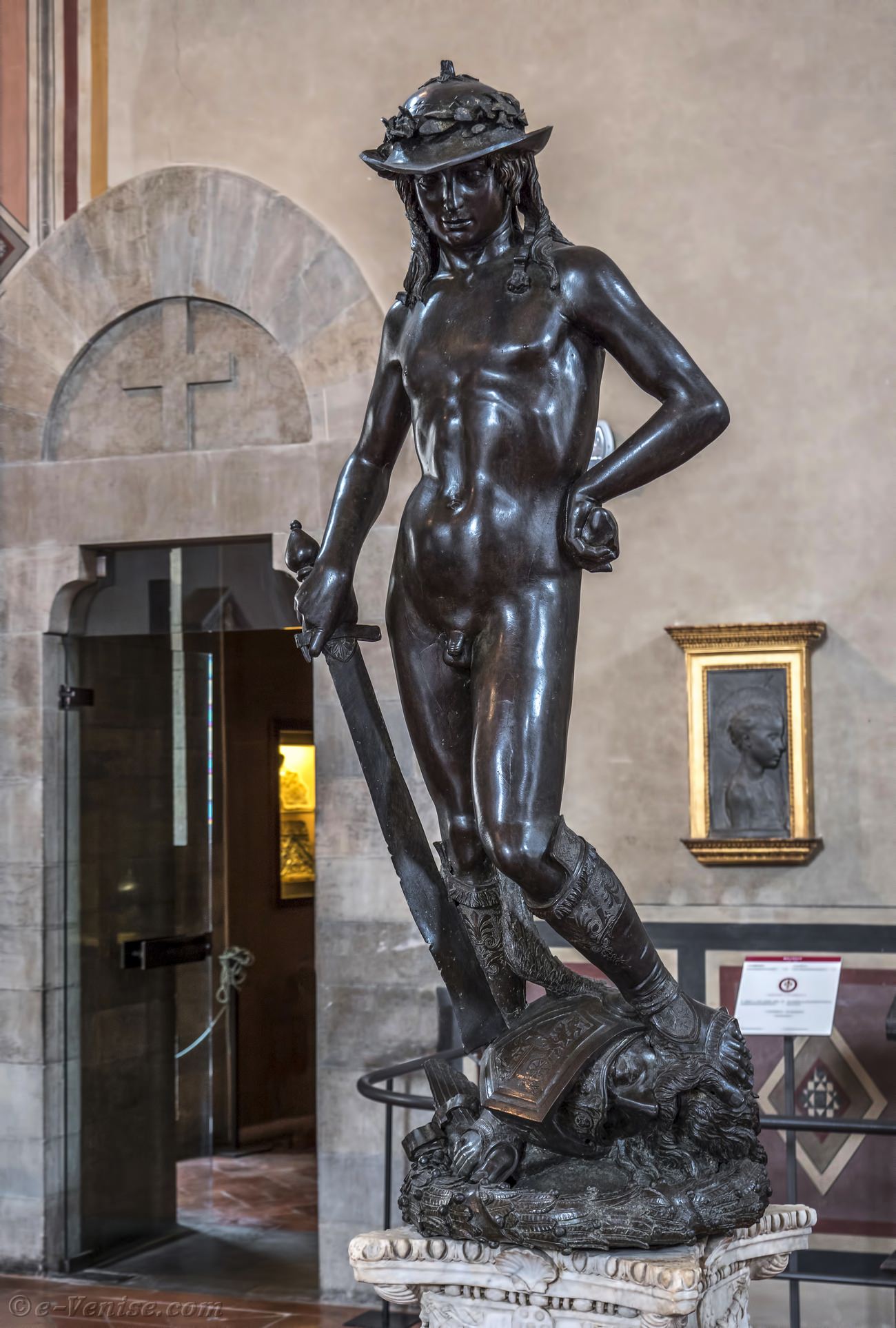
Donatello’s David: The Bronze That Defies Giants – The Power of Your Story
Donatello’s David stands not only as the first freestanding nude since antiquity but as a monument to the extraordinary power of the story we tell ourselves—the story we tell ourselves about ourselves, first privately in the bronze pour and then publicly through Florence’s defiant gaze. When I look at Donatello’s David, I see the embodiment of narrative self-triumph, of how our internal stories create the architecture of our audacity, our poise, and the way we topple the world’s tyrants.
Donatello cast David around 1440 in bronze at his Florence workshop, imbuing metal with the youthful swagger of a shepherd boy who felled Goliath. David’s story is that of an overlooked youth no one expected to conquer the Philistine champion, yet he becomes the hero who rewrites the narrative of the underestimated. His contrapposto stance, feather-adorned hat, sword larger than his body, and serene gaze tell a story of belief in improbable victory. This is the story Donatello forged in bronze—the story “I am not defined by my stature, nor by my shepherd staff, but by my cunning and conviction.”
The power of this story begins within. David’s contemplative eyes gaze upward, not in fear of the severed head at his feet but envisioning triumph. This internal narrative is one of quiet self-assurance: “I am the slinger before the stone flies.” The story we tell ourselves before we face the giant conditions the decapitation. Like David, our internal monologue can be a source of graceful audacity or paralyzing proportion. The story we nurture within becomes our sling and our stone.
But the story of David is not just internal; it is told to the world in every curve and contrapposto of the figure. Public storytelling is a proclamation: “This is who I am—the underdog victorious.” Its intimate scale—5 feet 2 inches—asserts human-scale heroism, demanding that republics acknowledge the story embodied. Placed originally in the Medici palace courtyard, not to intimidate but to inspire, it proclaims the power of individual cunning intertwined with civic virtue against Medici “giants.”
Donatello’s David teaches an essential truth: the story you tell yourself shapes how oppression perceives you—and falls before it. Our self-story is a beacon or a burden. It influences not only our self-image but the republican scripts that determine our resistance. Just as David‘s poised victory inspired Florence’s hope against tyrannical dukes, our narratives influence the battles we choose, the odds we defy, and the legacy we hoist.
An exquisite detail is the feather from Goliath’s helmet curling intimately against David’s thigh—capturing the line between trophy and talisman. This duality speaks to the complexity of storytelling: it is not about flawless invincibility but about holding together contradiction in our narrative identity—the vulnerability and the valor, the boy and the bronze. Donatello reminds us that authentic self-stories are sensual, strategic, and subversive.
This story also reminds me as a coach that transformation is a process of casting. The bronze was molten chaos, undefined, until Donatello saw the story within and poured it forth. Similarly, people often carry raw potential locked inside unshaped narratives. Coaching is the art of uncovering the David within—the story that needs to be cast, reshaped, and stood. The moment you start telling yourself “I am the shepherd facing my Goliath” is when giants tumble.
David‘s story is universal. It resonates from 1440 Florence to today’s entrepreneurial leaps, career pivots, personal Goliaths. The power lies in the story you hold before you sling the stone. Will you cower in proportion, or like David, radiate poise and possibility?
The stories we tell ourselves—the ones we announce to ourselves and the city—construct our victories. Donatello’s David is a timeless reminder that the greatest sculpture is often the one we cast from our own mettle through the narratives we choose. Our story shapes the reality we conquer; it beckons us to stand lithe, poised, and triumphant—not by avoiding our giants but by owning our story.
Your Story about Happiness
What’s your story about happiness? How would you rate your happiness over the last six months? Is your answer acceptable to you? According to your story, how important is happiness and how do you go about achieving it? Are you clear about where or how happiness might be realized for you? If there is something out there – some activity, some person – that dependably brings you happiness, how long has it been since you encountered it or her or him? What do you think is the connection, if any, between engagement and happiness? If your level of happiness is not where you want it to be, then what’s the story you tell yourself that explains why it’s not happening at this point in your life? If you continue on the same trajectory, then what kind of happiness do you expect is likely in your future, short-term and long.
Do you consider you own happiness an afterthought? An indulgence? A form of selfishness? Have you removed joy joy, as opposed to contentment – from the spectrum of emotions you expect and wish to experience during the remainder of your life?
Jot down ten moments/occassions during the last thirty days where you experienced joy:
- ________________________________________________________
- ________________________________________________________
- ________________________________________________________
- ________________________________________________________
- ________________________________________________________
- ________________________________________________________
- ________________________________________________________
- ________________________________________________________
- ________________________________________________________
- _____________________________________________________
Raphael’s School of Athens: The Gathering of Minds – The Power of Your Story
Raphael’s School of Athens stands not only as the crowning fresco of Renaissance humanism but as a monument to the extraordinary power of the story we tell ourselves—the story we tell ourselves about ourselves, first privately in the draftsman’s vision and then publicly through philosophy’s eternal forum. When I look at The School of Athens, I see the embodiment of narrative self-convocation, of how our internal stories create the architecture of our intellect, our dialogue, and the way we convene the world’s wisdom.
Raphael painted The School of Athens between 1509–1511 in the Vatican’s Stanza della Segnatura, imbuing the vaulted hall with the animated discourse of antiquity’s greatest thinkers. The fresco’s story is that of scattered minds no one expected to unite across millennia, yet they become the heroes who rewrite the narrative of isolated genius. Plato points heavenward, Aristotle gestures earthward, Euclid diagrams geometry, Heraclitus broods alone—each figure tells a story of belief in collective enlightenment. This is the story Raphael frescoed into eternity—the story “I am not defined by my solitude, nor by my era, but by my place in the conversation of minds.”
The power of this story begins within. Euclid’s focused gaze on his compass is not distraction but devotion; he is not lost in proof but discovering. This internal narrative is one of profound self-conviction: “I am the geometer before the theorem unfolds.” The story we tell ourselves before we join the discourse conditions the discovery. Like Raphael, our internal monologue can be a source of synthetic brilliance or fragmented isolation. The story we nurture within becomes our compass and our conversation.
But the story of The School of Athens is not just internal; it is told to the world in every gesture and grouping of the mural. Public storytelling is a convocation: “This is who we are—thinkers in eternal dialogue.” Its architectural grandeur—spanning the vault—asserts intellectual vastness, demanding that popes and patrons acknowledge the story embodied. Commissioned by Julius II for the papal library, not to flatter but to elevate, it proclaims the power of individual insight intertwined with universal inquiry.
Raphael’s School of Athens teaches an essential truth: the story you tell yourself shapes how ideas perceive you—and converge through you. Our self-story is a beacon or a boundary. It influences not only our self-image but the intellectual scripts that determine our contributions. Just as the fresco’s harmonious assembly inspired Renaissance Florence and Rome’s hope against scholastic dogma, our narratives influence the dialogues we host, the syntheses we forge, and the legacy we illuminate.
An exquisite detail is Heraclitus (Michelangelo portrait) brooding alone at right—pen in hand, isolated yet integral—capturing the line between solitary genius and communal chorus. This duality speaks to the complexity of storytelling: it is not about unanimous agreement but about holding together contradiction in our narrative identity—the loner and the assembly, the question and the quest. Raphael reminds us that authentic self-stories are dynamic, dialogic, and durable.
This story also reminds me as a coach that transformation is a process of assembly. The blank vault was conceptual void, undefined, until Raphael saw the story within and orchestrated it forth. Similarly, people often carry raw insight locked inside unshaped narratives. Coaching is the art of uncovering the School within—the story that needs to be convened, reshaped, and conversed. The moment you start telling yourself “I am the convener facing my void” is when wisdom gathers.
The School of Athens‘ story is universal. It resonates from 1511 Vatican to today’s interdisciplinary breakthroughs, team innovations, knowledge synthesis. The power lies in the story you hold before you open the discourse. Will you isolate in echo chambers, or like Raphael, radiate assembly and advancement?
The stories we tell ourselves—the ones we announce to ourselves and the academy—construct our understanding. Raphael’s School of Athens is a timeless reminder that the greatest fresco is often the one we paint from our own minds through the narratives we choose. Our story shapes the reality we comprehend; it beckons us to gesture boldly, poised, and profound—not by silencing our thinkers but by owning our story.
Your Story about Friends
What is your story about friendship? According to your story, how important are friends? How fully engaged are you with them? (that is don’t calculate in your mind simply how often you see them but what you do and how you are when you’re together). If close friendships are important to you, yet they are clearly not happening in your life, what is the story you tell yourself that obstructs this from happening?
To what extent are friendships important to your realizing what you need and want from life? If you have few or no friends, why is that? Is this a relatively recent development – that is, something that happened since you got married for example, or had a family, or got more consumed by work, or got promoted, or got divorced, or experienced a significant loss, or moved away from your hometown?
When you think of your closest friendships over the last five years, can you say any of them has grown and deepened? People who have a best friend at work are seven times more likely to be engaged in their work, get more done in less time, have fewer accidents and are more likely to innovate and share new ideas.
Suppose you had no friends – what would that be like? This may seem like a morbid exercise but write down three ways in which being completely friendless might make your life poorer (no one to turn to in times of crisis and celebration, no one to mourn your passing, etc.)
- _________________________________________________________________
- _________________________________________________________________
- _________________________________________________________________
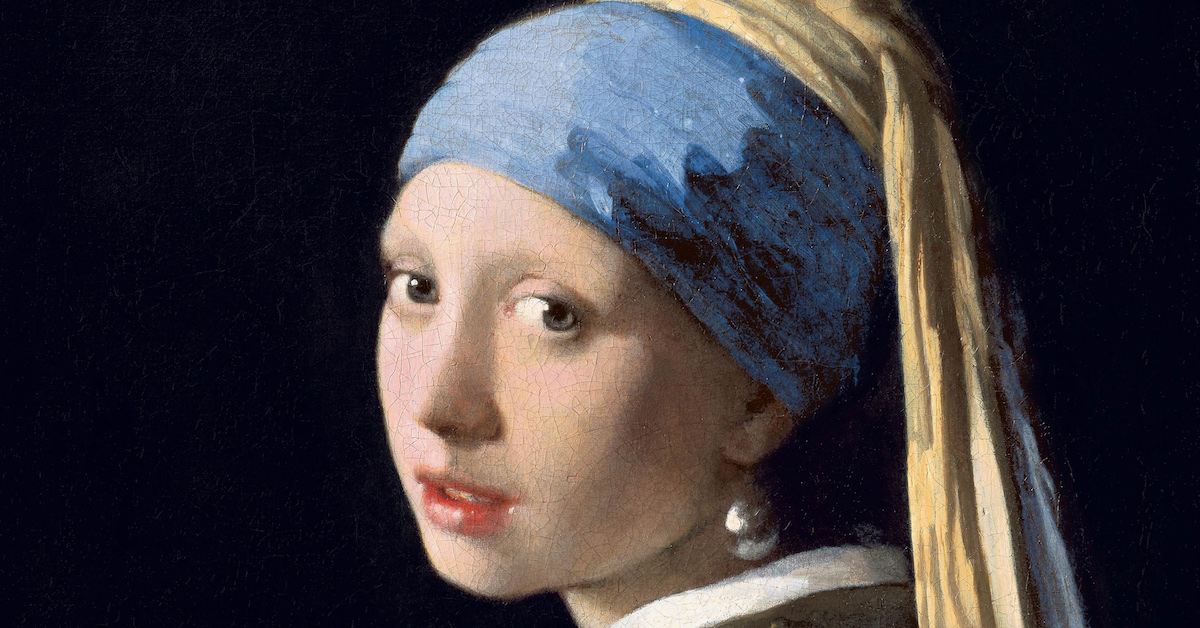
Vermeer’s Girl with a Pearl Earring: The Gaze That Captures Mystery – The Power of Your Story
Vermeer’s Girl with a Pearl Earring stands not only as the “Mona Lisa of the North” but as a monument to the extraordinary power of the story we tell ourselves—the story we tell ourselves about ourselves, first privately in the camera obscura’s glow and then publicly through the viewer’s eternal encounter. When I look at Girl with a Pearl Earring, I see the embodiment of narrative self-mystery, of how our internal stories create the architecture of our enigma, our allure, and the way we invite the world’s gaze.
Johannes Vermeer painted Girl with a Pearl Earring around 1665 in Delft’s intimate studio, imbuing canvas with the turning glance of an ordinary girl transformed into timeless icon. The girl’s story is that of a fleeting moment no one expected to haunt generations, yet she becomes the heroine who rewrites the narrative of the unseen. Her direct gaze over shoulder, luminous pearl earring catching light, and turban-framed face tell a story of belief in hidden depths. This is the story Vermeer veiled in pigment—the story “I am not defined by my station, nor by my silence, but by my mystery and magnetism.”
The power of this story begins within. The girl’s half-turned eyes engage not in confrontation but invitation; she is not posing but emerging. This internal narrative is one of quiet self-possession: “I am the enigma before the question forms.” The story we tell ourselves before we meet the gaze conditions the connection. Like Vermeer, our internal monologue can be a source of intimate radiance or veiled withdrawal. The story we nurture within becomes our pearl and our profile.
But the story of Girl with a Pearl Earring is not just internal; it is told to the world in every glaze and glow of the portrait. Public storytelling is an encounter: “This is who I am—the mystery unveiled.” Its intimate scale—17×15 inches—asserts personal magnetism, demanding that beholders acknowledge the story embodied. Hung in private Dutch homes, not to dominate but to draw near, it proclaims the power of individual presence intertwined with universal curiosity.
Vermeer’s Girl with a Pearl Earring teaches an essential truth: the story you tell yourself shapes how the world gazes upon you—and lingers. Our self-story is a beacon or a blur. It influences not only our self-image but the relational scripts that determine our allure. Just as the girl’s poised turn inspired centuries of fascination against Dutch realism’s plainness, our narratives influence the connections we kindle, the impressions we leave, and the legacy we haunt.
An exquisite detail is the pearl earring’s single luminous highlight—capturing the line between shadow and sparkle. This duality speaks to the complexity of storytelling: it is not about total revelation but about holding together contradiction in our narrative identity—the hidden and the hinted, the ordinary and the otherworldly. Vermeer reminds us that authentic self-stories are subtle, seductive, and sustaining.
This story also reminds me as a coach that transformation is a process of illumination. The canvas was shadowed potential, undefined, until Vermeer saw the story within and lit it forth. Similarly, people often carry raw charisma locked inside unshaped narratives. Coaching is the art of uncovering the Girl within—the story that needs to be turned, reshaped, and regarded. The moment you start telling yourself “I am the gaze facing my mystery” is when connection begins.
Girl with a Pearl Earring‘s story is universal. It resonates from 1665 Delft to today’s personal branding, intimate encounters, self-discovery quests. The power lies in the story you hold before you turn to meet the world. Will you avert in obscurity, or like the Girl, radiate invitation and intrigue?
The stories we tell ourselves—the ones we announce to ourselves and others—construct our presence. Vermeer’s Girl with a Pearl Earring is a timeless reminder that the greatest portrait is often the one we paint from our own depths through the narratives we choose. Our story shapes the reality we reveal; it beckons us to glance boldly, poised, and pearled—not by hiding our mysteries but by owning our story.
Write Your Current Story (or try to)
The following are the steps in a process we’ve devised and refined over the years, from feedback our clients have provided. It starts with you writing your current story – a first draft. Eventually, after some hard and honest work – and several drafts – you’ll have produced a story that accurately reflects the way things have been going in your life. Then you’ll discard this current story, recasting it now as your ‘old story’ and replace it with your new, forward – moving story.
But that’s getting ahead of ourselves – especially considering that the majority of those I’ve worked with have not quite ‘gotten’ their current story on the first attempt.
STEP 1: Identify the important areas of your life where the stories you tell yourself or others are clearly not working. They simply do not take you where you ultimately want to go – for example, with personal relationships, work, financial health, physical health, with your boss, your daughter, your morning routine. Ask yourself: in what areas is it clear I can’t get to where I want to go with the story I’ve got?
- ________________________________________________________________
- _________________________________________________________________
- _________________________________________________________________
- _________________________________________________________________
- _________________________________________________________________
Keep going, if you have more.
STEP 2. Articulate as clearly as possible the story you currently have that isn’t working. Put it down on paper. Eventually we’ll refer to this as your Old Story.
Before you begin writing your own Old Story:
Really bring it to life. Express your logic, your rationale, your thinking process about why you’ve been living the way you have. By getting it down on paper, you can see it, study it, break it down, judge how it flows (or stumbles) as a story. Write in the voice you typically use privately with yourself. Don’t hold back. If it’s a rationalizing, scapegoating voice, then use that. If it’s bitter or prideful, use it. This story – initially, anyway is for your eyes, no one else’s, so don’t write your story scared; no need to be diplomatic or politically correct. At some point you may wish to share it with others, as many people do in our workshops.
Some tricks to a more authentic story:
Exaggerating your voice often makes it easier to recognize how destructive or illogical the story you’ve been telling yourself actually is. For example, if you feel used and taken for granted, listen to the voice and capture both the message and the emotion in your writing. Get down and dirty. Tell the story you really think – no matter how ugly it sounds – capture it.
Just as novelist and screenwriters go through dozens of drafts before they get it right, prepare to go through several rewrites before you can effectively capture the voice, content, and essence of your faulty Old Story. Clients tell me they go through three, eight, fifteen drafts. When it’s right, you’ll know it.
Just as writers emphasize detail, you, too, should get as specific and concrete as you can with your Old Story. Capture the nuances of how you talk to yourself and the logic of your thinking. The elements of a story that make it persuasive or not – theme, tone, major characters, pace – provide color and texture to life, so try to capture them on paper.
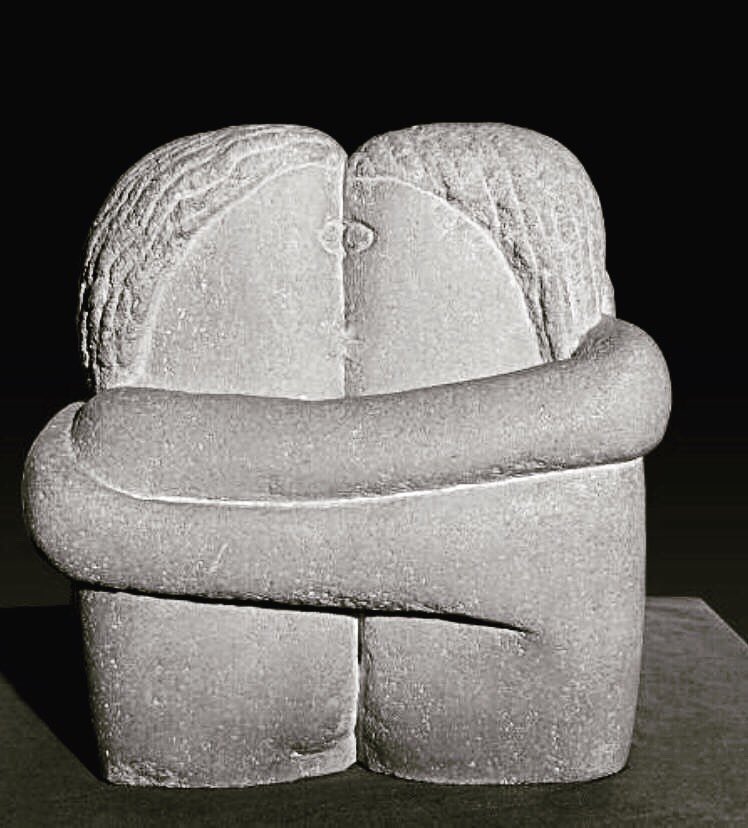
Brâncuși’s The Kiss: The Fusion That Defies Solitude – The Power of Your Story
Brâncuși’s The Kiss stands not only as the primal fusion of modern sculpture but as a monument to the extraordinary power of the story we tell ourselves—the story we tell ourselves about ourselves, first privately in the chisel’s solitude and then publicly through stone’s eternal embrace. When I gaze at The Kiss, I see the embodiment of narrative self-union, of how our internal stories create the architecture of our intimacy, our indivisibility, and the way we merge with the world’s essence.
Constantin Brâncuși carved The Kiss between 1907-08 in his freezing Paris studio at Impasse Ronsin, imbuing limestone with the primal lock of two lovers fused into single ovoid form. The lovers’ story is that of isolated forms no one expected to transcend separation, yet they become the heroes who rewrite the narrative of division. Arms gripped in primal clasp, lips sealed eternal, heads ovoid unity tell a story of belief in transcendent oneness. This is the story Brâncuși chiseled into eternity—the story “I am not defined by my isolation, nor by my edges, but by my fusion and forever.”
The power of this story begins within. The lovers’ fused gaze is not fragmented but complete; they are not two but one emerging. This internal narrative is one of profound self-integration: “I am the embrace before the separation dissolves.” The story we tell ourselves before we reach out conditions the union. Like Brâncuși, our internal monologue can be a source of indivisible wholeness or splintered solitude. The story we nurture within becomes our ovoid and our oneness.
But the story of The Kiss is not just internal; it is told to the world in every curve and contour of the block. Public storytelling is a consummation: “This is who we are—indivisible.” Its block-like scale—intimate yet monumental—asserts fused presence, demanding that beholders acknowledge the story embodied. Placed in ateliers and later collections, not to separate but to seal, it proclaims the power of individual essence intertwined with relational eternity.
Brâncuși’s The Kiss teaches an essential truth: the story you tell yourself shapes how separation perceives you—and dissolves before it. Our self-story is a beacon or a boundary. It influences not only our self-image but the relational scripts that determine our connections. Just as The Kiss‘s primal unity inspired modernism’s hope against fragmentation, our narratives influence the bonds we forge, the mergers we manifest, and the legacy we entwine.
An exquisite detail is the single incised line separating yet uniting the fused forms—capturing the line between individuality and infinity. This duality speaks to the complexity of storytelling: it is not about total dissolution but about holding together contradiction in our narrative identity—the me and the we, the alone and the all-one. Brâncuși reminds us that authentic self-stories are seamless, sensual, and sovereign.
This story also reminds me as a coach that transformation is a process of fusion. The limestone block was divided mass, undefined, until Brâncuși saw the story within and carved it whole. Similarly, people often carry raw potential locked inside divided narratives. Coaching is the art of uncovering the Kiss within—the story that needs to be fused, reshaped, and felt. The moment you start telling yourself “I am the embrace facing my isolation” is when oneness begins.
The Kiss‘s story is universal. It resonates from 1908 Paris to today’s partnerships, creative collaborations, soul mergers. The power lies in the story you hold before you clasp hands. Will you remain edged apart, or like Brâncuși’s lovers, radiate fusion and forever?
The stories we tell ourselves—the ones we announce to ourselves and others—construct our unions. Brâncuși’s The Kiss is a timeless reminder that the greatest sculpture is often the one we carve from our own forms through the narratives we choose. Our story shapes the reality we entwine; it beckons us to grip boldly, poised, and primal—not by fearing our solitudes but by owning our story.
Okay. Now take a stab at your Old Story.
Old Story
______________________________________________________________________________________________________________________________________________________________________________________________________________________________________________________________________________________________________________________________________________________________________________________________________________________________________________________________________________________________________________________________________________________________________________________________________________________________________________________________________________________________________________________________________
Note your feelings as you’re reading and writing your old story. Clients often experience shock, embarrassment, even self-loathing when they write and read their Old Stories as they genuinely face their rationale for the first time. ‘This story is making me sick as I write it’. one client wrote as part of his story.
You can only write your New Story – eventually – if you’ve isolated what it is about your Old Story that’s faulty. (If there’s nothing faulty in it, then there’s no reason to write a new one, right?). How do you do that?
STEP 3: Identify the faulty elements of your old story by asking yourself three questions, about both the total story and each of the individual points it makes:
- Will this story make me where I want to go in life (while at the same time remaining true to my deepest values and beliefs?)
- Does the story reflect the truth as much as possible?
- Does this story stimulate me to take action?
These three questions are the foundations for the three rules of good storytelling, which I will cover in detail. Your Old Story usually flouts one or more of these rules, often all three. I refer to them shorthanded as Purpose, Truth and Hope-Filled Action. It is the lack of one or more of these criteria that makes your Old Story flawed and ultimately unworkable. In your New Story, on the other hand, all three rules will be addressed and conformed to. You simply cannot tell a good story without satisfying each and every one of these three elements.
So: Does your Old Story work for you?
The answer will be found by holding it up, first, against your purpose in life. Is this story you wrote above, the one you’re right now living and have been for some time, moving you toward fulfilling and remaining true to that great purpose?
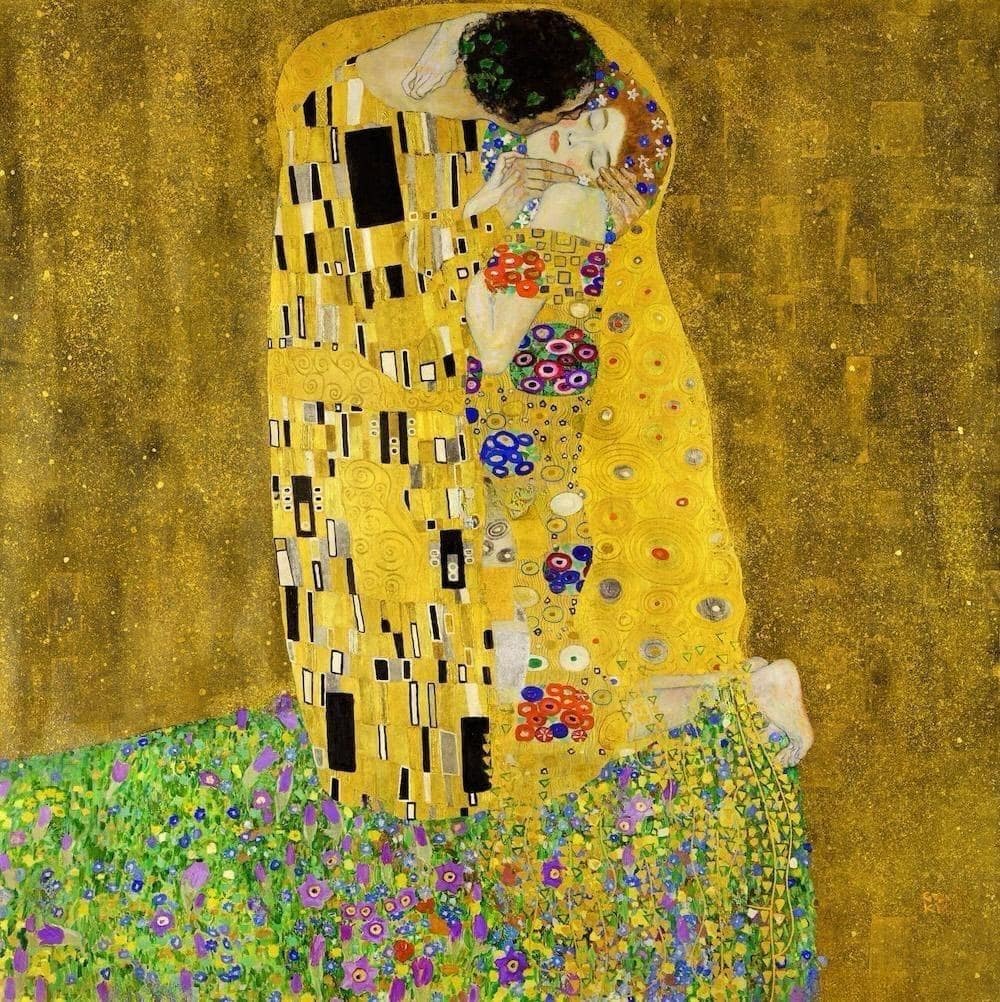
Klimt’s The Kiss: The Golden Embrace of Eternity – The Power of Your Story
Gustav Klimt’s The Kiss stands not only as the radiant pinnacle of Viennese Secession but as a monument to the extraordinary power of the story we tell ourselves—the story we tell ourselves about ourselves, first privately in the gold leaf’s alchemy and then publicly through love’s eternal shimmer. When I look at The Kiss, I see the embodiment of narrative self-surrender, of how our internal stories create the architecture of our passion, our fusion, and the way we transcend the world’s edges.
Klimt painted The Kiss in 1907–08 at his Vienna studio during his Golden Phase, imbuing 5×5-foot canvas with two lovers kneeling on wildflower cliff’s edge, locked in golden rapture. The lovers’ story is that of isolated souls no one expected to merge beyond mortality, yet they become the heroes who rewrite the narrative of transience. Man’s rectangular robe grips woman’s circular gown, faces obscured in ecstasy, gold leaf cloaks their unity tell a story of belief in ecstatic eternity. This is the story Klimt gilded into immortality—the story “I am not defined by my finitude, nor by my isolation, but by my rapture and radiance.”
The power of this story begins within. The woman’s closed eyes and craned neck are not submission but surrender; she is not lost but luminous. This internal narrative is one of profound self-dissolution: “I am the embrace before the self dissolves.” The story we tell ourselves before we yield conditions the union. Like Klimt, our internal monologue can be a source of transcendent bliss or fearful fragmentation. The story we nurture within becomes our gold leaf and our glow.
But the story of The Kiss is not just internal; it is told to the world in every pattern and shimmer of the canvas. Public storytelling is a consummation: “This is who we are—eternal in ecstasy.” Its square monumentality asserts overwhelming intimacy, demanding that beholders acknowledge the story embodied. Debuted 1908 Kunstschau Vienna amid scandal, not to shock but to sanctify, it proclaims the power of individual passion intertwined with universal yearning.
Klimt’s The Kiss teaches an essential truth: the story you tell yourself shapes how separation perceives you—and melts before it. Our self-story is a beacon or a boundary. It influences not only our self-image but the erotic scripts that determine our bonds. Just as The Kiss‘s golden fusion inspired fin-de-siècle Vienna’s hope against decay, our narratives influence the raptures we risk, the eternities we envision, and the legacy we illuminate.
An exquisite detail is the rectangular masculine patterns yielding to feminine circles—capturing the line between structure and surrender. This duality speaks to the complexity of storytelling: it is not about perfect harmony but about holding together contradiction in our narrative identity—the finite and the forever, the grip and the glow. Klimt reminds us that authentic self-stories are ornate, orgasmic, and otherworldly.
This story also reminds me as a coach that transformation is a process of gilding. The canvas was blank longing, undefined, until Klimt saw the story within and leafed it forth. Similarly, people often carry raw passion locked inside unshaped narratives. Coaching is the art of uncovering the Kiss within—the story that needs to be gilded, reshaped, and gazed. The moment you start telling yourself “I am the rapture facing my abyss” is when eternity begins.
The Kiss‘s story is universal. It resonates from 1908 Vienna to today’s soul mergers, creative passions, existential leaps. The power lies in the story you hold before you kneel to love. Will you cling to edges, or like Klimt’s lovers, radiate fusion and forever?
The stories we tell ourselves—the ones we announce to ourselves and lovers—construct our bliss. Klimt’s The Kiss is a timeless reminder that the greatest masterpiece is often the one we gild from our own longing through the narratives we choose. Our story shapes the reality we embrace; it beckons us to kneel boldly, poised, and pearled—not by fearing our abysses but by owning our story.
Two
The premise of your story, the purpose of your life
Imagine this: You find yourself atop a tall building in the heart of a bustling city, gazing across to another rooftop. A single wooden board stretches between you and the other structure—a flimsy bridge suspended high above the streets.
A man in a suit—let’s call him “The Banker”—appears beside you. He invites you, with a charismatic grin, to cross the board. “Walk across,” he says, “and win a fantastic prize: €1,000. Or €10,000. Or €1,000,000! Name your reward, and it shall be yours.”
You peer down. The city is blurry with distance, the board barely more than a tightrope. Your heart races at the possibility… but also at the risk. No matter how tempting the prize, your feet remain glued to the rooftop. The money—so alluring in the abstract—has no real pull here, where the danger is undeniable and the reward can’t overcome the instinct to protect yourself.
You are not alone. Around you, others decline. A poll of would-be adventurers, dreamers, and pragmatists reveals a near-universal reluctance to cross, regardless of how high the stakes climb in their favor. The threat outweighs the promise; money is not enough.
The Hero’s Heart Revealed
Now, let’s shift the story.
Flames erupt in the building across from where you stand. Through the smoke, you spot your loved ones: the people who matter most to you—your family, your child, your partner, your friend—are trapped, calling for help.
A new choice presents itself: the same wobbly board, the same dizzying void below, but the stakes are remade. The risk remains, but the reward is no longer money—it is love, connection, the irreplaceable presence of another human in your life.
Suddenly, legs that were frozen before begin to move. People discover courage they did not know was in them. They cross the board—not for gold, but because the story they are living is no longer about “winning” or self-preservation, but about purpose, meaning, and the heroic heartbeat that comes alive when what (and who) they value is truly at stake.
Lessons from the Board
- Motivation is Meaningful: Money often fails to move us when real personal risk is involved. Our actions are shaped more by meaning than by material promises.
- The Power of Story: The tale you tell yourself—of who you are, what matters, and what you’re willing to risk or save—changes everything.
- The Hero’s Journey: When the call is strong—when our family or values are on the line—we find the will to face even our greatest fears.
This is the difference between living for external rewards and living for what truly lights your fire. Sometimes, what gets you to cross the board isn’t at the end—it’s already in your heart
Your Hero’s Journey
He who has a why to live, said Nietzsche, can bear with almost any how. I have yet to meet a person who, given the proposition laid out above – risk your life or the lives of your family members – has said that he or she would not walk that narrow plank and a one – in – five – chance of dying. I present the wood plank example not to show clients that saving their family from harm is their ultimate purpose in life – it’s a purpose, a vital one, but not the purpose, not the reason you are on this earth – but to show just how dramatically our story, and our willingness to spend energy and take risk, change when there is a great purpose. In short, when the stakes are a large sum of money – almost never a transcendent purpose – no one walks across that plank. When the stakes are love and life and that which has incalculable value, everyone goes.
A great purpose is the epicenter of everyone’s life story. Purpose is one of the three foundations of good storytelling
Without purpose, no character in a book, or movie or in art would do anything interesting, meaningful, memorable, worthwhile. Without purpose , our life story has no meaning. It has no coherence, no direction, no inexorable momentum. Without purpose, our life still ‘moves’ along – whatever that means, but it lacks an organizing principle. Without purpose, it is all but impossible to be fully engaged. To be extraordinary.
With purpose, on the other hand, people do amazing things: good, smart, productive things, often heroic things, unprecedented things.
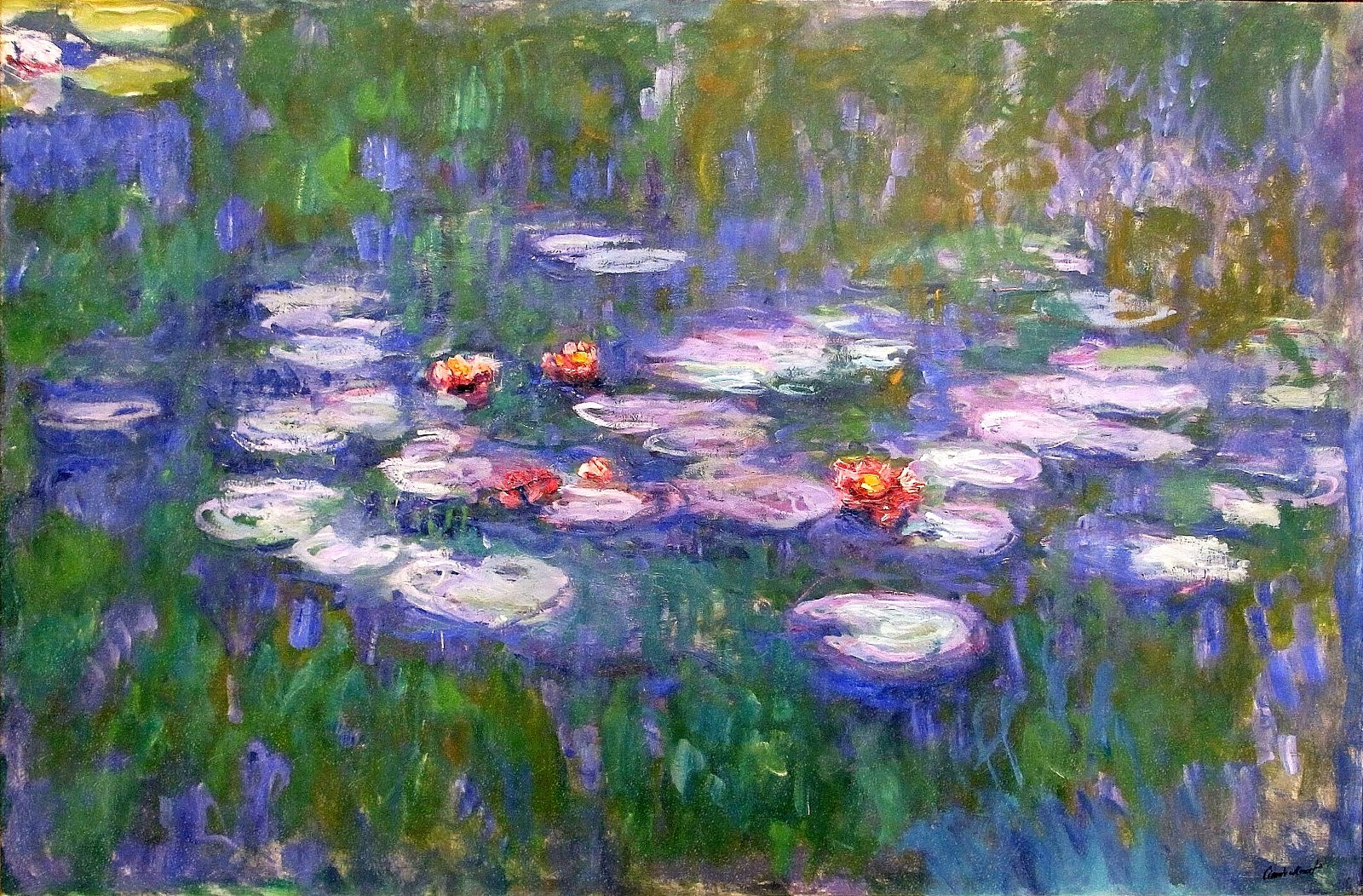
Monet’s Water Lilies: The Reflection That Dissolves Ego – The Power of Your Story
Claude Monet’s Water Lilies stands not only as the immersive symphony of Impressionism but as a monument to the extraordinary power of the story we tell ourselves—the story we tell ourselves about ourselves, first privately in Giverny’s pondside gaze and then publicly through canvas’s liquid infinity. When I look at Water Lilies, I see the embodiment of narrative self-dissolution, of how our internal stories create the architecture of our fluidity, our boundlessness, and the way we merge with the world’s flow.
Monet painted the Water Lilies series from 1896–1926 in his Giverny garden studio, imbuing massive triptychs (6×17 feet) with lily pads drifting on reflective waters under shifting skies. The lilies’ story is that of defined forms no one expected to blur into universal flux, yet they become the heroes who rewrite the narrative of separation. Pad edges softening into sky-blue depths, reflections mirroring infinity, light dappling dissolution tell a story of belief in transcendent impermanence. This is the story Monet brushed into eternity—the story “I am not defined by my edges, nor by my surface tension, but by my reflection and release.”
The power of this story begins within. The lily pad’s gentle curve amid ripple is not isolation but intermingling; it is not floating apart but flowing within. This internal narrative is one of profound self-fluidity: “I am the reflection before the self sharpens.” The story we tell ourselves before we gaze into the pond conditions the dissolution. Like Monet, our internal monologue can be a source of boundless serenity or rigid reflection. The story we nurture within becomes our water and our wave.
But the story of Water Lilies is not just internal; it is told to the world in every stroke and shimmer of the panels. Public storytelling is an immersion: “This is who we are—formless in flow.” Its panoramic scale envelops the viewer, demanding that beholders surrender to the story embodied. Installed in Paris’ Orangerie (1927), not to frame but to envelop, it proclaims the power of individual perception intertwined with cosmic continuity.
Monet’s Water Lilies teaches an essential truth: the story you tell yourself shapes how solidity perceives you—and yields before it. Our self-story is a beacon or a boundary. It influences not only our self-image but the perceptual scripts that determine our flow. Just as the lilies’ fluid reflections inspired modernist Paris’s hope against representational rigidity, our narratives influence the boundaries we blur, the depths we dive, and the legacy we dissolve into.
An exquisite detail is the single pad’s edge fading into infinite blue—capturing the line between form and formlessness. This duality speaks to the complexity of storytelling: it is not about crystalline clarity but about holding together contradiction in our narrative identity—the defined and the diffuse, the surface and the submerged. Monet reminds us that authentic self-stories are rippling, radiant, and released.
This story also reminds me as a coach that transformation is a process of reflection. The canvas was blank tension, undefined, until Monet saw the story within and rippled it forth. Similarly, people often carry raw fluidity locked inside rigid narratives. Coaching is the art of uncovering the Lily within—the story that needs to be dappled, reshaped, and released. The moment you start telling yourself “I am the reflection facing my edges” is when flow begins.
Water Lilies‘ story is universal. It resonates from 1926 Giverny to today’s mindfulness practices, creative flows, ego dissolutions. The power lies in the story you hold before you gaze into the depths. Will you cling to contours, or like Monet’s lilies, radiate reflection and release?
The stories we tell ourselves—the ones we announce to ourselves and the pond—construct our fluidity. Monet’s Water Lilies is a timeless reminder that the greatest masterpiece is often the one we reflect from our own depths through the narratives we choose. Our story shapes the reality we flow through; it beckons us to drift boldly, poised, and pearled—not by fearing our forms but by owning our story.
Sometimes a person does not lack a purpose, it seems he has one – at least claimed to have one – but then he went about living his life and telling a story that supported that purpose hardly at all. And if that’s so, then what does it mean, really, to have a purpose? Or do you just say you have a purpose to cover yourself? Or do you not understand the meaning of the word ‘purpose’?
Purpose is the thing in your life story you will fight for. It is the ground you will defend at any cost. Purpose is not the same as ‘incentive’, but rather the motor behind it, the end that drives why you have energy for some things and not for others.
To find one’s true purpose sometimes takes work. Fortunately, the skill it requires is one that every person is blessed with.
For a few people, naming one’s purpose comes with remarkable ease. The individual feels it in the deepest part of his or her soul; the purpose has always been there, even if it got lost for a very long while, remaining unexpressed to oneself and to those who are the objects of one’s purpose. Deep enduring purpose is virtually always motivated by a desire for the well-being of others.
You know purpose when you see it.
To author a workable, fulfilling new story, you will need to ask yourself many questions and then answer them, none more important than those that concern purpose. Purpose is the sail on the boat, the yeast in the bread. Once you know your purpose – that is, what matters – then everything else can fall into place. Getting your purpose clear is your defining truth. What is the purpose of your life? To be the most successful earner in your circle? To leave the world a better place than when you entered it? To honor God? To live to a hundred? To seek out adventure and risk? Whatever it is, it had better be something for which you will move mountains, cross deserts, seven days a week, no questions asked.
Once you find your purpose, you have a chance to live a story that moves you and those around you.
The Words on Your Tombstone
Remember when your mother asked you, “Are you telling me a story or is that really true?” The assumption being: A story is what you concoct to keep yourself out of trouble. But your mother’s error was the same one many of us make when we think about stories. We fail to recognize that everything we say is a story – nothing more, nothing less. It would have been more accurate for Mom to have said, “I know you’re telling me a story but I need to know if your story truly reflects the facts or if you’re intentionally making things up to get out of trouble or to get what you want”. Happily no mother talks like that.
Giovanni Boccaccio’s Decameron is more than a collection of 100 tales; it is a grand meditation on the profound power of the stories we tell ourselves—internal narratives that shape how we perceive ourselves and the world—and how, in the darkest of times, storytelling becomes a radical act of survival and transformation.
Imagine yourself in the midst of the 14th-century Black Death, death all around, chaos gripping Florence and beyond. In this context, ten young aristocrats—seven women and three men—retreat to a countryside villa. Their decision to isolate is the first act of narrative authorship: “We write a new story for ourselves, one of refuge and creativity.” This framing of their situation as a heroic quest to defy death itself reveals the essential human impulse to control what we can—our story—and find meaning beyond suffering.
Boccaccio’s structure is brilliantly meta: a frame narrative that sets up a storytelling festival, where each day, a different member of the group acts as king or queen, setting the theme, and each person tells a story each evening. This cyclical ritual offers not only entertainment but a deliberate, healing narrative architecture. The stories become collective heroic acts, each a step along a shared journey out of despair.
The storytellers consciously choose tales that range from humor to tragedy, from romance to practical wisdom, reflecting the entire spectrum of human experience. For example, Panfilo’s chivalric romances transport listeners to worlds of noble quests and courtly love, creating a narrative of aspiration. Filostrato’s tragic love stories evoke empathy and the power of emotional truth, allowing the group to collectively engage with pain and loss rather than deny it. Fiammetta’s sensual and comedic stories celebrate the pleasure of life, an essential narrative counterbalance to the plague’s harsh shadow.
Central to Decameron is the theme of human agency through narrative. The plague is an uncontrollable external force, yet within the villa, storytelling becomes the arena where agency reigns. Queen Pampinea’s declaration, “Through stories, we govern our world,” captures this shift. By naming and shaping experience, they sanctify life, transforming plague into the backdrop for a new social order built on imagination and connection.
The power of the story told to oneself is also exemplified in the diversity of characters’ approaches to storytelling. Take Dioneo, whose risqué and irreverent tales challenge societal norms and censorship, suggesting that authentic self-expression breaks chains of oppression. Contrast him with Filostrato, whose somber stories acknowledge heartache but find dignity in suffering, revealing layers of narrative complexity that honor both lightness and depth.
One of the most compelling themes is how narratives serve as social commentary and subtle resistance. Tales exposing the hypocrisy of clergy, the foolishness of the wealthy, or the cleverness of the common folk invert the official stories of power. For example, the stories of cunning wives outwitting jealous husbands or of resourceful merchants emphasize intelligence and wit as tools to reclaim dignity, underscoring the democratizing power of storytelling.
Boccaccio infuses the collection with symbolism and structural richness. The garden villa is a metaphorical Paradise, a narrative sanctuary offering refuge from the apocalypse outside. The repetitive cycle of telling stories for ten days frames time as pliable, storytelling as a way to suspend doom and remake reality. Each dawn interrupts the night’s suspenseful tales, echoing the cliffhanger that continues the story of survival.
Language in Decameron sparkles with dialect and humor that humanizes and democratizes the telling. Boccaccio’s masterful use of vernacular brings immediacy and intimacy, making stories feel alive and participatory. His mix of comedy, tragedy, and earthy humanity foregrounds storytelling as a shared, communal act—one that embraces all facets of life.
The frame story is also layered with reflections on the act of storytelling itself. Characters within stories face dilemmas mirroring their storytellers’ concerns, creating a fractal narrative web. This recursive pattern blurs the lines between reality and fiction, revealing that the story we tell ourselves is always a narrative interpretation, always also a shared act.
At its core, Decameron is a manifesto for the power of narrative resilience. In the face of death, isolation, and fear, the regret or denial narratives often trap us in passivity, but the conscious crafting of stories enfolds us in community and hope. The young nobles’ collective telling is a blueprint for crisis storytelling, a precursor to modern psychological and social survival techniques.
The Decameron’s legacy continues robustly in modern culture—pandemic storytelling, digital storytelling platforms, collective memoirs during crises, and the enduring human need to share experience through narrative reflect Boccaccio’s insight. The work celebrates not only the tales themselves but the very human impulse to keep telling them, again and again, to find meaning and life in even the darkest times.
In our current era of global uncertainty and isolation, Decameron reminds us that the most potent power we possess is the story we tell ourselves about ourselves—and the stories we offer others to live by. It insists: when faced with annihilation, respond with creation; when silenced by fear, speak; when engulfed by loss, remember and retell.
Ultimately, The Decameron is more than stories; it is a transcendent act—a collective human boldness that defies the end of the world through the beginning of new stories. What will be the story you tell yourself when confronted by your own dark night? This timeless question lies at the heart of Boccaccio’s enduring masterpiece.
With every story, it is vital clear that one understand the purpose behind what is being said. The critical first step to getting our stories right is ensuring that the story we are telling at the moment is aligned with our ultimate mission in life, a phrase I use largely interchangeably with ‘purpose’ – as in the purpose. Not just a purpose. Your hero’s journey Your ultimate mission is the thing that continually renews your spirit, the thing that continually renews your spirit, the thing that gets you to stop and smell the roses. It is the indomitable force that moves you to action when nothing else can, yet it can ground you with a single whisper in your quietest moment; it is at once the bedrock of your soul and (as the phrase goes) the wind beneath your wings. It spells out the most overarching goals you want and need to achieve in your time here, and the manner in which you feel you must do it (that is, you pursue these goals in accordance with your values and beliefs).
Honoré de Balzac’s The Human Comedy is an extraordinary exploration of the stories we tell ourselves about ambition, power, social mobility, and human nature—internal narratives that define identity amid the rapidly changing society of 19th-century France. This sprawling cycle of novels reveals how individual fictions intertwine in a vast social tapestry, shaping destinies and reflecting the complexity of human desire.
At the center are characters constructing self-stories to navigate Parisian life, whether through relentless ambition, romantic idealism, or moral compromise. Balzac’s protagonist Eugène de Rastignac epitomizes the young aspirant’s narrative: “I will conquer Paris by wit and will; social ranks are but stories waiting to be rewritten.” His journey from provincial obscurity to political influence illustrates how personal storycraft enables social transformation, yet also tests integrity amid temptation.
Contrast this with the tragic Lucien de Rubempré, whose self-story is one of romantic delusion and desperate yearning for recognition. His illusions about art, love, and status collide with harsh realities, exposing the peril of narratives untethered from truth. Lucien’s downfall underscores storytelling’s dual nature—constructive or self-destructive depending on awareness.
Balzac presents society itself as a vast narrative machine where stories circulate in salons, courts, and streets, shaping reputation and opportunity. Characters manipulate and consume social narratives, reinforcing status quo or catalyzing change. Madame de Beauséant’s cynical reflections reveal how narrative control wields power over identity and destiny.
The extensive structure of The Human Comedy, with interconnected tales, mirrors life’s narrative complexity—individual stories intersecting, overlapping, sometimes clashing, underscoring that no story exists in isolation. Balzac’s realism offers detailed psychological portraits, revealing how characters’ internal monologues reflect broader social fictions.
Language balances precise social commentary with rich character introspection, enlivening the narrative texture. Paris itself becomes a character—a city of hope, despair, and relentless reinvention—its changing streets and salons literalizing narrative flux.
Secondary characters such as the calculating Vautrin and the idealistic Goriot personify divergent narrative archetypes: the manipulator scripting survival through deceit; the devoted father writing a story of sacrifice and love.
The Human Comedy resonates because it captures eternal human struggles: ambition against ethics, love versus social ambition, individual agency against systemic constraints. Its themes echo modern dilemmas of identity construction in a media-saturated, socially stratified world.
Balzac ultimately affirms storytelling as both a personal art and a social force, capable of elevating or ensnaring. Eugène’s closing reflections—”To succeed, one must be both author and actor in the vast human comedy”—remind us that we continually rewrite our role amid the grand play of life.
Through panoramic social scope, psychological depth, and ambitious narrative interweaving, The Human Comedy celebrates the power of internal narratives to shape life’s stage, urging conscious authorship over passive roles in the unfolding human drama.
Our ultimate mission must be clearly defined. If you find this difficult to do, ask yourself: “If I was standing at the rear of the chapel listening to people eulogize me at my own funeral, like Tom Sawyer and Huck Finn get to do, what would it gladden me to hear? What might someone say up there, or around my burial plot, that would make me think, ‘Hey, I guess I really did lead a worthwhile life?” By envisioning the end of your life, by coming to terms with the question ‘How do I want to be remembered? or ‘What is the legacy I most want to leave? you provide yourself with your single most important navigational coordinate: fundamental purpose, which henceforth will drive everything you do. By envisioning the end of your life, you are in simplest terms, pausing to define what could reasonably be called a purposeful life, as lived by you.
After you finish this part of the journey, close your eyes. Visualize a tombstone: your. It’s got your name engraved in it, the year of your birth and (imagined) year of death. Can you see it? What does it say underneath? Is it simply the word ‘beloved’ and numerous familial relationships? Is that okay? Does it work for you? Does it say more? Does it say more? Does it need to?
Now I know that tombstones almost never state the deceased’s ultimate purpose (Every now and then you’ll one that says something like ‘He lived to help others’ though it’s hard to know whether that was really their purpose or the purpose the survivors wanted etched for perpetuity. Stil, it doesn’t hurt to imagine your own tombstone, if for no reason other than to think about where you’re headed.
It is the ultimate game; the ultimate endgame. You must answer this seemingly simple, maddeningly simple query in a way that fully satisfies you. If you don’t then you’ll find it pretty nearly impossible to make the necessary course corrections your life almost certainly requires.

The Power of Your Story in Don Quixote – by Peter de Kuster
What if the story you tell yourself about yourself could transform a forgotten country squire into the world’s most famous knight? Miguel de Cervantes’ Don Quixote reveals this exact alchemy: the story you tell yourself—to yourself first, then others—becomes your reality. Alonso Quijano doesn’t merely read chivalric romances; he rewrites his identity. One night in his La Mancha library, he whispers: “I was clerk Quijano. Tomorrow, I am Don Quixote de la Mancha, sworn protector of widows and orphans.” This is pure Hero’s Journey ignition—your internal narrative becomes the Call to Adventure you answer.
Watch the power unfold. Quixote doesn’t debate windmills’ nature; he declares them giants. Innkeepers? Castle lords. Brass basins? Golden helmets. His story doesn’t seek permission—it demands participation. The barber protests: “It’s just a shaving bowl!” Quixote replies: “To blind eyes, yes. To knightly vision, Mambrino’s helm.” Your story rewrites the world for everyone encountering it. People argue facts or join the legend. The barber becomes conflicted; part of him wants to mock, part believes.
Enter Sancho Panza, peasant realist narrating: “I know pigs, duchesses, and sensible wages.” Quixote reframes: “You are my eternal squire, future governor.” Sancho counters: “Islands flood, señor.” Yet he mounts the donkey. Why? Quixote’s story seduces. Sancho starts telling himself fragments: “Maybe governorship fits.” By Part II, ruling Barataria, Sancho blends proverbs with idealism: “Flies enter open mouths.” He internalized the narrative. The stories we tell others become the stories they tell themselves.
This relational alchemy is crucial. Quixote elevates Aldonza Lorenzo to Dulcinea: “La Mancha’s purest lady.” Aldonza protests peasant reality, but his gaze elevates her carriage. Your narrative plants mythic seeds. She begins living the story. Love’s true power? Not possession, but elevation through authored identity.
Cervantes exposes shadow side: unchecked stories invite manipulation. Duke and Duchess stage cruel pranks—enchanted boats, fake enchanters—because their boredom needs authored amusement. “Mad knight entertains us.” Quixote suffers, yet endures. External stories only wound when internalized. Innkeeper scorn, muleteer beatings, scholarly debunkings—Quixote absorbs without surrender: “They see machinery; I see destiny.” Solitary conviction trumps collective ridicule.
Structure reveals narrative evolution. Part I: pure delusion charging windmills. Part II: meta-awareness. Characters read Part I. Duke taunts: “Your Barcelona ballad precedes you!” Quixote confronts fictionality: “Even Moors know my legend.” This breaks reality’s fourth wall. Modern question: Are you living your story, or someone else’s bestseller?
Language weaponizes contrast. Quixote’s lofty archaisms—”Fear not, fair maiden!”—clash Sancho’s proverbs: “Rome took its time.” Bilingual dance births hybrid wisdom. Rocinante embodies fragility: “Starved nag becomes destrier through belief.” Falls aren’t defeats; they’re “noble wounds.”
Deathbed delivers reckoning. Priest demands sanity; Quixote whispers: “I played Don Quixote the Fool. Now dies Alonso Quijano the Good.” Victory or defeat? Both. Delusion fueled purpose; sanity brought peace. Stories serve seasons. Knightly myth launched quest; human truth enabled closure.
Modern applications explode. Social media? Quixote with filters authoring “influencer.” Startups? “Unicorn destiny” against VC skepticism. Therapy? Explicitly Hero’s Journey. Cancel culture? Dukes rewriting reputations. Therapy coaches narrative sovereignty.
Quixote’s immortality proves power. “Greatest novel ever” outlives Cervantes—statues, musicals, films. Your story births collective myth. Children inherit parental tales; companies founder visions; nations shared narratives.
Five-act structure governs yours: Solitary authorship (library conviction), relational co-creation (Sancho evolution), external resistance (Duke tests), meta-awareness (Part II fictionality), integration (deathbed wisdom).
Sancho’s governorship blends: “More flies through ears than mouths.” Idealism needs pragmatism. Your story requires both wings and landing gear.
Library lesson: Great legends gestate alone. Journal, meditate, vision-board first. Share prematurely? Dilution. Conviction first.
Dukes warn: Others manipulate narratives—advertising desire, politics enemies. Recognize authored assaults on your story.
Quixote charges windmills asking: Giants or machinery? You decide. Others follow your gaze. Rocinante awaits.
What story begins today? The one you tell yourself—quietly first, boldly next. That’s the power of your story.
Your Ultimate Mission, Out Loud
When I work to get clients to define and refine their Ultimate MIssion, their Quest I almost always have to get tough with them. I put them through a vigorous interrogation to make sure that when they’ve reached their ‘answer’ they haven’t done so by fooling or mischaracterizing themselves. Amazingly, almost no one gets his or her ultimate mission on the first attempt. Often, an individual will come up with a purpose that sounds deep and good – My ultimate mission is to give my family the financial security I never had, by becoming a managing director of my firm – but which, upon scrutiny, is flimsy or undercooked, not yet at the most fundamental level of purpose – e.g. My quest is to be an extraordinary storyteller, leader in field and a role model for generations to come.
The story of How Green Was My Valley carries a profound lesson about the power of your story—the story you tell yourself about yourself, first to yourself, and then to the world. When I first read Richard Llewellyn’s classic as a boy, it struck a deep chord, long before I fully knew why. I understood that identity is born not just of facts or circumstances but of the stories woven through memory, relationship, and meaning. This valley, the lives lived inside it—the love, the grief, the change—all became a masterclass in how narrative shapes reality.
At the heart of the novel is a young boy named Huw Morgan, growing up in a coal-mining village nestled among the rolling green hills of Wales. From the earliest pages, Huw’s voice pulses with the pride and deep belonging that come from telling yourself, “I come from this valley. These hills and this family are part of me.” This isn’t simple nostalgia; it’s the foundation of identity—a narrative fortress built from the sights, sounds, and rhythms of daily life. The green valley becomes not just a place but a story that sustains.
Huw’s father, Gwilym Morgan, is a pillar in this narrative. Through his stern morality and strength, he tells himself the story of honorable labor and family devotion, even as the darkening reality of the mines threatens their lives. For Gwilym, and for Huw watching closely, work is more than toil: it is dignity, purpose, and legacy. When strikes divide the village and danger darkens their doorsteps, Gwilym doesn’t waver. His story—a steady beacon—whispers, “We endure. We stand for what is right.” And Huw begins to carry this story forward, seeing in his father not just a man but a legend of steadfastness.
The family becomes a crucible where stories intertwine. Huw’s brothers spread themselves across paths shaped by their own narratives—whether Ivor seeking fame far from home, Ianto fleeing hardship abroad, or Davy caught in the sacrifice of the union fight. While they drift, Huw stays, telling himself again and again, “This valley is who I am. My roots run deep here.” His mother, Bronwen, weaves her own stories of strength and sustenance, transforming grief from the loss of Ivor into a narrative of resilience, saying softly, “Our suffering becomes our strength.” Family stories, like river tributaries, join into the river of identity carrying each member forward.
How Green Was My Valley is alive with community stories, too—tales told and retold over chapel fires and mining meals. The local preacher, Mr. Gruffydd, battles his own narrative crisis, struggling to reconcile faith with the harshness that surrounds him. His sermons evolve from condemning wrath to comforting compassion, reminding us that stories are never fixed but change with understanding and experience. Huw absorbs these shifts, learning that even sacred narratives are written and re-written, that belief itself is a story we choose to carry.
The valley landscape itself is a character in this story. Richard Llewellyn paints the green hills, the blooming heather, the roaming sheep with such vividness that the place becomes memory personified. This natural world holds the narratives of generations—its beauty is the physical manifestation of the stories cherished by its people. But as mines grow and black dust settles, this green narrative confronts the dark forces of change. “Am I still the boy of these hills,” Huw wonders, “or a cast-shadow silhouette of coal?” The valley asks for a new story, one combining past and present.
One of the most powerful moments is Huw’s moment in the boxing ring—an image of bodily courage echoing narrative courage. The physical fight is more than sport; it is the body giving life to the story of endurance, of standing tall when crushed by circumstance. That fight teaches a universal truth: the story your body enacts—the repeated narrative of rising after each fall—is as potent as the story your mind tells.
The Decameron taught me that stories can sustain all kinds of transformations, and in How Green Was My Valley, Llewellyn shows how stories sustain even when everything else shifts. As neighbors emigrate to distant lands, Huw’s choice to stay anchors a powerful narrative of rootedness—“My story cannot be bought with gold; it lives in these hills and hearts.” The march of the modern world tries to rewrite their stories, but personal narrative pushes back.
The enchanting rhythm of Llewellyn’s prose mirrors the cycles of memory itself—family dinners flickering with joy and pain, chapel bells tolling the passage of time, the valley’s green as the pulse that carries the community’s heartbeat. My own mind drifts back to my childhood town, to my own valleys—kitchens filled with smells, the quiet strength of family stories, the daily toil woven with love. That connection was not a happenstance; it was narrative resonance.
The way community binds through shared stories is another profound lesson. Even the small scandals, like the preacher’s kiss on Huw’s sister Angharad, ripple through the social story, shaping relationships and moral lessons. Each individual narrative shapes the collective one, revealing that no story lives alone.
Romance and love stories in the book reveal layers of narrative maturity—childhood friendship becoming adult partnership, waiting with patience rather than clinging to possessiveness. Huw’s love for Bronwen exemplifies how relationships are narratives in motion. They teach me that stories are not fixed but alive, evolving with time and truth.
When disaster strikes—the mine collapses, lives lost and changed forever—Huw’s survival is a metaphor for narrative resilience. Though covered in coal dust, his story is green still inside. That crisis moment whispers a lesson for every life: realities may blacken your body, but your self-narrative can remain untarnished if you author it with courage.
The future and changes to the valley challenge inherited stories. Huw’s steadfastness amid mass emigration becomes a choice about what story to hold onto, mirroring the global tensions between migration and rootedness. His legacy speaks to all who face uprooting: your narrative soil determines whether you thrive or merely survive.
The chapel scenes in the novel perfectly symbolize the power of shared stories—hymns and prayers become collective affirmations that nourish soul and community alike. The chapel’s presence throughout the narrative is a reminder that our stories live not just inside us but in the sacred spaces we create together.
Reflecting on this book as the foundation of my own journey, I recognize how deeply it moved me. My father, a factory worker, embodied the proud resilience of working-class stories. My mother’s kitchen stories became my own legends. Like Huw in the ring, I learned early that embodying my story with strength changes the world around me.
In my coaching today, I return to these themes: the power of the story you carry, how you shape it daily, and the legacy you author beyond your own life. Every one of us faces valleys—moments of darkness and dust—but, like Huw Morgan, the green inside our soul comes from the stories we dare to believe and tell.
The question I always ask clients is: What color is your valley? Is it shadowed by coal dust or glowing with the green of memory and hope? Because the power of your story—your internal narrative told first to yourself and then to others—ultimately transforms not just your life but the lives around you.
This is the timeless gift of How Green Was My Valley: it shows that no matter how hard the world tries to rewrite your story, you hold the pen. Your valley, your life, can always be as green as the stories you choose to tell.
This story honors how How Green Was My Valley shaped my understanding of narrative’s transformative power—showing that identity and resilience arise from how we tell our story to ourselves and the world.
Given its influence over you – its often invisible influence – your ultimate mission merits being written down as early in life as possible, and modified and deepened with every passing year until death.
Yet most people never write down their purpose. Or say it out loud. Or even think about what it might be in its purest form. Often the first time an individual’s purpose is articulated is at his or her funeral, and then only if he or she is lucky enough to have a eulogizer who saw his or her purpose for what it was. During my three day workshops I encourage – okay, require is more like it – clients to write their ULTIMATE QUEST, just as they must write their Old Story and New Story, just as they will write their Training MIssions and Rituals (more on those later). Committing your Ultimate Quest to writing, year after year, keeps the most navigational tool we human beings possess always within our reach.
Because your Ultimate Quest is concerned with the biggest ticket stuff, not small-scale goals, the language employed when writing it is often grand, perhaps even grandiose. While we of course encourage participants to come up with their own words to express themselves, the word ‘extraordinary’ recurs by far the most often.
- “Learning to make films is very easy. Learning what to make films about is very hard.” – George Lucas
- “I believe it is the pre-production planning that is the most important aspect of filmmaking.” – Roger Corman
- “Anybody can direct a picture once they know the fundamentals. Directing is not a mystery, it’s not an art.” – John Ford
- “Time is gold in filmmaking. The ability to not walk away from a scene before its perfected.” – Stanley Kubrick
- “The essence of cinema is editing.” – Francis Ford Coppola
- “You’ve got to put everything into the one movie and just try and make a great movie because you may not get this chance again.” – Christopher Nolan
- “If it can be written or thought, it can be filmed.” – Stanley Kubrick
- “Pick up a camera. Shoot something. No matter how small, no matter how cheesy… Now you’re a director.” – James Cameron
- “A director must be a policeman, a midwife, a psychoanalyst, a sycophant and a bastard.” – Billy Wilder
- “The good ideas will survive.” – Quentin Tarantino
- “You have to find something that you love enough to be able to take risks.” – George Lucas
- “When given an opportunity, deliver excellence and never quit.” – Robert Rodriguez
- “If you just love movies enough, you can make a good one.” – Quentin Tarantino
- “I would travel down to hell and wrestle a film away from the devil if it was necessary.” – Werner Herzog
- “People will say, ‘There are a million ways to shoot a scene’, but I don’t think so. I think there’re two, maybe. And the other one is wrong.” – David Fincher
- “The moment you start a film you take a deep breath and leap off into a big black hole of uncertainty and doubt.” – Alan Parker
- “On every film you make you set out in search of ‘Rosebud’. It can be very elusive.” – Alan Parker
- “Making movies, momentum is everything.” – Alan Parker
- “For me, a film is not written by the screenplay or the dialogue, it’s written by the way of the filming.” – Agnes Varda
- “I give it everything I have. I think everyone should.” – Francis Ford Coppola
What is your Ultimate Quest? Before you write it down – using whatever words that speak to you and move you; you’re writing this, after all, for yourself, no one else – ask yourself these questions:
- How do you want to be remembered?
- What is the legacy you most want to leave for others
- How would you most like to hear people eulogize you at your funeral?
- What is worth dying for?
- What makes your life really worth living?
- In what areas of your life must you truly be extraordinary to fulfill your destiny?
My Ultimate Quest is ___________________________________________________________________________________________________________________________________________________________________________________________________________________________________________________________________________________________________________________________________________________________________
As clients try to get at their Ultimate Quest, one of my responsibilities is to do all I can to ensure that he or she doesn’t (continue to) spend the rest of his or her life chasing a fraudulent purpose.

The novel War and Peace by Leo Tolstoy is a vast epic set during the Napoleonic Wars in early 19th century Russia. The story weaves together the lives of aristocratic families, chiefly the Rostovs, Bolkonskys, and Bezukhovs, amidst the chaos of war and the rhythms of everyday life. Central characters include Pierre Bezukhov, the awkward but sincere heir struggling to find meaning; Prince Andrei Bolkonsky, a proud soldier wrestling with ambition and loss; and Natasha Rostov, a passionate young woman learning love and heartbreak.
The novel explores not only historical events and battles but also profound philosophical questions about fate, free will, and the nature of history itself. Tolstoy delves deeply into the inner lives of his characters, revealing how personal growth and human connection persist in the shadow of war’s vast forces. From grand ballrooms to muddy battlefields, the narrative examines how individuals navigate destiny, purpose, and the search for truth in an unpredictable world.
Pierre’s arc reveals a restless soul seeking spirituality and purpose beyond privilege. His encounters with Freemasonry, imprisonment, and ultimate redemption exemplify the inner transformation Tolstoy champions—finding meaning through moral awakening and compassion. Prince Andrei’s journey charts pride humbled by suffering and the rediscovery of love’s redemptive power. Natasha’s vibrant spirit represents hope and renewal, even amid pain and disillusionment.
Amid sweeping historical detail, War and Peace becomes a meditation on time and history. Tolstoy critiques the idea of great men shaping history, instead portraying history as a tide of countless individual wills and actions. He asserts that true purpose lies not in power or fame but in the everyday acts of kindness, courage, and love that weave the fabric of life.
War and Peace teaches that purpose is less a destination than a lifelong journey of becoming. Pierre, Andrei, and Natasha are mirrors of ourselves—each seeking meaning beyond the surface, wrestling with despair, hope, pride, and humility. Their stories intertwine history with inner transformation, reminding us that purpose blossoms when we embrace the mystery of life rather than command it.
Purpose here asks us to lean into struggle—be it battle or heartbreak—with honesty and courage. Pierre’s spiritual awakening, borne from crisis and compassion, shows that true freedom arises when ego falls away. Andrei’s painful growth reveals how vulnerability expands the heart. Natasha’s joy and resilience remind us that renewal always follows loss.
Tolstoy portrays purpose as deeply relational and profoundly practical. It is found in our connections, our commitments, and in the gentle insistence to choose love over indifference every day. The novel invites us to see that history is shaped by ordinary acts of will—small choices that ripple outward.
In the vast tapestry of war and peace, Tolstoy finds grace in human imperfection—the willingness to strive, forgive, and grow despite confusion and chaos. Purpose is, above all, a call to awaken to life as it is, to embrace its beauty and suffering fully, and to walk steadily toward a deeper truth.
 Commedia dell' Arte